woensdag 20 juni 2012

Hyde Koos Breukel Mirelle Thijsen's Choice of Photobooks on Care environments and Matters of Life and Death Photography

HYDE

/ Koos Breukel

The series of portraits of Michael Matthews might almost be described as a manifesto, so strong are the lines of force prefiguring Koos Breukel’s later work.
He originally responded to a request from Matthews, an 
HIV-positive poet and performer who saw these 
photographic sessions as his ‘last performance’ before his 
death. These are sombre images of dry, dark, cracked skin, 
of the pure lines of a delicate bone structure, capturing the 
light falling on the ultimate beauty of a changing human body 
from which Koos was to make an artwork in its own right
 – with the little book composed by Willem van Zoetendaal forming its delicate yet powerful punctuation. (text Elisabeth Nora)
  • YEAR1996
  • SIZE18x15
  • COLOURDuotone + Gold and Silver ink
  • BINDINGHardbound
  • PAGES36
  • TEXTMichael Matthews (1958-1996)
  • CONCEPTWillem van Zoetendaal
  • DESIGNWillem van Zoetendaal
  • ISBN90-75574-03-7


Photobooks on care environments and matters of life and death in post-war Holland: THEN and NOW

This exhibition focuses on the meaning and significance of photobooks concerning health care environments. Heart-rending, intimate stories on matters of life, sickness, death and personal loss, are observed and experienced by consecutive generations of photographers working in the documentary tradition. Martien Coppens (1908-1986), Koos Breukel(1962), Carel van Hees (1954), Rince de Jong (1970), Roy Villevoye (1960), and Albert van Westing (1960) unveil various aspects of the everyday lives of their friends and family, as well as people in their professional environment who suffer from a severe illness or find themselves facing grim adversity. The photographers record how these people, some of whom are very dear to them, try to deal with their illness or misfortune with a need to hold on to memories of a happier past, and to understand their slow deterioration and the bewilderment that comes with it. There is often a great sense of urgency: the clock is ticking.

The world of the loved one, the patient, is turned upside down. Suddenly, life is built around medical care and attempts to find a new sense of meaning and purpose. A new dimension is added to the concept of ‘home’: ‘home’ is no longer a safe and protected place, and consequently the patient no longer experiences it as such. ‘Home’ turns into a health care environment. Simultaneously, a different kind of reality suddenly becomes of vital importance close to home: the care facility. That turns into a new ‘home’ of sorts, in the shape of a transitory location of controlled care and attention. The hospital, the nursing home, the mental institution; they are like hotels – a temporary accommodation, often born out of necessity, sometimes unwanted; a place to meet fellow sufferers. The photographer infringes upon that environment; he/she considers the ‘home away from home’ his/her work environment.

The core of the exhibition is shaped by photobooks published by and on the Dutch public health care. In addition, photobooks on consumer driven health care and loss within one’s domestic circle and circle of friends are put on view, self-published by modern day photographers. Those publications are considered to be an extension of the genre. Within the genre, photobooks since post-war reconstruction constitute a category of their own.


After World War II photographers recorded their fascination of the harsh reality of human suffering in a number of photobooks. Each of the 25 photobooks selected for this exhibition represents a photographer’s strategy regarding the documentation of medical and personal care in public and private space, then and now. Not only do they show the progression of personal tragedy; they also display the development of care environments in The Netherlands, and the birth of a genre in documentary photography. In this exhibition you will find visual narratives on academic hospitals by the first generation of photographers to work in a tradition of humanist photography and who were members of the Dutch photographer’s guild (GKf). Among them are Eva Besnyö (1910-2003) and Ad Windig (1912-1996). Photobooks that were published after the Second World War are composed around the verb ‘to live’. Moralistic and patronizing in tone they speak of nursing and nurturing in a confined workplace; mental bewilderment and daily care; a ‘day in the life’ of a patient in a care environment that tries to mimic a home life. These publications subsequently make way for self-published and digitally produced book projects. The personal involvement reflected in those projects is domestic and local in nature, focused on the photographer’s own environment and family. Books on display by contemporary author-photographers like Linda-Maria Birbeck (1974), Annelies Goedhart (1979) and Jaap Scheeren (1979) reveal that approach.

Photobooks are selected that were groundbreaking in their day and in the way they depict the socially, often highly sensitive, themes of health care in text and images. Further, the books stand out for their technical execution, layout and way of photographic storytelling. In sum, this exhibition is about commissioners, photographers, graphic designers and graphic industry that have played an important role in the history of photography and graphic design. 


Signing photobooks Koos Breukel Tweede Schinkelstreet Amsterdam from duringworkinghours on Vimeo.

Koos Breukel (The Hague, 1962) studied at the Royal Academy of Arts in The Hague from 1982 to1986, after which he began working as a freelance photographer based in Amsterdam. He specialized in portrait photography and his work was soon being published in magazines and newspapers in the Netherlands. He had his first solo exhibition at the Noorderlicht Festival in Groningen in 1991. In 1994 he published his first monograph, The Wretched Skin. The book Hyde , with photographs of his good friend Michael Matthews who was terminally ill, was published in 1997, to be followed in 2001 by Photo Studio, and Cosmetic View in 2006, all published by Basalt/Van Zoetendaal Collections. For his exhibition Among Photographers at the Museum of Photography in The Hague in 2007, Breukel combined portraits of 58 photographers with one or more photos from the oeuvre of each of them. Koos Breukel has held solo exhibitions at the Nederlands Foto Instituut in Rotterdam, Museum De Hallen in Haarlem, the Kunsthal in Rotterdam, Pori Art Museum in Finland and Bergen Kunstmuseum in Norway, plus other venues. He has participated in many group shows in institutions worldwide, including Ropongi Louis Vuitton, Tokyo; Kumho Museum of Art, Seoul; Institut Néerlandais, Paris and Maison Européene de la Photographie, Paris. Koos Breukel is represented by Van Zoetendaal Collections in Amsterdam.


donderdag 14 juni 2012

Destroyed Wealth Here lives my home Eddo Hartmann Photography


Hier woont mijn huis /Here lives my home

ISBN: 978 94 014 02248
Formaat: 24 x 30 cm 74 pag.
Uitvoering: full color druk met hardcover linnen omslag
Vormgeving: Sonja van Hamel www.sonjavanhamel.nl 
Uitgeverij Lannoo: www.lannoo.be

A gripping visual testimony
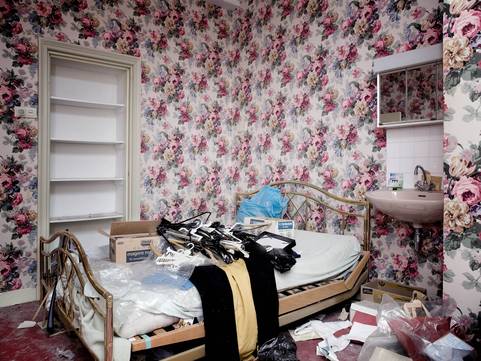
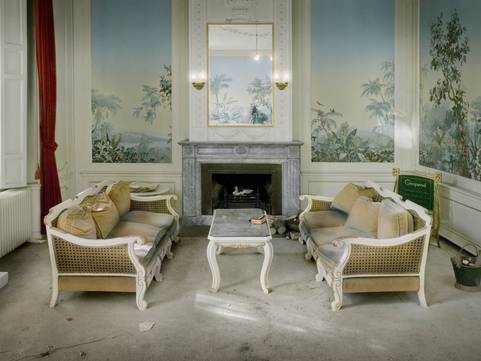
On 15 March 2008, the photographer Eddo Hartmann went through something that, for other people, will only remain a thought-experiment. After twenty-one years, he stepped inside the rooms of his childhood once again and saw that, as he did so, everything and nothing had changed. Everything – because a thick layer of papers, folders, letters and books covered the floors, tables, sofas and chairs. Nothing – because under that layer everything was still intact, everything was standing or lying exactly as it did when his brother, his mother and he had left the place in haste on 17 October 1987.

What effect does the confrontation with the rooms, objects and interiors of your childhood have on your memories? And what if those memories are of traumatic events? Hartmann confronts the house and registers in this impressive work in minute detail what he discovers in each room.

Eddo Hartmann (b. 1973) was educated at the Royal Academy of Fine Arts in The Hague. Apart from his personal oeuvre he also works as a freelance photographer for advertising agencies and design studios in the Netherlands and abroad. His work can be found in various Dutch photo collections and has received several awards. Early 2012 he was nominated for the prestigious Swiss ‘Prix Prictet’.


woensdag 6 juni 2012

Nicaragua La Guerra de Libaracion Richard Cross Latin American Photobook Photography


Nicaragua : la guerra de liberación = der Befreiungskrieg / Ernesto Cardenal, Richard Cross.

[Managua, Nicaragua] : Ministerio de Cultura de Nicaragua


The Latin American Photobook 

Horacio Fernandez (Author) 


A growing appreciation of the photobook has inspired a flood of new scholarship and connoisseurship of the form--few as surprising and inspiring as The Latin American Photobook, the culmination of a four-year, cross-continental research effort led by Horacio Fernandez, author of the seminal volume Fotografia Pública. Compiled with the input of a committee of researchers, scholars, and photographers, including Marcelo Brodsky, Iatã Cannabrava, Pablo Ortiz Monasterio and Martin ParrThe Latin American Photobook presents 150 volumes from Argentina, Bolivia, Brazil, Chile, Colombia, Cuba, Ecuador, Mexico, Nicaragua, Peru and Venezuela. It begins with the 1920s and continues up to today, providing revelatory perspectives on the under-charted history of Latin American photography, and featuring work by great figures such as Claudia Andujar, Barbara Brändli, Manuel Álvarez Bravo, Horacio Coppola, Paz Errázuriz,Graciela Iturbide, Sara Facio, Paolo Gasparini, Daniel González, Boris Kossoy, Sergio Larrain and many others. The book is divided into thematic sections such as "The City," "Conceptual Art and Photography" and "Photography and Literature," the latter a category uniquely important to Latin America. Fernandez's texts, exhaustively researched and richly illustrated, offer insight not only on each individual title and photographer, but on the multivalent social, political, and artistic histories of the region as well. This book is an unparalleled resource for those interested in Latin American photography or in discovering these heretofore unknown gems in the history of the photobook at large. 


Richard Cross began his career as a photographer after college at the Daily Globe in Worthington, Minnesota. However, he soon found himself working as an agricultural photographer for the Peace Corps in Columbia. In 1979, he was drawn north to document the wars raging in El Salvador and Honduras. There, Cross freelanced for major news outlets including U.S. News and World Report, Newsweek, and the Associated Press and was nominated for a Pulitzer Prize for his work in the region. He was killed along with Dial Torgerson, a Los Angeles Times reporter, in a car struck by an explosive on June 21st. Before his death, he co-authored two books, Nicaragua: La Guerra de Liberacion and Ma Ngombe: Guerreros Ganaderos en Palenque.


See also 

the Anguish of War and the Price of Revolution Nicaragua Susan Meiselas Antiphotojournalism Photography


See for

Koen Wessing a photographer 10 years after a Revolution