donderdag 6 november 2008

Retrospective William Eggleston Southern Gothic Color Photography

Southern Gothic

William Eggleston is even more colorful than his groundbreaking photographs.


‘Bill Eggleston has a show at the Whitney?” asks a woman at the bar of the Lamplighter Lounge in Memphis. She practically spits out her Budweiser. “I hate his shit!” Sam Cooke is on the jukebox, which plays real 45s; place mats are spread along the wood veneer, and the complimentary matchbooks are from D&D Bail Bonds in Wichita Falls, Texas. The bartender, Shirley, slices potatoes in the kitchen. A young couple are making out at a back table.

“I’m from in the same town as him,” says another woman, who hails from Sumner, Mississippi. “I know his cousin Maudie. She’s a photographer, too.”

“I like Weegee’s photographs,” the first woman cuts in. And again: “Bill Eggleston at the Whitney?”

There’s a snapshot of William Eggleston at the back of the Lamp, displayed by a vase of unnaturally colored silk flowers, a dish of peppermints, and a cutout of James Dean. If this sounds like an Eggleston photograph, it’s close. That same day, in fact, the Lamp turns up in a box of proofs at the Eggleston Artistic Trust. There in supersaturated color is the EAT MORE POSSUM sign.

Eggleston has a precarious relationship with the Lamp, one of his favorite haunts. In fact, he’s barred from entering. “I got really drunk one time,” he admits, “and I threw a hamburger at Shirley, who had just made it. But we’re still friends.”

Shirley concurs. “He calls me up every now and then, asks how I’m doing, and I say, ‘Good,’” she says, fond but firm. She is pleased to own an Eggleston photograph at home and proud of his success, but, like the Lamp’s regulars, her feelings for her famous neighbor are complicated. “I like Bill, but he can’t come in here. Will you be sure and tell him I said hello?”

The consummate insider-outsider, Eggleston remains aloof in the many worlds he inhabits—including the art circles of New York and the dive-bar culture of Memphis. Those intricate relationships will be on full display at the Whitney when his first comprehensive retrospective, “William Eggleston: Democratic Camera,” opens Friday—his most prominent return to the city since his MoMA debut in 1976.

We met recently at the offices of his archive, a few miles east of the Lamp. As always, he’s dressed sharp: off-white lace-up oxfords, dark tailored pants, an undone bow tie over a blue oxford shirt monogrammed with a large orange B. “Got it at a yard sale. It had my name on it: B, for Bill.” He laughs. Eggleston has been known to wear the occasional knee-high Austrian riding boots and, according to Lamp regulars, “Zorro capes.” “Sometimes, yes,” he says. “It’s comfortable, and it looks good.”

In 1967, when Eggleston arrived in New York from Memphis bearing a box of slides that would redefine photography, he was an anomaly. Not only was he one of the first photographers to wholeheartedly embrace color, but he embraced exactly what made color photography so controversial in highbrow circles: He treated the commonplace as art. Eggleston shot “democratically,” meaning anything—parking lots, shopping centers—was a worthy subject. “I thought I was doing the right thing, put it that way,” he says now. “And if someone told me something otherwise, I just put it aside.”

He was soon befriended by a small “club” of artists—equally groundbreaking photographers Diane Arbus, Lee Friedlander, and Garry Winogrand. “Though our work was different, we felt that we were compatriots,” Eggleston says. “Somehow I knew we were, attitude-wise, doing the same thing.”

Eggleston’s 1976 MoMA show launched his career and proved a turning point in the history of photography. Scorned at the time for being vulgar and banal, the show has since been revered for exactly those reasons. The exhibit was accompanied by a cheekily titled book, William Eggleston’s Guide, misread by many as an artistic travelogue to his native South. In truth, it was a Michelin guide to Eggleston’s singularly heightened way of seeing: His use of supernatural dye-transfer color, which implied that the ordinary was not at all so. His startling compositions directed viewers to look as closely as his camera, to recognize the grace, violence, and humor implicit in the mundane. A dog walking down a street. A fire burning in a barbecue grill. A red ceiling.

The New York art world became fascinated with Eggleston’s southernness, and he, in turn, immersed himself in the scene, setting up house in the Chelsea Hotel with Warhol star Viva. But he never really became a New Yorker. Eggleston maintained a life in Memphis and a marriage to his wife, Rosa (with whom he has three children), while openly having other relationships.

Evidence of this double life shows up in the Whitney retrospective, which highlights the museum premiere of Eggleston’s foray into filmmaking. Stranded in Canton is a full-length video vérité, shot in New Orleans and Memphis and navigating a seventies Delta netherworld of quaalude-popping dentists, soliloquizing transvestites, cryptologists, geeks, bluesmen—a southern equivalent of the Chelsea. His parallel lives, he says, are necessary: “It does get confusing sometimes. But each of these things allows the other. It creates a state of mind.”
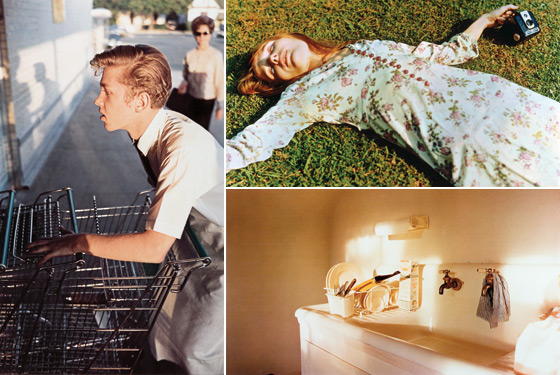

Untitled, from "Los Alamos," 1965-68 and 1972-74; Untitled, 1975; Untitled (St. Simons Island, Georgia) from "Morals of Vision," 1978.
© Eggleston Artistic Trust)

During his time in New York, Eggleston would roam the city with cameras, but he rarely shot pictures. “Those streets were Garry Winogrand’s world,” he says. Since then, his style of working has loosened so that he never knows where he will end up each day. A few years ago, he returned to New York and photographed a crushed-car lot in Queens. Recently he completed a Fondation Cartier commission to photograph Paris. “Years ago there, working in black and white, heavily under the influence of Henri Cartier-Bresson, I just didn’t see any pictures,” he says. “Now, once I start working, it’s no different from anywhere else in the world. Sometimes I have to ask, ‘Are we in Paris?’ ”

The Whitney retrospective certainly demonstrates Eggleston’s mastery in depicting the place of a place. But it is equally possible to see the show as just the opposite: a career-long meditation on how the particular can reveal the abstract—the composition of light and its reflection.

It’s four o’clock, and Eggleston, sitting on the stoop outside his office, smokes another in a long line of cigarettes. The late sun striking the cars in the lot recalls his first real color photograph: a bag boy pushing a row of carts. “This is beginning to be my favorite kind of light,” he remarks, his words precise but elegantly drawn out. “It brings out a spectrum that appeals to me, warmer colors that I don’t always notice at other times. It’s like when a thunderstorm moves through and the light changes swiftly from cold to warm.”

woensdag 5 november 2008

Prize winners for the Taylor Wessing Photographic Portrait Prize 2008 Lottie Davies Hendrik Kerstens Catherine Balet Tom Stoddart Photography

The prize winners for the Taylor Wessing Photographic Portrait Prize 2008 were announced at the awards ceremony on the 4 November 2008 at the National Portrait Gallery:

The First Prize was awarded to Lottie Davies for Quints, 2008 from an ongoing project entitled Memories & Nightmares

Lottie Davies was born in Guildford, Surrey in 1971. After studying philosophy at the University of St Andrews she moved to London to learn about photography and work as a photographic assistant. She has been a professional photographer working for a range of lifestyle and travel magazines since 2000 and has exhibited at the AOP Gallery, the Schweppes Photographic Portrait Prize (2006) and at the Foto 8 Summer Show 2008. Memories & Nightmares is a series of portraits represented by the subject’s early childhood memories or nightmares. Quints, shot on large format, was inspired by her friend Caroline’s nightmare in which she was pregnant with quintuplets. Davies used a model, Alicia, to stand in for the subject to allow herself greater freedom to interpret the story and the quints were modelled by Alicia’s niece, Marla.

View image Listen to an interview with Lottie Davies


The Second Prize was awarded to Hendrik Kerstens for Bag, 2007

Hendrik Kerstens was born in 1956 in The Hague, Netherlands. Winner of the 2001 Dutch Panl Award Kerstens is a self-taught photographer who initially turned to a model close at hand, his daughter Paula. Since starting to photograph Paula in 1995 Kersten’s work has been exhibited in over 40 exhibitions across Europe and the United States. In his portraits Paula is always depicted as being austere, serene and illuminated with a characteristic ‘dutch’ light. In September he will open his first solo New York exhibition at the Witzenhausen Gallery. Kersten’s short-listed portrait was conceived in New York when he noticed the excessive amount of plastic bags given away in shops. As a humorous reaction to this environmental problem he photographed the plastic bag in the style of a seventeenth century cap.

View image Listen to an interview with Hendrik Kerstens


Third Prize was awarded to Catherine Balet for Ines connected with Amina, 2007 from the series Connected.

Born on the outskirts of Paris in 1959, Balet graduated from the Ecole des Beaux Arts, Paris and began her career as a painter. Since 1998 she has progressively turned towards photography and works as a freelance photographer for French and International publications. Specialising in portraiture, her first book, IDENTITY, was published by Steidl in Sept 2006 and examines the social and aesthetic significance of signs, labels and dress codes of European teenagers. Her work has been exhibited in three solo exhibitions in Paris and is now touring major French cities. Ines connected with Amina is the first image from a new series called Connected which explores the themes of intimacy, technology, and globalisation. The series utilises the lighting of the computers, telephones and i-Pods for long exposure portraits of young people in their everyday technological environments.

View image Listen to an interview with Catherine Balet


Fourth Prize was awarded to Tom Stoddart for Murdoch Reflects, 2007 commissioned by Time magazine

Born in 1953 Tom Stoddart began his photographic career on a local newspaper in his native north-east England. During his time as a photojournalist he has witnessed the war in Lebanon, the fall of the Berlin Wall, the election of President Nelson Mandela, the bloody siege of Sarajevo and the wars against Saddam Hussein in Iraq. Notably, in 1997 Tony Blair gave Stoddart exclusive access to his election campaign, and his recent extensive work on Africa’s AIDS pandemic has been widely published and exhibited. Established as one of the world’s most respected photojournalists, Stoddart works closely with Getty Images, to produce powerful photo essays on the serious world issues of our time. His shortlisted portrait is of Rupert Murdoch in his office at News International in Wapping to illustrate a story in Time magazine about his $5 billion acquisition of the Dow Jones & Company.

View image Listen to an interview with Tom Stoddart


Godfrey Argent Award

The Godfrey Argent Award, which this year goes to the photographer who submitted the best portrait in black and white, was awarded to Vanessa Winship for Sweet Nothings, 2007 from the series Sweet Nothings

This winning portrait is from a series of portraits inspired by a government campaign to educate rural girls. Winship visited a dozen schools to produce forty-five images of girls posing with their sisters or closest friends.

Born in 1960, Winship’s own childhood was spent in Lincolnshire where she developed an interest in black and white photographs of her family. This youthful fascination has continued into her own projects which are exclusively black and white. ‘For me, it feels strange that people associate black and white photography with reality and truth’ she says. ‘Yes, I am trying to be honest in my work, but I am not presenting it as reality. It is very much a two-dimensional representation of my perception of something.’

View image Listen to an interview with Vanessa Winship

maandag 3 november 2008

zondag 2 november 2008

Photographic Explorations Kees Scherer Photojournalism Photography

Kees Scherer, Waiting, 1955-59, London © Stichting FotoArchief Kees Scherer / MAI.
AMSTERDAM.- Foam_Fotografiemuseum Amsterdam presents a selection of vintage prints from Kees Scherer’s extensive oeuvre. As a photojournalist, in the 1950s and ’60s he published numerous reports of his global travels in Dutch newspapers and magazines. Scherer belonged to a generation of photographers that opened up photographic reporting to a wider public. He travelled in the United States, the Far East, Israel, and almost every country in Europe. This concise retrospective features sensitive and humorous pictures taken in Amsterdam, London, New York, Cannes and Paris as well as Mexico, Spain, Portugal and Italy. All the photos are vintage prints made by Scherer himself.

Born in an alcove apartment in Amsterdam’s working-class Jordaan neighbourhood, Kees Scherer (1920-1993) became interested in photography at a young age. When the war ended he began working as a freelance photographer for Dutch newspapers such as Het Vrije Volk, Trouw, de Volkskrant and Algemeen Handelsblad. In later years he established a reputation as a travel photographer for weekly magazines like Margriet and Avenue, and he published an impressive series of photo books. In 1955, he was one of the joint founders of World Press Photo. On 18 October 1985, the day his book Zuiderzee, dood water, nieuw leven (Zuiderzee, Still Water, New Life) appeared, he suffered a stroke. As a consequence he was no longer able to speak, write or photograph. Scherer was admitted to hospital where he died eight years later.

In 1987, a group of friends set up Stichting FotoArchief Kees Scherer to publicise the photo grapher’s work, as a result of which it was redis covered and republished in the 1990s.

The exhibition is accom panied by a volume entitled Kees Scherer – Beeldverhalen van een straatfotograaf 1948-1967, published by Uitgeverij De Verbeelding. It contains 176 pages and around 300 duotone photos. Lees Kees Scherer als niet-fotojournalist ... & Het instrument van de armoede ...

Photographic Explorations , by Kees Scherer can be seen from 7 November 2008 to 18 January 2009 at Foam_Fotografiemuseum Amsterdam.


Photographic Explorations Kees Scherer Photojournalism Photography

Kees Scherer, Waiting, 1955-59, London © Stichting FotoArchief Kees Scherer / MAI.
AMSTERDAM.- Foam_Fotografiemuseum Amsterdam presents a selection of vintage prints from Kees Scherer’s extensive oeuvre. As a photojournalist, in the 1950s and ’60s he published numerous reports of his global travels in Dutch newspapers and magazines. Scherer belonged to a generation of photographers that opened up photographic reporting to a wider public. He travelled in the United States, the Far East, Israel, and almost every country in Europe. This concise retrospective features sensitive and humorous pictures taken in Amsterdam, London, New York, Cannes and Paris as well as Mexico, Spain, Portugal and Italy. All the photos are vintage prints made by Scherer himself.

Born in an alcove apartment in Amsterdam’s working-class Jordaan neighbourhood, Kees Scherer (1920-1993) became interested in photography at a young age. When the war ended he began working as a freelance photographer for Dutch newspapers such as Het Vrije Volk, Trouw, de Volkskrant and Algemeen Handelsblad. In later years he established a reputation as a travel photographer for weekly magazines like Margriet and Avenue, and he published an impressive series of photo books. In 1955, he was one of the joint founders of World Press Photo. On 18 October 1985, the day his book Zuiderzee, dood water, nieuw leven (Zuiderzee, Still Water, New Life) appeared, he suffered a stroke. As a consequence he was no longer able to speak, write or photograph. Scherer was admitted to hospital where he died eight years later.

In 1987, a group of friends set up Stichting FotoArchief Kees Scherer to publicise the photo grapher’s work, as a result of which it was redis covered and republished in the 1990s.

The exhibition is accom panied by a volume entitled Kees Scherer – Beeldverhalen van een straatfotograaf 1948-1967, published by Uitgeverij De Verbeelding. It contains 176 pages and around 300 duotone photos. Lees Kees Scherer als niet-fotojournalist ... & Het instrument van de armoede ...

Photographic Explorations , by Kees Scherer can be seen from 7 November 2008 to 18 January 2009 at Foam_Fotografiemuseum Amsterdam.


Poisoned Landscape by Wout Berger Online Photobook Photography


Giflandschap (online photobook)
Wout Berger
Periode 1986-1992
Aantal pagina's 67
Vormgever Eric Nuyten en Heijmerink & Noyons, ontwerpers in samenwerking met Wout Berger en Noor Damen
Uitgever Fragment Uitgeverij (Amsterdam)
Formaat 34x27cm
ISBN 90-6579-074-8

The artist Wout Berger has been busy photographing since the 1960s. In 1986, commissioned by the city of Amsterdam, he photographed the transitional area between the city and countryside. In this peripheral region he stumbled across an area severely contaminated by chemical waste. He became fascinated by this landscape, where beautiful orchids bloomed. In this wasteland he recognized the opposition between form and content. This led to his large-scale project, "Giflandschap" (Poisoned landscape).

Between 1988 and 1990 he visited 1200 chemical waste dumps in the Netherlands, recording 170 of them. Most of these photographs look like idyllic landscapes – until you realize that carcinogenic materials are to be found under these innocent looking sites. They are landscapes of extremites.Between 1996 and 1998 Wout Berger photographed a series of landscapes throughout the world for a penitentiary in which a lot of refugees work and live. These refugees come from different parts of the world, most of the time far from The Netherlands, who want to stay in this country but may not. With this idea in mind, Berger explored a number of landscapes of a different kind and very distant from The Netherlands. Landscapes with no single trace of human beings. Photos of mountains, rocks, a volcano, rain forest (Iceland, Costa Rica and Vietnam).
A later commission, Sand Water Peat in 2000, inspired him to look for ‘artificial’ nature which he found in the glasshouse area in the west of the province of South-Holland. Somewhat different then the poisoned land, because here nature is nurtured for the benefits of the export of flowers and plants, which forms one of the most leading factors in Dutch economy. His images are beyond any stereotypes that occur in this theme of flower bulbs and glasshouses. The tulip, one of Holland’s famous icons, is a well-trodden path in advertising and calendars, but becomes in the hands of Wout Berger an emotional, desirable and voluptuous element.

Wout Berger’s most recent series of photos were taken in the neighbourhood of a small authentic village near Amsterdam, Ruigoord. This village has been since long an artistic oasis nearby Amsterdam. But the city of Amsterdam extends itself and swallows ground for harbours and industry in the surrounding areas.

Near Ruigoord they have cleaned a large area of ground, put sand on it as a new base for buildings and then seeded this area with seeds of small-scale and ordinary plants that must hold the sand for blowing away. This sand-area now contains all kinds of flowers like cornflowers, borinage, colourful weed, dandelions etc.

Here again Wout Berger found the tension between form and content, ‘real’ and ‘artificial’ nature. The beauty of so-called common nature is only of interest when photographed close by, he must have thought. Taken with a technical view camera, Berger conjures up something of a beautiful and colourful landscape with this simple focus close by, the photos don’t have a horizon, the weed and flowers are in juxtaposition and in contrast with the underlay, the sand soil culture.

The impressionism in this series of Ruigoord is stunning. They have a painterly concentration and beauty, these photographs. Every photo has its own character, varying from poetic (1) to graphic (2) and baroque (3), ending in a dramatic ground-landscape (5).

The same attitude towards small nature comes back again in his last photographs, like ‘Marram’, ‘de Kerf’ , ‘Ditch’ and ‘Fouille’. This play with dimensions and relations in close up with nature is not always what it looks like.JvK, dec.2003

vrijdag 31 oktober 2008

Pioneers of Travel Photography

Lees verder ...


Visitors of this exhibition travel to eight destinations, following the footsteps of the first travel photographers of the second half of the 19th century. The travel locations more or less chronologically follow the paths of the travellers and photographers who pursued their curiosity about faraway countries and cultures. The exhibition has been organised thanks to a collaboration with the Rijksmuseum in Amsterdam, which has a rich collection of early travel photos, but can not exhibit them itself right now. Teyler Museum’s own collection of travel stories has been given a new context with this exhibit and they have set up the historic Kaiser Panorama with stereo photographs in the Schilderijenzaal.
Dates: October 3-January 4, 2009
Location: Teylers Museum, Spaarne 16, Haarlem
For more information visit:
www.teylersmuseum.nl

Another online exhibition : “Global Views 19th Century Travel Photographs”
In the second half of the nineteenth century, the rapid development and increasing recognition of the art of photography, along with a growing fascination with other countries and cultures, marked the beginning of the formation of a “global visual culture.” In the decades following the invention of photography in 1839, professional photographic firms appeared in the major cities of Western Europe, as well as in more remote travel destinations such as Greece, Egypt, India, Asia, and the Middle East. The earliest travel photographers produced images primarily for publications which functioned as surrogates for travel, spurring curiosity and inspiring Grand Tour travelers who, by the 1870s and ’80s, were flocking to exotic sites to visit the monuments of the ancient and medieval past.Catering to this influx of European and American tourists, a growing number of travel photographers documented historical monuments and archeological sites, as well as scenes of daily life. Technological developments enabled these photographers to produce relatively large numbers of images that were chiefly intended to satisfy the burgeoning tourism trade and the thirst for images of the Orient, the term traditionally used in the nineteenth century to refer to the Middle East, South Asia, and East Asia. As the techniques of photography became less cumbersome, transporting equipment became more practical. Photographers began to sell their pictures on-site to tourists who collected them as souvenirs during their travels.
These unique photographs have artifactual value for the history of photography, as well as documentary value for the study of the architectural and social history of the regions in which they were produced…Read more and see the slideshow : “Global Views: 19th-Century Travel Photographs” Princeton
Van 3 oktober 2008 t/m 4 januari 2009 is in Teylers Museum een expositie met unieke historische reisfoto's uit de 19e eeuw. Een tijd waarin reizen en fotografie nog avontuurlijke en omslachtige ondernemingen waren.

De expositie wordt georganiseerd in samenwerking met het Rijksmuseum, dat een uitzonderlijke collectie foto’s bezit maar deze nooit tentoonstelt. Uit deze collectie is o.a. 'het panorama op Baalbek' van meesterfotograaf Gustave Le Gray te zien. Teylers Museum toont uit zijn collectie het zeldzame en eerste met foto’s geïllustreerde expeditieverslag 'Voyage au Soudan, met de vroegste foto’s van vrouwen uit Darfur (1854). Het Nationaal Archief leende twee groepsportretten van Alexandrine Tinne’s reisgezelschap in Algiers. Tinne was een Nederlandse ontdekkingsreizigster, die als een van de eerste vrouwen Noord-Afrika verkende. Lees verder ...

Beeld: beklimming van de grote pyramide door een toerist, 1885-1895 Blad uit het album van luitenant ter zee E.M. Wissmann (collectie Rijks Museum) 


Pioniers Direct na de introductie in 1839 werd al beweerd dat de fotografie van bijzonder nut zou zijn voor de illustratie van reisverslagen. Immers, een foto is sneller gemaakt dan een prent naar een tekening. Maar ook het maken van een foto was in het begin een moeizame onderneming en zeker op reis. Er moest een grote hoeveelheid materiaal mee, zoals de glazen platen die als negatief dienden, de lens met het zware onderstel, een tent of kar om in het donker ter plaatse te kunnen ontwikkelen en de flessen met chemicaliën waarmee dat gebeurde. Een verre reis was een kostbare investering: er waren heel wat dragers en transportmiddelen nodig. Verre reizen De meeste vroege fotoreizen vonden plaats in het kader van archeologische expedities. De fotograaf kreeg opdracht illustraties te maken voor wetenschappelijke verslagen. Maar de eerste fotoreizen volgden ook een andere traditie: die van de ‘Grand Tour’, de reis die vermogende westerse jongelingen ondernamen om kennis te maken met de antieke wereld. Zij reisden via Italië en Griekenland naar het Midden Oosten. Met de opening van het Suezkanaal in 1869 werden ook verdere bestemmingen beter bereikbaar: India, Indo-China, China, Japan en, vooral voor Nederlanders, Indonesië.
Professionals ter plaatse Al snel kreeg de fotografie een commerciële inslag. Sommige fotografen vestigden zich op populaire reisbestemmingen om de voorbijtrekkende expedities en particulieren van fotosouvenirs te voorzien. Zo waren er al vroeg Engelse fotografen permanent actief in Rome en werkte bijvoorbeeld de Engelsman Francis Frith in Cairo, waar hij zich specialiseerde in de spectaculaire 3D stereofotografie. In de expositie zijn veel foto's van deze specialisten te bewonderen. In kijkkasten kunnen de bezoekers voor even in 3D naar Amerika of Japan reizen en de opening van het Suezkanaal in 1869 herbeleven.
Boxcamera Na de introductie van de boxcamera van Kodak in 1888 wordt fotograferen een stuk makkelijker. De foto’s werden nu in een handzaam kastje belicht op een rolletje, dat ter ontwikkeling en afdruk naar het laboratorium werd verstuurd. Opeens was fotografie voor menigeen bereikbaar. Vooral na 1900 toen een simpele boxcamera nog maar 1 dollar kostte! In de tentoonstelling worden albums getoond van enkele amateur-fotografen, die rond 1900 de wereld afreisden. Onder hen zijn de Rotterdamse dominee Louis Heldring en de oprichter van de Koninklijke Shell, G.A. Kessler.