zaterdag 8 augustus 2009

Photoalbums from the Dutch East Indies Herinneringen in beeld Photography


Herinneringen in beeld
Fotoalbums uit Nederlands-Indiƫ
Ouwehand, Liesbeth

In dit boek worden ruim tweehonderd bijzondere foto’s uit de historische collectie van het KITLV gepresenteerd. Beelden uit de Indische archipel, die tussen 1860 en 1960 op de gevoelige plaat zijn gezet door amateurs en professionele fotografen. Unieke foto’s gemaakt op bijvoorbeeld de Aroe-eilanden, in het rivierengebied van de Flamingo-baai op Nieuw-Guinea, in Buitenzorg en op het eiland Amsterdam in de Baai van Batavia. Naast foto’s, die een ‘schat van herinneringen’ vormden voor de samenstellers van deze fotoalbums, wordt ook aandacht besteed aan de ‘behuizing’ van de foto’s. Er zijn daarom ook illustraties opgenomen van de fraai vormgegeven albumkaften en pagina’s. Een breed spectrum aan genres komt aan bod: van familiealbums tot militaire albums en van reclamealbums tot afscheidsalbums. Het boek geeft de verscheidenheid aan herinneringen weer in de albumcollectie van het KITLV. Verscheidenheid in vormgeving, invalshoek en periode, die een blijvende herinnering vormen aan reizen, wonen en werken in de archipel. Met Herinneringen in beeld wordt een dwarsdoorsnede uit de albumcollectie van het KITLV voor een breed publiek toegankelijk.

Liesbeth Ouwehand (1975) is cultureel antropoloog en als collectiespecialist verbonden aan de afdeling Collecties van het KITLV. Lees verder ...

See for the Photobooks of the Dutch East Indies ...


See also ...

vrijdag 7 augustus 2009

Wim Crouwel & Bruynzeel Fineerfabriek Graphic Design Company Photography

See for Wim Crouwel ...


Bruynzeel Fineerfabriek NV. [Foreword Directie Bruynzee.l Photography Jan Versnel. Layout Harry N. Sierman].

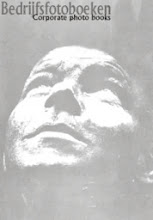
Zaandam / 1962 / 66 p. / pb. (sewn) / 23x23cm / 38 b&w photographs, in opdracht en uit bedrijfsarchief bedrijf, bedrijfsrapportage en productfoto's, productieproces, toepassing en monsters van geleverde materialen). Ill. 4 b&w photographs, 2 color / beeldmerk (adelaar), grafische weergave van zaagwijze en stadia in triplexfabricage). / NN / Firmenschrift / Photographie - Anthologie - Auftragsphotographie, commissioned photography - Nederland, Niederlande - 20. Jahrh. / Printed by Drukkerij C. Huig NV, Zaandam (boekdruk). - Opdrachtgever: Bruynzeel Fineerfabriek NV, Zaandam (voorlichting). - Grensgeval tussen productcatalogus en bedrijfsfotoboek met kenmerken van foto-typo-taal. De tekst is gezet uit de Gill. De toepassing van verschillende papiersoorten, foto's voorzien van steuncoloren, colorvlakken en productfoto's bepalen de opmaak.


woensdag 5 augustus 2009

Young photography talent from all over the world the Black Snapper

The Black Snapper presents young photography talent from all over the world.

The magazine has gone live on August 1st 2009 and is working with guest curators such as Abbas of Magnum Photos, Kiyosato Museum of Photographic Arts in Japan, International Photo Festival Bangladesh, Centro de la Imagen in Peru and The New York Times Magazine. In the Netherlands, guest curators include nrc.next, Vrij Nederland magazine and Canvas International Art.

Each day The Black Snapper presents a different photographer selected by one of the many guest curators, who switch places on a weekly basis. Visitors of the online magazine can expect to see a new series of some eight to twenty photos each day.

The Black Snapper aims to create an online community that will inspire professionals and photography lovers worldwide and expose new talent. In addition, the online magazine emphatically supports the emancipation and promotion of photographers from Asia, Africa and South America.

The online magazine will refresh daily at midnight on the international dateline. Next to the presented photos, project description and/or artist statements are published and the curators will explain their choices. The diversity of the guest curators prevents any one taste or preference from becoming dominant.

Please visit our archive section, where previously displayed images are stored, our navigate to publishing photographers’ own website or representing gallery.

The Black Snapper is the brainchild of designer Frank Kloos and documentary photographer Diederik Meijer, both based in Amsterdam. The online magazine was born from their passion for photography. The Black Snapper uses the Internet to discover and present photographic talent from all over the world in a faster and more uncomplicated way.

dinsdag 4 augustus 2009

Streets of the World Seoul Jeroen Swolfs Photography


Dutch Photographer Hits Korea for World Cities Book
By Malia Douglas Contributing Writer

A book centered on highlighting the increasingly globalized nature of the world through photographs of the main streets of the planet's capital cities saw Seoul ticked off the list over the weekend.The man behind the endeavor, Dutch photographer Jeroen Swolfs, 34, made a whirlwind four-day visit toward the end of last week, before checking out Sunday. Like many travelers passing through, his stay was short ― but his was a thoroughly involved affair. His remit was to determine which among Seoul's myriad of bustling streets best represented the city, and ultimately deserved the title of the city's ``main street.''It is hoped that the book, to be called ``Streets of the World,''' will feature every one of the world's capital cities.Swolfs said the world is now a freer and more transparent place, and many of its problems such as terrorism and climate change are not regional but shared.``The project will be a book about the streets of the world,'' he explained. ``I'll go to every capital of every country and photograph the main street. ``Using the photographs, I seek to capture the essence of each country. It will provide a kind of snapshot of the level of development across the world.''The idea for this project came nearly 10 years ago from Swolf's keen interest in cities and the stories that they can show. The book will be a combination of photography and photojournalism, allowing him to portray how each place appears and relates the important issues taking place in each country. From his base in Bangkok, Swolfs will be sponsored by a private investor to travel the world for five years. ``Kosovo, East Timor, Afghanistan and Iraq, I'll be going to those countries, too. If it's officially a country, it's going to be covered by this book,'' he said. Swolfs will also include Taipei, the capital of Taiwan, the island nation claimed by China as its sovereign territory, as well as Tibet, as both can be viewed as culturally distinct entities. He admitted that a city such as Seoul ― with a metropolitan population of 24.5 million spread across multiple financial and commercial centers ― provides a unique challenge. ``It's challenging when there are so many major streets. In this kind of situation, I'll use my creativity to select a street I think will capture the essence of the city,'' Swolfs explained.His technique begins by meeting locals to ask them what kind of street they would usually go to. In Seoul, Swolfs garnered opinion from a variety of people, both Koreans and foreigners. ``I explained the project [to them] and asked them where they think there's normal life, not touristy stuff going on, a place where you can see a normal kind of day in that city.'' That place turned out to be Jongno. He set up his equipment at the site and spent two full days observing and photographing the street as the day unfolded. Swolfs said he liked the way the street presents Koreans going about their day in a variety of roles. ``Korea got out of the wars in an inspiring way ― I want the photo to show that and to present a positive light... I want to show that the Koreans worked really hard to develop so quickly and I want to bring across that they did a good job.''He believes the project will benefit the world by allowing us to see both an image of every city and to read about some of the political and social issues going on in each of the cities. ``It's about trying to find out where our humanity stands in our time as a human race.''Swolfs flew into Seoul from Tokyo, and will photograph his way across Asia, before traveling around Oceania and crossing Africa and the Middle East. His next stop? He left Korea bound for Taipei, where the process will start all over again.To see pictures to be included in the book, visit www.streetsoftheworld.nl. The content is in Dutch.Staff Reporter Bryan Kay contributed reporting to this article.bk@koreatimes.co.kr

vrijdag 31 juli 2009

the E-books of Wolfgang Tillmans Photography

tillmans is acclaimed as a chronicler of his generation,and he has garnered international recognition as oneof the most significant artists to emerge in the 1990s.his distinctive work has been hugely influential for ageneration of younger artists.

at first tillmans documented the european club scenein a manner that captured its dynamic style with anaffecting sincerity, and he presented this work incarefully crafted spreads for british fashion andlifestyle magazines (such as i-D).he then increasingly presented subjects ranging fromstill lifes to portraits of friends and celebrities,subtly alluding to his interest in issues such ashomelessness, racism, and gay rights.despite his use of magazine layouts as an early vehiclefor his work, his provocative images always challengedthe superficial gloss of the fashion industry andsubverted notions of beauty and sexuality.

while certain works are notably singular and iconic,his use of a shifting scale for his prints and anever-changing rotation of images with each successiveinstallation demonstrates his desire to see all of hispictures as universally significant.in doing so, tillmans suggests that an unassuming imageof jars of jam on a counter-top carries equal weight andimportance as an image of a bolt of lightning or apolitical rally.by applying the same clarity of vision and intensity ofpurpose to every picture - whether an image of a place,person, situation, or an abstraction - tillmans offers avisually unified perspective on the diverse phenomenathat comprise the broad spectrum of lived experience.since the 1990s, tillmans's work has turned increasingly

Police helicopter, lees de recensie ...