maandag 10 december 2007

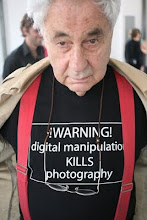
Is Photography Dead Newsweek

Is Photography Dead? By Peter Plagens NEWSWEEK Updated: 2:42 PM ET Dec 1, 2007

How is that even remotely possible? The medium certainly looks alive, well and, if anything, overpopulated. There are hordes of photographers out there, working with back-to-basics pinhole cameras and pixeled images measured in gigabytes, with street photography taken by cell phones and massive photo "shoots" whose crews, complexity and expense resemble those of movie sets. Step into almost any serious art gallery in Chelsea, Santa Monica or Mayfair and you're likely to be greeted with breathtaking large-format color photographs, such as Andreas Gefeller's overhead views of parking lots digitally montaged from thousands of individual shots or Didier Massard's completely "fabricated photographs" of phantasmagoric landscapes. And the establishment's seal of approval for photography has been renewed in two current museum exhibitions. In "Depth of Field"— the first installation in the new contemporary-photography galleries at the Metropolitan Museum of Art in New York, on display through March 23—the fare includes Thomas Struth's hyperdetailed chromogenic print of the interior of San Zaccaria in Venice and Adam Fuss's exposure of a piece of photo paper floating in water to a simultaneous splash and strobe.

At the National Gallery of Art in Washington, "The Art of the American Snapshot, 1888–1978" (up through Dec. 31) celebrates average Americans who wielded their Brownies and Instamatics to stunning effect.

Yet wandering the galleries of these two shows, you can't help but wonder if the entire medium hasn't fractured itself beyond all recognition. Sculpture did the same thing a while back, so that now "sculpture" can indicate a hole in the ground as readily as a bronze statue. Digitalization has made much of art photography's vast variety possible. But it's also a major reason that, 25 years after the technology exploded what photography could do and be, the medium seems to have lost its soul. Film photography's artistic cachet was always that no matter how much darkroom fiddling someone added to a photograph, the picture was, at its core, a record of something real that occurred in front of the camera. A digital photograph, on the other hand, can be a Photoshop fairy tale, containing only a tiny trace of a small fragment of reality. By now, we've witnessed all the magical morphing and seen all the clever tricks that have turned so many photographers—formerly bearers of truth—into conjurers of fiction. It's hard to say "gee whiz" anymore.

Art and truth used to be fast friends. Until the beginning of modernism, the most admired quality in Western art was mimesis—objects in painting and sculpture closely resembling things in real life. William Henry Fox Talbot, who produced the first photographic prints from a negative in 1839, immediately saw the mimetic new medium as an art form. Talbot wanted only to be able to "draw" more accurately than by hand. In fact, he called his first book of reproduced photographs "The Pencil of Nature." For at least a century thereafter, any photograph with a claim to being art had in its DNA at least a few chromosomes from Talbot's "The Open Door" (1844), a picture of a tree-branch broom leaning just-so-esthetically against a dark doorway. Of course, great photographers have never merely recorded visual facts indiscriminately, like a court stenographer taking down testimony. They've selected their subjects carefully and framed their views of them precisely, in order to give their pictures the look of "art." Later in the 19th century, "pictorialist" photographers used soft focus, toothy paper, sepia tones, multiple negatives and even scratching back into the image as ways of getting photographs to look more like paintings.

Soon, photography escaped the exclusive grasp of the professionals and moneyed hobbyists who could afford its cumbersome equipment, and the public began to take its own pictures. In the 1920s, small, inexpensive fast-shutter cameras like the Kodak Brownie appeared. By 1950, according to Kodak, nearly three quarters of American families owned cameras and took 2 billion photographs with them. By the 1970s, they were taking 9 billion pictures a year, most of them quick, informal snapshots. To be sure, some masterpieces did emerge—mostly accidentally—from this Everest-size heap of images. The person who pointed his Brownie at the woman in "Unknown [photographer], 1950s" in "The Art of the American Snapshot" probably didn't anticipate that she'd cover her face with her hands just as he clicked the shutter. And he (or she) couldn't predict that the result would be a great composition—long fingers and angular elbows set against the gentle downhill sweep of a field—and a wonderful metaphor for photography's tango with the truth. What the inadvertently great snapshot shared with the work of realist artist-photographers like Dorothea Lange and Walker Evans in the 1930s and '40s, and Diane Arbus and Robert Frank in the 1950s and '60s, was that the people in them were who they looked like they were—raw-boned farmers, gritty miners, harried housewives, burly bikers—really doing what they looked like they were doing.

In the late 1970s, however, the concept of fiction in photography reared its little postmodern head. "The big change in attitude from realist photography," says Lawrence Miller, who owns a prominent photography gallery in New York, "was when Metro Pictures [one of the hippest galleries in SoHo] showed Cindy Sherman in 1980." Sherman's fictional self-portraits—fake "film stills" with the artist posed as a negligeed blonde on a bed, or a dark-haired femme fatale in a chic apartment—weren't photography's first turn away from the straight, nonfiction reportage most people think of as great photography. But her pictures represented something new in the way that photography was considered as art. It wasn't just for reportage anymore. The Talbotian esthetic door was now fully opened for photographers to make photographs just as well as to take them. The advent of digital technology only exacerbated photography's flight into fable.

We live in a culture dominated by pixels, increasingly unmoored from corpor-eal reality. Movies are stuffed with CGI and, in such "performance animation" films as "Beowulf," overwhelmed by them. Some big pop-music hits are so cyberized the singer might as well be telling you to press 1 if you know your party's exten-sion. Even sculpture has adopted digital "rapid prototyping" technology that allows whatever a programmer can imagine to be translated into 3-D objects in plastic. Why should photography be any different? Why shouldn't it give in to the digital temptation to make every landscape shot look like the most absolutely beautiful scenery in the whole history of the universe, or turn every urban view into a high-rise fantasy?

Photography is finally escaping any dependence on what is in front of a lens, but it comes at the price of its special claim on a viewer's attention as "evidence" rooted in reality. As gallery material, photographs are now essentially no different from paintings concocted entirely from an artist's imagination, except that they lack painting's manual touch and surface variation. As the great modern photographer Lisette Model once said, "Photography is the easiest art, which perhaps makes it the hardest." She had no idea how easy exotic effects would get, and just how hard that would make it to capture beauty and truth in the same photograph. The next great photographers—if there are to be any—will have to find a way to reclaim photography's special link to reality. And they'll have to do it in a brand-new way.

URL: http://www.newsweek.com/id/73349
© Newsweek Mag

vrijdag 7 december 2007

There is Something in the air in Prince Albert, South Africa by Cuny Janssen Photography

There is Something in the Air in Prince Albert

Photographs of a deserted cosmos in a beautifully printed and elaborately designed book – this is the fourth title from the young Dutch photographer Cuny Janssen. Her photographs recall the work of Wolfgang Tillmans in a very personal diary (of a place). Cuny Janssen travels frequently to Prince Albert, South Africa, to the middle of the “Great Karoo” an ancient seabed formed millions of years ago. It is this severe dry landscape that Jansen explores with her camera and upon which she projects stark portraits of local young people. Indeed it is the balance between fresh, young lives and unspoiled and harsh nature that lends this body of work a highly contemplative feel. The essay by Craig McEwan is a poem, an elegy for the archaic land written in geological time.
Cuny Janssen Biography
1975 Born in Nijmegen
1998 Hochschule der Künste, Berlin
1999 Assistent to Thomas Struth, Düsseldorf
1996 - 2000 Hogeschool voor de Kunsten, Utrecht (HKU)
Lives and works in Amsterdam
Selected Exhibitions
2007 Portraits, 2D3D Galerie, Innsbruck
2007 Portrait und Menschenbild, Art Cologne Die Photographische Sammlung / SK Stiftung Kultur, Cologne
2007 There is Something in the Air, Sabine Schmidt Galerie, Cologne (solo)
2007 New Talents, Art Cologne (solo)
2006 Finding Thoughts, Sabine Schmidt Galerie, Cologne (solo)
2006 Duchenne Kunsteditie 2006, Art Amsterdam, KunstRAI, Amsterdam
2006 Cadres, Frans Hals Museum, Haarlem
2005 Best verzorgde boeken 2004, Stedelijk Museum Amsterdam
2005 Some Trees“, Staatliche Kunstsammlungen Dresden; Neuer Aachener Kunstverein; SeARCH, Amsterdam
2005 Cadres, Custodis, Paris
2005 Finding Thoughts, The Photographers' Gallery, London (solo)
2005 Portrait/Landscape, Museum Het Valkhof, Nijmegen (solo)
2004 To find a home, SeARCH, Amsterdam
2003 Prix de Rome, Institut Neerlandais, Paris
2002 Femmes d‘image, Maison Européene, Paris
2002 India, Center for Fine Arts, Nijmegen (solo)
Literature
2007 There is Something in the Air in Prince Albert, Snoeck Verlag Cologne
2005 Finding Thoughts, The Photographers' Gallery London
2004 Portrait/Landscape, Schaden.com Cologne
2002 India, foto‘s van Cuny Janssen


woensdag 5 december 2007

NeoRealismo Italian Photography

The photographic aspects of the cultural movement known as Neorealismo had a striking impact on Italian photography from the early 1940s. Part of a short-lived if highly influential reaction against fascism and the pictorial values that it had promoted, it also drew inspiration from the literary and cinematic ideas emerging in the chaos of post-war Italy. The films of Rossellini, Visconti, and Fellini are marked by this moment, as is the literature of Italo Calvino. The affinities between photography and cinema, as well as with painting, were particularly strong in this respect. It is clear that the film-makers in particular drew heavily on the visual approach and subject matter of the photographers.

Alberto Lattuada, a young cinematographer, wrote a short book in 1941 about the need to see photography as a documentary medium that could grasp reality in an instantaneous form and implied both a judgement and a selection of the facts. His work on a penal colony in Sardinia, made in 1941, conforms to these aspirations. Lattuada's work was a plea for a photography that sought to escape from fascist propaganda and ideology, to focus on presenting the reality of Italy's situation to the public. This manifesto for a new photography, informed by left-wing ideas and close in spirit to French humanism, was particularly urgent in the reconstruction period when the social and political issues that confronted Italy—land reform, industrialization, the problem of the mezzogiorno, were acute.

In 1948 the Venice Biennale was devoted to the Fronte nuovo della arti, which inspired many photographers. Because Neorealismo could be seen to cross the arts, to be a form of inspiration to create a new Italy from the wreckage of history, it was less of a movement than a Zeitgeist—the spirit of the times, as the writer Calvino acknowledged. In photography, Neorealismo's main output was in the form of reportage on various social and political problems, and in particular on exploring the deprived parts of Italy that the Italian press tended to ignore. Neorealismo devoted considerable attention to rural poverty and to the archaic way of life of the peasants of Italy's more remote regions. Significant among them are Valentino Petrelli's (b. 1922) work on the small village of Africo, in Calabria, Mario De Biasi's (b. 1923) in the bassi (working-class areas) of Naples, Fulvio Roiter's (b. 1926) in the mines of Sicily and the mountains of Umbria, Franco Pinna's on rural communities in Sardinia. Their work appeared in certain important magazines of the time, Ferrania, Realismo, and Il caffe, where it was often presented as an indictment of social ills.

The use of stark black-and-white photography to present social and political facts is a key visual feature of Neorealismo, and it evolved into a formalism that marks much of Italian photography in the 1950s and 1960s, particularly present in the work of Mario Giacomelli. At the same time, some of the paparazzo photography of Italy's dolce vita in the 1950s has clear affinities with Neorealismo, especially in the sense that it seeks to unmask celebrities and present them as ordinary people.

Peter Hamilton Bibliography Zanner, I., Neorealismo e fotografia (1987)

Nederlands fotomuseum NeoRealismo

De 'nieuwe werkelijkheid' in de italiaanse fotografie 15 december 2007 t/m 9 maart

Ruim 200 foto's van grote namen uit de Italiaanse fotografie, als Federico Patellani, Pietro Donzetti, Mario Giacomelli, Mario de Biasi en Franco Pinna, zijn nu voor het eerst samengebracht in de grote internationale tentoonstelling NeoRealismo. De nieuwe fotografie in Italië 1932-1960.

Het Neorealisme in Italië ontstond als reactie op het fascisme, eerst nog met name in de film maar de na de Tweede Wereldoorlog ontwikkelde zich ook een fotografische stroming. Het leverde prachtige, licht heroïserende en vaak ook dramatische foto's op van het gewone leven en bracht de werkelijkheid in het door armoede geteisterde naoorlogse Italië in beeld. De tentoonstelling laat de wisselwerking tussen fotografie, film en literatuur zien en bestaat uit groten-deels vintage afdrukken, filmfragmenten, affiches, tijdschriften en boeken.

Het `neorealisme' ontwikkelde zich in Italië vooral als reactie op de fotografische en filmische stijlen van het fascisme, waarin een ver van de realiteit verwijderde esthetiek dominant was.

Het `neorealisme' staat voornamelijk als filmische stroming te boek, maar er heeft zich na WOII ook een belangrijke fotografische pendant ontwikkeld met fotografen als Federico Patellani, Pietro Donzetti, Mario Giacomelli, Mario de Biasi en Franco Pinna. Kenmerkend voor hun documentaire werk -steevast in zwart-wit- is de licht heroïserende aandacht voor de gewone man of vrouw en voor het alledaagse leven, waarbij ook de armoede in beeld kwam die het naoorlogse Italië lange tijd teisterde. Het gebruik van de 'methode' van het neorealisme (filmmakers lieten bijvoorbeeld gewone mensen zichzelf `spelen') leidde tot verhitte debatten over de scheidslijnen tussen engagement en journalistiek, tussen documentaire en kunst ­ een discussieonderwerp dat ook in onze tijd regelmatig terugkeert.

Niet eerder was er zo'n uitgebreide tentoonstelling over deze invloedrijke `stroming' in de fotografie. Een groot deel van de 200 tentoongestelde foto's, in de meeste gevallen vintage afdrukken, is afkomstig uit de collectie Bertero, Milaan. Ook omvat de tentoonstelling filmfragmenten, affiches, tijdschriften en boeken. De tentoonstelling is samengesteld door Enrica Viganò en Giuseppe Pina en geproduceerd door AdmirA, Milaan.

NeoRealismo Italian Photography

The photographic aspects of the cultural movement known as Neorealismo had a striking impact on Italian photography from the early 1940s. Part of a short-lived if highly influential reaction against fascism and the pictorial values that it had promoted, it also drew inspiration from the literary and cinematic ideas emerging in the chaos of post-war Italy. The films of Rossellini, Visconti, and Fellini are marked by this moment, as is the literature of Italo Calvino. The affinities between photography and cinema, as well as with painting, were particularly strong in this respect. It is clear that the film-makers in particular drew heavily on the visual approach and subject matter of the photographers.

Alberto Lattuada, a young cinematographer, wrote a short book in 1941 about the need to see photography as a documentary medium that could grasp reality in an instantaneous form and implied both a judgement and a selection of the facts. His work on a penal colony in Sardinia, made in 1941, conforms to these aspirations. Lattuada's work was a plea for a photography that sought to escape from fascist propaganda and ideology, to focus on presenting the reality of Italy's situation to the public. This manifesto for a new photography, informed by left-wing ideas and close in spirit to French humanism, was particularly urgent in the reconstruction period when the social and political issues that confronted Italy—land reform, industrialization, the problem of the mezzogiorno, were acute.

In 1948 the Venice Biennale was devoted to the Fronte nuovo della arti, which inspired many photographers. Because Neorealismo could be seen to cross the arts, to be a form of inspiration to create a new Italy from the wreckage of history, it was less of a movement than a Zeitgeist—the spirit of the times, as the writer Calvino acknowledged. In photography, Neorealismo's main output was in the form of reportage on various social and political problems, and in particular on exploring the deprived parts of Italy that the Italian press tended to ignore. Neorealismo devoted considerable attention to rural poverty and to the archaic way of life of the peasants of Italy's more remote regions. Significant among them are Valentino Petrelli's (b. 1922) work on the small village of Africo, in Calabria, Mario De Biasi's (b. 1923) in the bassi (working-class areas) of Naples, Fulvio Roiter's (b. 1926) in the mines of Sicily and the mountains of Umbria, Franco Pinna's on rural communities in Sardinia. Their work appeared in certain important magazines of the time, Ferrania, Realismo, and Il caffe, where it was often presented as an indictment of social ills.

The use of stark black-and-white photography to present social and political facts is a key visual feature of Neorealismo, and it evolved into a formalism that marks much of Italian photography in the 1950s and 1960s, particularly present in the work of Mario Giacomelli. At the same time, some of the paparazzo photography of Italy's dolce vita in the 1950s has clear affinities with Neorealismo, especially in the sense that it seeks to unmask celebrities and present them as ordinary people.

Peter Hamilton Bibliography Zanner, I., Neorealismo e fotografia (1987)

Nederlands fotomuseum NeoRealismo

De 'nieuwe werkelijkheid' in de italiaanse fotografie 15 december 2007 t/m 9 maart

Ruim 200 foto's van grote namen uit de Italiaanse fotografie, als Federico Patellani, Pietro Donzetti, Mario Giacomelli, Mario de Biasi en Franco Pinna, zijn nu voor het eerst samengebracht in de grote internationale tentoonstelling NeoRealismo. De nieuwe fotografie in Italië 1932-1960.

Het Neorealisme in Italië ontstond als reactie op het fascisme, eerst nog met name in de film maar de na de Tweede Wereldoorlog ontwikkelde zich ook een fotografische stroming. Het leverde prachtige, licht heroïserende en vaak ook dramatische foto's op van het gewone leven en bracht de werkelijkheid in het door armoede geteisterde naoorlogse Italië in beeld. De tentoonstelling laat de wisselwerking tussen fotografie, film en literatuur zien en bestaat uit groten-deels vintage afdrukken, filmfragmenten, affiches, tijdschriften en boeken.

Het `neorealisme' ontwikkelde zich in Italië vooral als reactie op de fotografische en filmische stijlen van het fascisme, waarin een ver van de realiteit verwijderde esthetiek dominant was.

Het `neorealisme' staat voornamelijk als filmische stroming te boek, maar er heeft zich na WOII ook een belangrijke fotografische pendant ontwikkeld met fotografen als Federico Patellani, Pietro Donzetti, Mario Giacomelli, Mario de Biasi en Franco Pinna. Kenmerkend voor hun documentaire werk -steevast in zwart-wit- is de licht heroïserende aandacht voor de gewone man of vrouw en voor het alledaagse leven, waarbij ook de armoede in beeld kwam die het naoorlogse Italië lange tijd teisterde. Het gebruik van de 'methode' van het neorealisme (filmmakers lieten bijvoorbeeld gewone mensen zichzelf `spelen') leidde tot verhitte debatten over de scheidslijnen tussen engagement en journalistiek, tussen documentaire en kunst ­ een discussieonderwerp dat ook in onze tijd regelmatig terugkeert.

Niet eerder was er zo'n uitgebreide tentoonstelling over deze invloedrijke `stroming' in de fotografie. Een groot deel van de 200 tentoongestelde foto's, in de meeste gevallen vintage afdrukken, is afkomstig uit de collectie Bertero, Milaan. Ook omvat de tentoonstelling filmfragmenten, affiches, tijdschriften en boeken. De tentoonstelling is samengesteld door Enrica Viganò en Giuseppe Pina en geproduceerd door AdmirA, Milaan.

maandag 3 december 2007

WEEGEE from the Berinson Collection Photography

WEEGEE - from the Berinson Collection 14 December 2007 - 5 March 2008

Foam_Fotografiemuseum Amsterdam presents an exhibition of work by the legendary photographer Weegee, regarded as the prototypical modern photojournalist and one of the most important photographers of the 20th century. His uncompromising and unprettified photographs have an immediate, almost violent impact. They show crimes and accidents in the New York of the 1930s and 1940s, but also document life and events on the streets of the city. All 231 black-and-white photographs are vintage prints from the collection of Hendrik A. Berinson, compiled over a period of more than 20 years. This is the single most important and extensive collection of Weegee’s work made up exclusively of original prints. The exhibition contains many of Weegee’s most famous images and photographs, many of which have never been reproduced.

Weegee was born Usher Fellig in Zloczew, near Lemberg, in 1899. Lemberg was at the time capital of Galicia, but is now no more than a Ukrainian provincial town. In 1906 his parents decided to emigrate to the United States. His father left first, and sent for his family in 1910. At immigration, Usher’s first name was changed to Arthur, which was to remain his official name until 1938, when he himself adopted the nickname Weegee.

Weegee’s famous and unmistakable photographic works were created between 1935 and 1947. He was often the first to take the pictures of a of a crime scene, a catastrophe, an arrest or a suicide. But he also photographed couples at the cinema, bathers at Coney Island beach and masked dancers at charity balls – a panorama of a society characterized by social opposites.

It is almost impossible to view Weegee’s work without being emotionally affected by them. His photographs are as unique as they are precise and highly direct, always enticing the viewer to become involved. The photos are so accessible and straightforward, characterized by the immediate proximity in which they are taken, the head-on angle and the aggressive flash, that captions are not needed to understand their meaning. His intention is to freeze a precise moment on film, capturing the story as spontaneously as it happens.

Weegee produced all his photographs to sell to the daily papers. The art market and museums only came to recognize the artistic value of his images in the 1970s. He set new standards for photo reporting and created his own visual language and artistic style. This and his working methods, the composition and the reflection on the press of the day influenced such later photographers as Diane Arbus, Garry Winogrand and William Eggleston.

WEEGEE – from the Berinson Collection can be seen from 14 December 2007 - 5 March 2008 at Foam_Fotografiemuseum Amsterdam. Open daily 10.00-18.00, Thurs/Fri 10.00-21.00.


"He will take his camera and ride off in search of new evidence that his city, even in her most drunken and disorderly and pathetic moments, is beautiful."
- William McCleery in Naked City

zondag 2 december 2007

From Our House To Your House selected by Martin Parr Photography Seasons Greetings

This is a collection of home-made pictorial Christmas cards, from the 1930s to the 1990s. There is the usual cavalcade of outdated fashion, poor taste, and even worse humour. Families arrayed in their Sunday best, stiff and upright, or laboriously showing off their skills as performers or musicians. The 1979 card from "The Ritchie family": full colour, appalling clothes, dubious mantelpiece ornaments, porn-star moustaches. The 1980 card from Merrily and Dick Gifford, their children "Debbie, Deanna, Dick, Dan, Daurie, Ann, David, and Dicksie" all lined up by the side of the pool.

Most extraordinary, however, are the image manipulations. Often these entail distortions of scale: a family playing among outsize Christmas baubles, for instance. And there's a peculiar fascination with the notion of giant children who have their parents, literally, in the palm of their hands.

These cards (and their attendant Christmas letters) are the means by which American families presented themselves to the world, to their extended network of friends and acquaintances. But the cracks and faultlines within those families are also all too visible, all too painfully on show.