dinsdag 17 januari 2012

The Meta-Experience of Errata Editions “Books on Books” Set One by Luke Strosnider


Last year on a spring day I made my way to the Richard and Ronay Menschel Library at Rochester, New York’s George Eastman House International Museum of Photography and Film. One Friday per month a close friend and I would meet at “old man Eastman’s place,” as we called, it to peruse the most recently acquired photography books. As barely-employed recent MFA graduates, this was a way to get our hands and eyes on lavish volumes of beautiful images at a price we could afford: free.
The Menschel Library’s glass-walled reading room overlooks one of Eastman’s meticulously-kept gardens and green was just beginning to challenge brown’s dominance over the landscape after yet another punishing Western New York winter. As my pal and I grabbed a few books from the Recent Acquisitions shelf, I spotted another friend, immersed in what looked like more than casual research. Her hands were sheathed in white cotton gloves and before her sat a cloth-covered, v-shaped book holder cradling what appeared to be a very old volume.

I made my way over to her table and when I found that she was looking at one of the library’s two original copies of The Pencil of Nature (1844-1846) by William Henry Fox Talbot a bolt of recognition shot through me. She explained her research but I could barely concentrate; before me lay the first photo book, the format’s origin; the second copy (a second copy!) rested on a cart a few inches away. I was rapt and she offered the gloves to me. My fingers approached the paper with tweezer-like precision; it felt like a photohistorical game of Operation™, complete with a virtual zapping vibration when my fingers connected with the page.
I recalled this encounter with The Pencil of Nature upon learning of Errata Edition’s “Books on Books” project. In essence, the project is a series of reprints of highly-influential photobooks. But these are far more peculiar objects than your run-of-the-mill reprints. The publisher calls them “complete studies of [the] originals.” Each “book on book” contains a page-by-page reproduction of the original photobook (images and texts) and adds a contemporary essay exploring the historical and artistic relevance of that particular volume. Also included is a short biography of the artist, a bibliography, and a brief but illuminating essay on the making of the original edition.
The project is the brainchild of Jeffery Ladd, a photographer himself, but perhaps more widely known as the publisher of the photobook-focused blog 5B4 . Thus far, the “Books on Books” series are the only titles from the Errata Editions imprint. As of this writing (March, 2010), there are two “sets” of what Errata calls an on-going publishing project: set one (#’s 1-4) consists of annotated reproductions of Photographe de Paris by Eugene Atget, American Photographs by Walker Evans, Fait by Sophie Ristelhueber, and In Flagrante by Chris Killip; set two (#’s 5-8), released in early 2010, features Life is Good …New York! by William Klein, Toshi-e by Yutaka Takanashi, In Boksburg by David Goldblatt, and Chili September 1973 by Koen Wessing. The series aims to make hard-to-find, expensive, and historically-vital photography books available to people of modest means. As Errata puts it on their website, “the series is dedicated to making rare and out-of-print photography books accessible to students and photobook enthusiasts.” As such, the books are affordable: the trade editions retail for $39.95, while a limited edition of each “set” (featuring a reproduction tipped into the book’s cloth cover) is available for $200.
I was overcome when encountering Talbot’s seminal work. I’ve always been moved by “aura”, and to lay hands on an original copy of The Pencil of Nature created some sort of thrilling temporal disturbance; it felt like a form of time travel. How would the freshly printed volumes of the “Books on Books” series compare to the experience of the originals? Would these surrogate publications bring me closer to their subjects? Or were they merely less-expensive substitutes for rare objects I would never be able to afford. As I placed my order for the first four titles, my curiosity was piqued: what would be the “Books on Books” experience?
I’m not really sure what I was expecting—shrink-wrapping is a standard aspect of mass-market book packaging these days—but the minor absurdity of the situation made me chuckle. These affordable recreations of rare, highly-sought-after, and powerfully-expensive objects were receiving more protective treatment at the time of their publication than the originals ever did.
Beyond the cellophane barriers were slim, plain volumes with stiff covers of clean black cloth. White ink debossing declared BOOKS ON BOOKS with the volume number in the lower right. A bellyband displayed the book’s title and an image of the original book’s cover. For a book published in 1938, Walker Evans’s American Photographs (Books on Books #2) bears a very minimalist, contemporary cover. Set in Evans’s choice (as I learned from John T. Hill’s essay “American Photographs: Legacy of Seeing,” included in the volume) of Caslon type, the cover plainly proclaims:
WALKER EVANS
AMERICAN
PHOTO-
GRAPHS
THE MUSEUM OF MODERN ART
Just beneath this image, the title is repeated:
Walker Evans
AMERICAN PHOTOGRAPHS
Looking closely at the typography of both the original cover and the “title” of the Errata Edition furthers my feelings of space-time disruption. Adding to the weirdness is the slight-but-noticeable rise and fall in the hand-set letters of THE MUSUEM OF MODERN ART on the original’s cover, versus the flawless, digitally set straightness of the title lying just below.
Studying the reproduced cover of Atget’s Photographe de Paris (Books on Books #1), my eyes zero in on the slightly rounded and worn lower right-hand corner of the cover. Another realization comes: this is not an old book re-published in 2009. Instead, this is a scan of one specific copy ofPhotographe de Paris, a copy that has survived the long, possibly harrowing, journey from 1930 to today. Overlapping spheres of time, of era, and object create a Venn diagram with this “book on book” at the center.
Moving beyond the reproduced cover, this object’s “objectness” confronts us even more strongly. The page layout of the series is sensible yet jarring: the page spreads of the original books are reproduced smaller than the pages of the book-on-book itself. A white border surrounds the images of the original page spreads. This is eminently practical as the Books on Books are all the same size (7 by 9.5 inches) and the originals they commemorate are not. Thus Killip’s In Flagrante, a more typical photobook size (11 ¾ x 9 ¾ inches) fills most of the spread, while Ristelhueber’s Fait(smaller but taller and narrower at 6 ¾ x 4 ¼ inches) floats in a pool of white with a 2 inch border on the book’s fore-edge. But this is only the case when one opening of the original is reproduced within one opening of the Errata Edition; some openings are reproduced 4-up to an opening (two openings on one page). The visual effect of this layout is not unlike the old schoolboy trick of clandestinely hiding an issue of “The Amazing Spider-Man” behind a wider, taller textbook.
The shrinking of these classic photobooks so that they’ll fit the format of this new series isn’t a fatal flaw, but it does deny a pure simulation of the experience of the original volumes. Errata Editions doesn’t seek to give us an exact reprint, and that is not the point of this project. But so much of what gives a photobook its specific character relates to its size and proportions. In my own meager photobook collection many if not most are larger than 7 by 9.5 inches and would need to be shrunk to fit within the confines of a “Book on Book.” Also, the placement and participation of one’s thumbs while reading is another peculiarity of the journey through a “Book on Book.” You see your thumbs holding a book, but they’re not holding the book you’re looking at per se. It’s an odd way to encounter a photobook. Another bit of the uncanny experience of this unique series.
In his essay that accompanies Photographe de Paris, David Campany introduces the concept of a photograph as an “intelligent document,” something which is simultaneously a soulless mechanical record and an intended expression of a creative mind. It is a fitting concept to apply to the entire “Books on Books” idea: accurate reproductions of photobooks, but with nuanced choices and viewpoints intended to inspire contemplation of the role of the book as a capsule for photographs. “Books on Books” go well beyond the muteness of a simple reprint: the annotations (essay, biography, bibliography, etc.) contribute vital information for understanding both a specific volume and the genre in general. Replacements of the originals they are not, but that was never their intent. They are accessible commemorations of the ideas and materials that make up these specific works.

Luke Strosnider is a writer, artist, and educator currently based in Chicago, Illinois. His words, images, and projects explore the photograph as a measure of time, a keeper of memory, and a conveyor of information. For more of his work, please visit www.lukestrosnider.com .


maandag 16 januari 2012

Sweet Life, 122 Colour Photographs, The Banquet, Drum Errata Editions Summer 2012 Photobooks Photography


2012 is an exciting year as Errata Editions becomes a 501(c)3 non-profit organization. One of the goals of the Errata Foundation will be to distribute our books to schools and public libraries for free through the estabilshment of library donation programs.


*


*

Books on Books #13
Ed van der Elsken: Sweet Life
Hardcover w/ Dustjacket
9.5 x 7 in.
190 pages
120 Duotone illustrations
Essays by Ed van der Elsken, Frits Gierstberg
ISBN: 978-1-935004-25-7
$39.95


In 1960, armed with two magazine commissions and a stipend from Netherlands television, Ed van der Elsken and his wife Gerda set off on a fourteen month journey around the world. Six years after their return, he published his travelogue Sweet Life which exhibited a panoply of layout effects - double-page bleeds, crops, printed in deep gravure, and different cover designs for each of the six countries in which it was published. Books on Books #13 presents a study of this classic book with a contemporary essay by Frits Gierstberg.


Martin Parr and Gerry Badger : The Photobook: A History volume 1/ The Indecisive Moment: The 'Stream-of-Consciousness' Photobook

Ed van der Elsken Sweet Life

Out of stream-of-consciousness photography emerged several distinct genres - the 'personal' documentary, the diaristic photobook, the photonovel and so on. Another was the photographic odyssey, the photographer's quest to find himself (it's generally a boy thing), the photographic version of On the Road. The epitome of this genre is, of course , Robert Frank's The Americans, but not far behind is Ed van der Elsken's epic photojourney - Sweet Life. Whereas Frank criss-crossed the United States, Van der Elsken was even more wide-ranging. Sweet Life is the result of a 14-month world trip that he made in 1960-1, covering West Africa, the Malay Peninsula, the Philippines, Hong Kong, Japan, the United States and Mexico. Sweet Life was the name of a little tramp steamer in the Philippines, which makes its appearance in the book. Not surprisingly, modes of transport form one of the volume's major leitmotifs.

Van der Elsken's rationale for this freewheeling odyssey is typical Existential: 'I didn't understand one damn thing about it, except that it's enough to keep me in a delirium of deligth, surprise, enthusiasm, despair, enough to keep me roaming, stumbling, faltering, cursing, adoring, hating the destruction, the violence in myself and others.'

Although Sweet Life chronicles a journey, Van der Elsken's magnum opus has more in common with William Klein's New York than with The Americans. Like Klein, Van der Elsken designed the whole package himself, in an equally cinematic, improvisational, free-association way - there is no linear determinism in the narrative, though it does progress more-of-less logically from country to country.Like Klein, Van der Elsken brings into play a whole panoply of layout effects - double-page bleeds, crops, running pictures together and so on - and it is an unprecedented book in that a different cover for each of the seven countries in which it was published. Also like Klein's book, van der Elsken's was a big hit in Japan. His work consituted a significant influence on the young japanese photographers of the 1960s, about to be hit by the iconoclasm of the Provoke era.

Van der Elsken's words quoted above describe the tenor of the book as much as his journey. Sweet Life is a sprawing, exuberant cornucopia, a preview of the pure stream-of-consciousness, machine-gun approach that would soon come with the japanese Provoke aestetic, Van der Elsken's work has its dark and pessistic undertones, although in Sweet Life bold, frantic energies predominate.

*


*

Books on Books #14
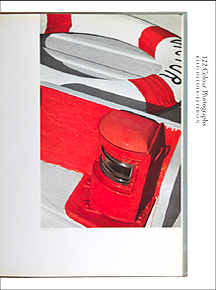
Keld Helmer-Petersen: 122 Colour Photographs
Hardcover w/ Dustjacket
9.5 x 7 in.
136 pages
75 Color illustrations
Essays by Mette Sandbye, Jeffrey Ladd
ISBN: 978-1-935004-27-1
$39.95


In 1948 the Danish photographer Keld Helmer-Petersen prefigured the work of Willam Eggleston and Stephen Shore by two decades with the aim to make pictures that would only work in color, and not in black and white. By concentrating on the mundane and the everyday 122 Colour Photographs deserves credit as a singular, remarkably early and largely successful attempt to make color photography work. Books on Books #14 presents Helmer-Petersen’s masterwork along with an essay by the historian Mette Sandbye called Colour Cool.


*


*

Books on Books #15
Nobuyoshi Araki: The Banquet
Hardcover w/ Dustjacket
9.5 x 7 in.
136 pages
85 Color and Duotone illustrations
Essays by Nobuyoshi Araki, Ivan Vartanian
ISBN: 978-1-935004-29-5
$39.95


Nobuyoshi Araki’s “Shokuji” (The Banquet) is a tribute to his late wife Yoko through a ‘photo-diary’ of the food they shared together in the last months of her life. Resembling commercial food pictures that Araki had been making with a ring flash and a macro lens and combined with black-and-white images he photographed at home after doctors told Araki that his wife had only a month left to live. Books on Books #15 presents Araki’s deeply personal diary of loss in its entirety along with an essay by Ivan Vartanian.
"Shokuji (The Banquet) is another tribute to Nobuyoshi Araki's late wife Yoko...A 'photo-diary' of the food they ate together in the last months of her life, the book is divided into three sections. Two parts are double-page photographic spreads of food, enclosing a middle section that is a written 'food diary'...Araki was making commercial food pictures on a regular basis, and the color section of the book represents a selection of these, beginning in 1985, and shot with ring flash and a macro lens. The black-and-white section was photographed using available room light at home, and was started when doctors told Araki that his wife had only around a month left to live...The obvious metaphor is to suggest that the color was leaving Araki's world, but his intentions are not quite so simple. The retreat from color is a retreat from realism to romanticism, where what were clearly images of food now become images of matter, like micro-photography, echoing the viral landscape of the cancer that was destroying his wife."--Parr & Badger, The Photobook, A History, vol. I 
*


*

Books on Books #16
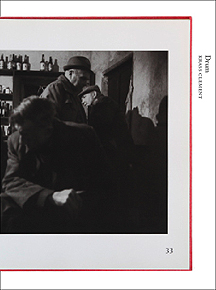
Krass Clement: Drum
Hardcover w/ Dustjacket
9.5 x 7 in.
120 pages
55 Duotone illustrations
Essays by Rune Gade, Jeffrey Ladd
ISBN: 978-1-935004-31-8
$39.95


Photographed in a single evening with only three rolls of film, Krass Clement’s Drum is now considered one of the most important contributions to the contemporary Danish photobook. Concentrating on one principal character – a hunched, weather beaten old man who sits alone with his drink, Drum comments on community, the outsider, alienation and the terrors of being alone. Books on Books #16 presents every page spread from Clement’s masterwork with an essay by the photo historian Rune Gade called Halting, Without Halting: On Krass Clement’s Photobook Drum.


zondag 15 januari 2012

Ed van der Elsken Color Snapshots Tokyo '80s Japan Photography


In the last years of his life Ed van der Elsken worked on what should have been his audiovisual magnum opus: Tokyo Symphony. The installation was meant to be his homage to Japan – a land that had embraced him personally as well as as a photographer and author.

The installation was never finished due to his early death at age 60. It was thought that the collection of 1,600 images, which is currently stored at the Nederlands Fotomuseum in Rotterdam, was all that remained of this ambitious project. In 2007, researcher Frank Ortmanns discovered five audiotapes belonging to the project. Fascinated by this missing piece of the puzzle, Ortmanns approached Paradox to discuss the possibility of posthumously realizing Tokyo Symphony. Taking into account Van der Elsken’s fascination with AV technology, it was concluded that a contemporary approach to this installation would be most appropriate. In other words: to make an installation as if Van der Elsken were still alive.


The immersive installation based on hundreds of unknown colour slides confronts the viewer with various traditional as well as contemporary and little known aspects of Tokyo: from demonstrations in Shibuya to weddings and memorial celebrations, from girls wrestling and karaoke in Harajuku to the Tsukiji fish market. Van der Elsken switches constantly from intimate portraits to lively street scenes. The spatial multi-screen design of the installation, which is accompanied by a soundtrack based on his original recordings, adds to the dynamic experience of the strange mixture of tradition and modernity that characterises the metropolis of Tokyo. Through the harmonic as well as disharmonic interplay of various audiovisual elements, the installation can be seen as a true modern symphony about urbanism and eastern culture – a symphony that reflects the notion of the all absorbing and omnipresent urban environment.


Ed van der Elsken´s photographs are represented worldwide in the collections of several renowned institutions including the Stedelijk Museum (Amsterdam), the Chicago Art Institute, the Kawasaki Modern Art Museum, the Special Collections Department of the University Leiden and the Museum of Modern Art (New York). 


Ed van der Elsken and Eikoh Hosoe: A 30-Year Dialogue by 
A year ago in this blog, Matthew Carson highlighted some of the lesser-known classics in the ICP Library collection. One of the books he wrote about was Ed van der Elsken’s Sweet Life (1966). As one of my all-time favorite photobooks, Sweet Life is an incredibly beautiful collection of rich inky high contrast gravure images taken in 1959-61 during van der Elsken’s 14-month journey around the world. It is also an invaluable resource for drawing attention to van der Elsken’s role as a “photographer’s photographer” – a visionary whose raw cinematic stream-of-consciousness aesthetic found only a limited following during his lifetime, yet is now cited for presaging the contemporary diarist work of photographers such as Nan Goldin. Travelling with his wife Gerda van der Veen to West Africa, the Malay Peninsula, the Philippines, Hong Kong, Japan, the United States and Mexico, Sweet Life also documents van der Elsken’s initial photographic exchange in what would become a 30-year ongoing relationship with Japan and the postwar Japanese photographic community. Read for more ...

Even before his 1956 breakthrough with Love on the Left Bank, Van der Elsken attracted attention in international exhibitions such as Edward Steichen’s The Family of Man (1955). Further important exhibitions followed, such as Sweet Life (Amsterdam, 1968), Masters of European Photography (London, 1973), Van der Elsken´s Amsterdam (Amsterdam, 1979), L´Amour à Saint Germain des Prés (Tokyo, 1986) and De ontdekking van Japan 1961-1988 (Amsterdam, 1988/1989). Also posthumously: Once Upon a Time (Amsterdam /Tokyo, 1991), Long Live Me! (Paris /Amsterdam /Porto /Modena /Antwerp, 1996 - 2006), and Documenta X (Kassel, 1997). His most influential photo books include Een liefdesgeschiedenis in Saint Germain des Prés(1956), Bagara (1958), Jazz (1958), Sweet Life (1966), Amsterdam! (1979), De ontdekking van Japan (1988) and Once Upon a Time (1991).