...a photoBook is an autonomous art form, comparable with a piece of sculpture, a play or a film. The photographs lose their own photographic character as things 'in themselves' and become parts, translated into printing ink, of a dramatic event called a book...
- Dutch photography critic Ralph Prins
Thema: Photo - Mario Carrrieri Milano du. Kulturelle Monatsschrift. 20. Jg., Juni 1960
Mario Carrieri was a leading photojournalist and cinematographer who devoted himself to photographing Milan for two years between 1957 and 1959. The obvious influence here is William Klein, whose book New York was published in Italy (among other countries). As Parr & Badger explain, however, the tone of Carrieri's work sidesteps the humor inherent to Klein's style. As such, he "confines himself to the city's grittier aspects, being drawn to the desolate outer suburbs, and even when photographing the city's glamorous center, he manages to make it look dark and dangerous...It's concentration on the seamier side of life makes Milano one of the most important works of the neo-realist tendency of the late 1950s."
Carrieri was influenced by William Klein"s Life is Good & Good For You in New York and shared a similarly raw view, though his layout is slightly more restrained. Carrieri spent time photographing in the suburbs as well as in the centre of Milan, focusing his attention mostly on the less glamorous working side of this hard Italian city. "One of the most important works of the neo-realist tendencyof the 1950s" (Parr). In the same year as Milano, Italia, Klein published his own impressions of Italy in Rome: The City and Its People. Parr, M. and Badger, G., The Photobook: A History Vol.I, p.214; Auer, M. and M., 802 photo books, p.393.
Another year has passed and that basically just means that more books have been published and many more are on the way. This was obviously an exciting year for me with my venture into the world of publishing and this list is a tip of the hat to projects that made me envious. Each exhibits strengths that make them destined for a long shelf life and educates as to the potential for book-making. Certainly I have missed many other great titles that have slipped past my radar but here are my picks for 2008. Check them out and enjoy.
1 Invaze 68 by Josef Koudelka (Torst/Aperture) Many weren't too sure of this one but I love it. I prefer the Torst Czech version with the recycled paper cover but need the Aperture edition for the texts.
2 101 Billionaires by Rob Hornstra (Borotov) The biggest surprise of Paris Photo. Missed out on his first but won't miss out on future ones.
3 Pretend You're Actually Alive by Leigh Ledare (PPP Editions) Great first book (even with the misshapen slipcase) from this young artist and I hope he keeps making 'em with the same intensity.
4 A New History of Photography by Ken Schles (Schaden/White Press) Inventive, witty, smart and great book craftsmanship and concept.
5 Beaufort West by Mikhail Subotzky (Chris Boot) My very first impression was not favorable...needless to say it has grown on me...and grown on me... 6 Sent A Letter by Dayanita Singh (Steidl) Delicate, quiet and very interesting.
7 Wonderland by Jason Eskanazi (De.Mo) A long time coming and well worth the wait.
8 Solitude of Ravens by Masahisa Fukase (Rathole) a reworking of an old masterpiece.
9 South East by Mark Steinmetz (Nazraeli) The second in what will be a trilogy. Mark is well due his moment and this is another that shows why.
10 A Road Trip Journal by Stephen Shore (Phaidon) Way too pricey to the point where I might say it isn't worth it but I like it too much.
Last year I caught a lot of grief from friends who joked that my 'best of' list totaled 35 books so this year I am keeping it to just 15. It's a bit easier on your wallet.
Feel free to make your own Best of 2008 list and contribute it to the comments section. I want to know what I missed. See for the list of 2007...
Robert Frank discusses his book, "The Americans," with Philip Gefter. The book is an intimate visual chronicle of common people in ordinary situations drawn from several trips he made through his adopted country in the mid-1950s. (Related Article)
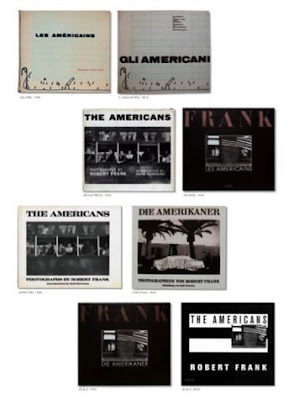
Robert Frank’sThe Americans was first published on May 15, 1958 by Robert Delpire in Paris. It featured 83 of Frank’s photographs taken in America in 1955 and 1956, accompanied by writings in French about American political and social history selected by Alain Bosquet. Delpire’s Les Américains formed part of the Encyclopédie essentielle series, which presented foreign countries to a French audience. Each of Frank’s photographs in this edition is placed on a right-hand page, with the texts on the left-hand pages.
The first English edition of The Americans was published in 1959 by Grove Press in New York. It presented the same photographs as the Delpire edition, however a text by Jack Kerouacreplaced the French writings. The book begins with Kerouac’s introduction, followed by Frank’s photographs in the same sequence as the Delpire edition. On the left-hand pages are short captions from Frank, which describe the location.
Since 1959 The Americans has been reprinted by different publishers, in multiple languages and formats. Frank has had varying influence on these editions; some were printed without his input, approval or knowledge. In July 2007 the Steidl edition of The Americans was printed. Frank was involved in every step of its design and production. The 83 photographs were scanned in tritone at Steidl’s digital darkroom from vintage prints in Frank’s collection, which revealed that many images in past editions were actually crops of the originals. For the Steidl book Frank studied and revised these crops and in many cases included the full photographs; in only a few cases the Delpire and Grove Press compositions remain.
The Steidl edition also reproduces two photographs printed from negatives different to those used for all previous editions. These photographs depict the same two subjects as in other editions (Metropolitan Life Insurance Building–New York City and Assembly Line–Detroit), but from a slightly different perspective.
Kerouac’s text and Frank’s captions remain unaltered from the Grove Press edition, the typography however was redesigned. As well as revising the book’s design, Frank also chose the paper, endpaper and book linen. He opted for a thread-stitched book, and conceived a new dust jacket made from the same paper as in the book (Xantur 170 g from Scheufelen, Germany), sealing it with a simple varnish. Frank personally oversaw printing on July 18, 2007, inspecting and approving each sheet at Steidl’s press in Göttingen. In January 2009 the National Gallery of Art, Washington, will celebrate the 50th anniversary of "The Americans" with an exhibition that will examine both the construction of the book and the photographs themselves. All 83 photographs published in "The Americans" will be presented in the order established in the book, providing a detailed examination of the book's roots in Frank's early work and the impact on his later art. Read more Robert Frank: Dissecting the American Image by Jno Cook...
“For me, making a photograph is mostly an intellectual process of understanding people or cities and their historical and phenomenological connections. At that point the photo is almost made, and all that remains is the mechanical process.” Thomas Struth
Thomas Struth’sinterest in family portraits was triggered by a psychoanalyst friend, who as a means of finding out more about their biographical backgrounds asked his patients to bring photographs of their family from their childhood. The position of family members to one another, the closeness or distance to the partner, to father and mother, brother or sister reveals much much more than is immediately apparent. Struth found this insight and the thought of what options photography offers in this context so fascinating that he began a series of family portraits in 1985, which today alongside other topics, forms a central component of his oeuvre.
Initially, the families portrayed came from Struth’s close family circle or are friends and acquaintances; he later extended the scope to countries outside Europe and other social classes. His only condition is that there is a connection between him and the families in question – Struth never photographs people to whom no such connection exists. Generally speaking the artist first organizes several sessions with the portrait subjects to get a sense of the families, the individual members and their relationship to one another. The chosen backdrop is always in the family’s domestic environment, and Thomas Struth lets his models decide on the setting so as to produce as authentic a portrayal as possible. The fascinating thing about Struth’s family portraits is their undeniably representative character. Even in what are seemingly the most casual groupings the need to present yourself as an individual within a hierarchical order remains – and the strength of this need varies from culture to culture.
In terms of art history Thomas Struth’s family portraits stand in the tradition of his great models from painting, from Goya to Velazquez. Read more ... & read an interview with Thomas Struth...
The exhibition is accompanied by a publication of Schirmer/Mosel Verlag, Munich
Thomas Struth Familienleben With an essay by Eric Konigsberg and texts by Gabriele Conrath-Scholl and Thomas Struth 92 pages, 28 duotone and color plates
...Photography is the visual medium of the modern world. As a means of recording, and as an art form in its own, it pervades our lives and shapes our perceptions...




 Thomas Struth





 Posts
Posts


