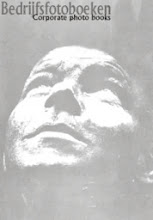
...a photoBook is an autonomous art form, comparable with a piece of sculpture, a play or a film. The photographs lose their own photographic character as things 'in themselves' and become parts, translated into printing ink, of a dramatic event called a book... - Dutch photography critic Ralph Prins


Eye pathologies by HIPPOLYTE BAYARD...
Juul Hondius, UN/Defender, 2000
Juul Hondius, Canal, 2000
Dutch photography: "a critical iconography of the present" is an expression used by Juul Hondius to describe his photographs, set-up scenes that deal with some of the most recurrent subjects of contemporary photojournalism, like refugees and international peace corps in former Yugoslavia and other international scenarios. These images look like thousands of news photos we've seen over and over, but have a neatness, richness of details and stillness that makes us 'stay' on the image, rather than being hit by the content and move fast on to the next one. Icons of icons, they mock the media language by restaging its subject matter, a "pathological" illustration of the numbness of our gaze on the world.

| Category of object | 20th century Dutch photographs |
| Period/Style | 1950-today |
| Medium & Support | photograph |
| Dimension | height: 35.4 cm = 13 7/8 in. width: 27.2 cm = 10 3/4 in. depth: 5.2 cm = 2 in. |
| Museum | Amsterdam, Rijksmuseum |
The dummy and all but four photographs were acquired from the estate, four loose prints were bought from HUP Gallery, Amsterdam
2007, Amsterdam, Rijksmuseum, inv. nrs. RP-F-2007-187 t/m 194
Cécile van der Harten (ed.), Flip Bool (ed.) and Gerard van Westerloo (ed.), Cécile van der Harten and Gerard van Westerloo, Sanne Sannes, 1937-1967, Fragment, Amsterdam, 1993
Bulletin van de Vereniging Rembrandt, vol. 18, n° 1, 2008, M. Boom, H. Rooseboom, Dummy voor ‘Dagboek van een erotomaan’, p. 23-27
Sanne Sannes - Darkness & Light 30 October – 9 December 2009

Foam_Fotografiemuseum Amsterdam presents Darkness & Light, a special retrospective of the photographic oeuvre by Sanne Sannes (1937-1967). In the relatively short period of time that Sannes worked as a photographer, he managed to build up a unique portfolio. His obsession with the erotic force of the female was overpowering. Women formed his favourite subject and were an endless source of inspiration to him. Sannes photographed women over and over again in ecstatic sessions, during which he portrayed them often in the nude and at their most intimate. This intimacy is emphasized by the out-of-focus and underexposed pictures, because Sannes worked with existing light and photographed with a hand-held camera.
With his grainy erotic portraits, his relentless urge to experiment, and his non-conformist attitude Sannes came to be seen as the most promising photographer in The Netherlands during the Sixties. He worked on exhibitions both in the Netherlands and abroad. Due to his untimely death, he never truly achieved an international breakthrough - he died in a car accident at the age of thirty.
Even though his career was not a long one, the oeuvre Sannes built up was of the highest quality. The exhibition at Foam shows a cross-section of this work and contains unique vintage prints, large format prints especially made by Sannes for exhibitions, projections and parts of the mock-up of Sannes’ never-published photo book Dagboek van een erotomaan [Diary of a Erotomaniac]. See for a review ...
See also Dirty Girl Sanne Sannes, VPRO, 1967 (18 min.) Foto-film over de fantasieën van een keurig getrouwde vrouw. Ze droomt van een bestaan waarin ze naaktmodel, prostituée en uiteindelijk moordenares van haar sullige echtgenoot is. Fotograaf en filmer Sanne Sannes stond op het punt om internationaal door te breken toen hij in 1967 onverwacht overleed.

As Parr and Badger describe, Peterka's book provides its viewer with an "urban meditation that uses photographic fragments, glimpses of the urban streetscape, to make a wider point about our political situation in the late twentieth century...The book's title may or may not be intentionally ironic. The dark, fragmented nature of the pictures indicate that it is, suggesting an anti-Communist critique made just prior to the 'Prague Spring...Peterka details a familiar iconography of photographic melancholia--abstracted signs, mysterious doorways, peeling and crumbling walls, miserable looking people on the streets, a broken mask lying by a lamp-post. With these apparent cliches, he creates an atmosphere of gloom and uncertainty, mirroring the alienated lives of modern man."
Impressive documentary photographs of remnants of the Cold War
The Cold War is over, yet its traces are still visible. For forty long years, the Iron Curtaindivided Europe into East and West; atomic-bomb shelters were built, weapons stockpiled, emergency drills carried out. Dutch documentary photographer Martin Roemers (*1962) decided to track down the remains of this period. For over ten years he repeatedly traveled through formerly hostile countries on both sides of the line: through eastern and western Germany, England, Belgium, the Netherlands, Poland, Ukraine, and other former East Bloc nations. He descended into underground tunnels; photographed abandoned control centers, old barracks, wrecked tanks, and ruined statues. In his images the era of enmity, the politics of deterrence, and the arms race appear ongoing and vivid, serving as a reminder for a future of peace.
Martin Roemers. Relics of the Cold War
Willy-Brandt-Haus, Berlin November 11, 2009 – January 15, 2010
Opening November 10, 2009 at 7:30 pm
From the text Same defenses, same fears by Martin Roemers:
Summer 1983. I’m on holiday with a friend in Germany. We’re walking through a wood in an easterly direction. It must be there. Through the trees we see something grayish. We can’t go any further. There’s a concrete wall in front of us. There’s nothing else to see. Except for the singing birds it is quiet. We walk along the wall until we reach a watchtower. A soldier is sitting inside and he looks at us. I take a picture of the lonely man in the tower. He takes a picture of us.
Fall 1989. The wall has fallen. I’m a photography student at the art academy. I drive through East Germany in my old car. On the way I pass countless Russian barracks. It looks like a completely different world from the outside. I wonder what they look like inside. I walk to the front gate and ask for permission to take a few pictures. “Njet,” they say.
Spring 2009. I’ve taken the last picture for this project in Moscow. The question I asked myself during this series was: “What are the consequences of this war that was never waged on the landscape?” I’ve looked for these places for eleven years between all my other work. Initially I focussed on the Soviet legacy in the old GDR, but gradually the project became bigger. Although the Cold War affected more continents, I’ve limited myself to East and West Europe. I’ve been surprised by the enormous quantities of shelters, bunkers, airfields, shooting ranges, barracks, missile bases, border barricades, and radar stations. They look identical on both sides of the Iron Curtain: the same defense mechanisms built out of the same fears.
All images taken from the book:
Martin Roemers
Relics of the Cold War
Edited by Nadine Barth, texts by Nadine Barth, H.J.A. Hofland, Martin Roemers
Published by Hatje Cantz
DIBBETS, JAN. FUCHS, R.H. & M.M.M.VOS. - Jan Dibbets. Met essays van R.H.Fuchs en M.M.M.Vos en een inleiding van Martin Friedma...