...a photoBook is an autonomous art form, comparable with a piece of sculpture, a play or a film. The photographs lose their own photographic character as things 'in themselves' and become parts, translated into printing ink, of a dramatic event called a book...
- Dutch photography critic Ralph Prins
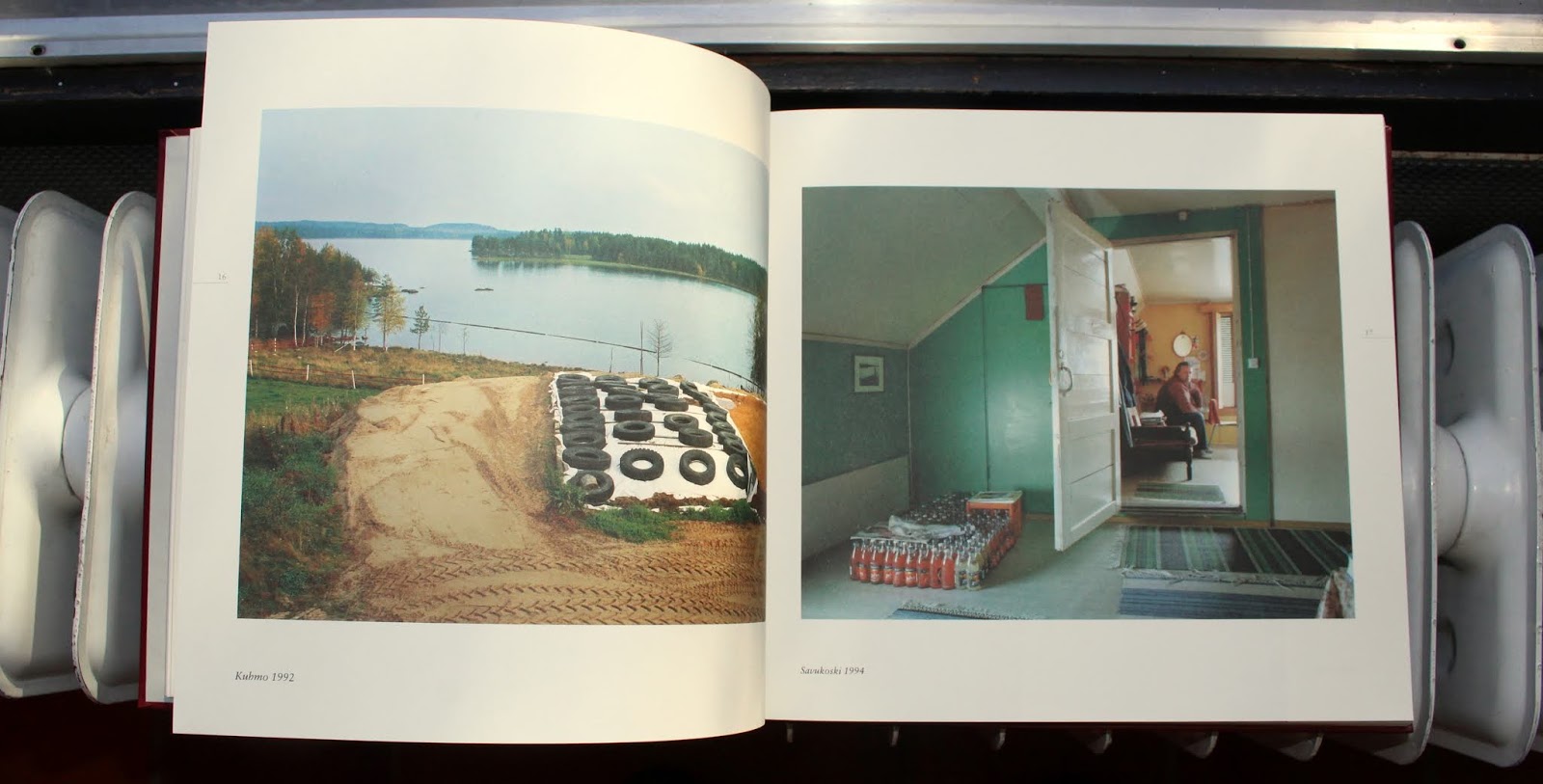
Naarashauki: The Female Pike
MÄNNIKKÖ, Esko
ISBN 10: 9529235003 / ISBN 13: 9789529235001
Published by Esko Männikkö, Oulu, Finland, 2008
Hardcover. Red cloth-covered boards with a tipped-in four-color plate on the cover and title stamped in gray on cover and spine, no dust jacket as issued. Photographs and text (in Finnish and English) by Esko Männikkö. 144 pp., with approximately 200 four-color plates. 9-5/8 x 10-1/4 inches. Out of print. Scarce.
[Cited in Andrew Roth, ed., The Open Book. (Göteborg, Sweden: Hasselblad Center in association with Steidl Verlag, Göttingen, Germany, 2004), and in Martin Parr and Gerry Badger, The Photobook: A History, Volume II. (London and New York: Phaidon, 2006).].
Revolving around the experience of fishing for pike in midwinter, Female Pike is a native son's "directed" study of rural Finnish people and their culture. then again, not really! Carefully posed and constructed by Männikkö, these portraits also challenge the notions of the "photograph as document" using subject matter that is easy bait for the viewer.
"In 1989 when spring was passing to summer, a shocking turmoil happened in Beijing, which has attracted the close attention of people at home and abroad; Influenced by foreign media, people have many questions, guesses and misunderstandings. What really happened in China? What is the situation now like in Beijing? This album, with its abundant pictures, will help our readers understand the whole story of and truth about the turmoil and the present situation in Beijing.
...
At 1:30 a.m. on June 4, the Beijing municipal government and the martial law headquarters issued an emergency notice asking all students and other citizens to leave Tiananmen Square. The notice was broadcast repeatedly for well over three hours over loudspeakers. The students on Tiananmen Square, after discussion among themselves, sent representatives to the troops to express their willingness to withdraw from the square and this was approved by the troops. Then at about 5 a.m., several thousand students left the square in an orderly manner through a wide corridor in the southeastern part of the square vacated by the troops, carrying their own banners and streamers. Those who refused to leave were Forced to leave by the soldiers. By 5:30 a.m., the clearing operation of the square had been completed.
...
During the whole operation not a single person was killed. The allegations that "Tiananmen Square was plunged into a bloodbath" and "thousands of people were killed in the square" are sheer rumours, and the true state of affairs will eventually be clear to the public
....
We will continue to strive for the realization of the socialist modernization. We are fully confident of our future." (from the foreword)
Pages: 93
Place: Beijing
Year: 1989
Publisher: Beijing Publishing House, Beijing
Size: 21 x 29 cm (approx.)
Publisher/Verlag: Thames & Hudson | From the 1900s to the Present | In the last decade there has been a major reappraisal of the role and status of the photobook within the history of photography. Newly revised histories of photography as recorded via the photobook have added enormously to our understanding of the mediums culture, particularly in places that are often marginalized, such as Latin America and Africa. However, until now, only a handful of Chinese books have made it onto historians short lists. Yet China has a fascinating history of photobook publishing, and The Chinese Photobook will reveal for the first time the richness and diversity of this heritage. This deluxe, lavishly produced volume is based on a collection compiled by Martin Parr and Beijing- and London-based Dutch photographer team WassinkLundgren. And while the collection was inspired initially by Parrs interest in propaganda books and in finding key works of socialist realist photography from the early days of the Communist Party and the Cultural Revolution era, the selection of books includes key volumes published as early as 1900, as well as contemporary volumes by emerging Chinese photographers. | Format: Hardback | Language/Sprache: english | 448 pp.
About the Archive
This is a digitized version of an article from The Times’s print archive, before the start of online publication in 1996. To preserve these articles as they originally appeared, The Times does not alter, edit or update them.
The article as it originally appeared.
VIEW PAGE IN TIMESMACHINE
June 7, 1989, Page 00008
The New York Times Archives
Administration officials estimate that elements of 10 People's Liberation Army units, totaling 100,000 to 150,000 troops, have been deployed in and around Beijing.
But with the exception of three units, the officials are uncertain to whom the troops profess allegience.
Army groups identified in Beijing include the 27th Army, normally based at Shijiazhuang, southwest of Beijing. It is one of four armies assigned to the Beijing Military Region. The 15th Airborne Army, part of China's strategic reserves based in Wuhan in central China, is also in the capital. It and the 27th conducted the attack on the students on Sunday. Other Beijing region units around the city are the 28th, 38th, 63d and 65th Armies. The 38th refused to use force against the students when martial law was declared three weeks ago and is reported to be one of the units now in a stand-off with the 27th and the paratroopers who hold the city.
Units brought in from other of China's seven military regions are the 16th, 64th and 39th armies from Shenyang region in the northeast and the 12th from Nanjing. Army of 3 Divisions
A Chinese Army numbers from 40,000 to 46,000 and is usually made up of three infantry divisions plus artillery, armor and support units.
The American officials said the units had probably been moved to the capital from outlying provinces on orders of Deng Xiaoping, China's leader, and President Yang Shangkun. But the officials are certain that the shooting of the students over the weekend, upset many of the army's leaders and they said some of them may now be refusing to take orders from political leaders. A senior American official said today that Washington believed that the attack in Tiananmen Square was led by Yang Baibing, the head of the army's General Political Department. The official said Mr. Yang is a nephew of President Yang, not a brother as has sometimes been reported.
The official said the American Embassy in Beijing was unable to determine exactly what is happening, since diplomats could not move freely around the city.
One official said ''Our information is spotty, but we don't think the Chinese know what's going on either.'' Not Believed at Full Strength
With the exception of the 38th Army, stationed near Beijing, military experts doubt that the nine other units sent to Beijing are at full strength. ''China still has a primitive logistic and resupply system and they simply could not move or support so many full strength units without a severe dislocation of their system,'' one logistics specialist in the Pentagon said.
American officials refused to give precise locations of the units around Beijing, nor would they estimate the size or identify the accompanying equipment of specific units.
Chinese armies vary in size and equipment depending upon where they are stationed and at what stage they have reached in China's military modernization program. Units in the Beijing and Shenyang Military Regions, where most of the units sent to Beijing are stationed, are heavy in tanks and armored personnel carriers, because they guard the northern and western boders adjacent to the Soviet Union. The 12th army from Nanjing along the coast is more lightly armed.
Experts who have examined the photos of equipment used by the mechanized 27th Army said the unit must be one of China's elite because it was armed with China's most up-to-date tank, the T-69.
Administration officials refused to discuss what role China's nuclear arsenal would play if full-scale civil war broke out. China's Second Artillery Corps is said to control the nuclear missiles under the direct command of the Central Military Commission headed by Mr. Deng. But one expert said that intercontinental missiles would be of no use to Chinese forces fighting one another. He would neither not speculate on the existence or utility of Chinese short-range nuclear weapons.
Correction: June 9, 1989
Friday, Late Edition - Final Because of an editing error, a military analysis article on Wednesday about the Chinese Army described the relationship between a military official and China's President incorrectly in some copies. The official, Yang Baibing, head of the army's general political department, is a brother of President Yang Shangkun. Gen. Yang Jianhua, a nephew of the President, commands the 27th Army.
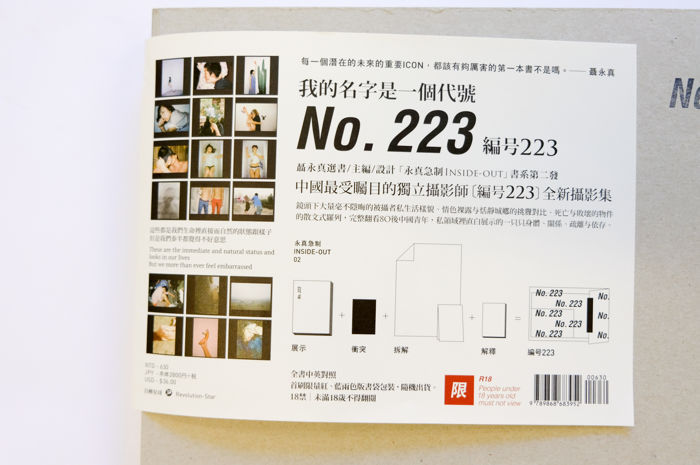
No.223.
Photographs by NO.223. Lin Zhipeng (aka No.223).
Revolution-Star Publishing & Creati, 2013. 240 pp., 166 color illustrations throughout, 7¼x10½".
Overview book with the works of Chinese Photographer Lin Zhipeng (nickname: 223). The book comes in a bag (published in two colours, this is the red one) with 2 additional booklets and 2 posters
Publisher/Verlag: Thames & Hudson | From the 1900s to the Present | In the last decade there has been a major reappraisal of the role and status of the photobook within the history of photography. Newly revised histories of photography as recorded via the photobook have added enormously to our understanding of the mediums culture, particularly in places that are often marginalized, such as Latin America and Africa. However, until now, only a handful of Chinese books have made it onto historians short lists. Yet China has a fascinating history of photobook publishing, and The Chinese Photobook will reveal for the first time the richness and diversity of this heritage. This deluxe, lavishly produced volume is based on a collection compiled by Martin Parr and Beijing- and London-based Dutch photographer team WassinkLundgren. And while the collection was inspired initially by Parrs interest in propaganda books and in finding key works of socialist realist photography from the early days of the Communist Party and the Cultural Revolution era, the selection of books includes key volumes published as early as 1900, as well as contemporary volumes by emerging Chinese photographers. | Format: Hardback | Language/Sprache: english | 448 pp.
Selected as one of the Best Books of 2012 by:
WassinkLundgren
Publisher's Description
These are the immediate and natural status and looks in our lives. But we more than ever feel embarrassed.
I am more into a simple, violent and immediate aesthetics that has a lot relation to life, I look for photography that can develop stories, although it still takes a lot of work to do, hope I can achieve that step by step.-------Lin Zhipeng
Lin Zhipeng(aka No.223) is born in Guangdong province, China and graduated from Guangdong University of Foreign Studies with major of financial English.
Lin is a photographer and freelance writer based in Beijing. He constructed a blog entitled North Latitude 23 with millions views and posted his personal photographs and words on it. He has contributed to numerous creative and fashion magazines as editor and writer and has produced photo shoots for magazines such as Vice, S magazine, VISION, City Pictorial, etc and brands such as United Nude, Converse, Glaceau Vitamin Water, Bacardi, etc. He also produced video works such as SANSAR, SCENE, Xanthium, etc. In 2007 he published the independent fashion magazine project TOO and in 2005, 2006 and 2011 published three volumes of photography entitled My Private Broadway. In 2012 he published a personal zine entitled VERSATILE. His photography works were included in 3030:NEW PHOTOGRAPHY IN CHINA, Elephant, Back to Black & White, TELL MUM EVERYTHING IS OK, etc. www.linzhipeng223.com
For The Sensation of the Sea, guest curator Joanna De Vos has invited several international artists to engage in a dialogue with The Mesdag Collection. These contemporary artists are captivated by the grandeur and tempestuousness of the ocean. The attraction of the sea is an inexhaustible source of inspiration for them, a ‘battery for the imagination’.
Odes to the performance In Search of the Miraculous by the Dutch artist Bas Jan Ader form the exhibition’s connecting thread. Ader disappeared in 1975 as he attempted to sail across the Atlantic. His soul became one with the untameable power of the sea. The tributes to Ader’s artistic practice highlight the enticement and mystery of the ocean.
ExhibitionThe Sensation of the Sea: In honour of Bas Jan Ader
From14 September 2018
To6 January 2019
Artists
Discover how the contemporary artworks integrate into our nineteenth-century museum and prepare yourself for a series of surprising and special ‘encounters’. The artworks of these artists will be on display in The Sensation of the Sea:
Nelly Agassi, Ruben Bellinkx, Ansuya Blom, Elke Andreas Boon, Dirk Braeckman, Stijn Cole, Thierry De Cordier, Wim Delvoye, Jan Dibbets, Jan Fabre, Nan Goldin, David Horvitz, Oda Jaune, Sigalit Landau, Enrique Marty, Fabien Mérelle, Johan Muyle, Katie O’Hagan, Ahmet Ögüt, Hans Op de Beeck, Mikes Poppe, Enrique Ramirez, Lonnie Van Brummelen, Hans Van Houwelingen, Yves Velter, Bill Viola, Jorinde Voigt, Julius Von Bismarck, Andy Wauman.
De zee die zindert, verslindt, verlangen oproept en gestraft moet worden
Recensie
Het Haags museum de Mesdag Collectie eert in een tentoonstelling met kunstwerken over de zee kunstenaar Bas Jan Ader, die op zee omkwam.
Sandra Smets
31 oktober 2018
De zee wordt gestraft, de branding gegeseld, in video van Julius Von Bismarck, in Mesdag Collectie foto Mesdag collectie
Woedend was koning Xerxes volgens de legende, zo'n 2500 jaar geleden. De Perzische heerser had het Griekse vasteland willen aanvallen en bouwde voor zijn troepen een brug over de Hellespont. Maar deze werd door een storm verwoest. En dus was Xerxes woedend. Op de zee. Hij gaf opdracht om driehonderd zweepslagen toe te dienen aan de zee.
Straf dan eerder de wind, maar goed, visualiseer dit en het levert een prachtig beeld op, mens versus natuurgeweld. Zo ziet ook de video eruit van Julius Von Bismarck die dit verhaal naspeelde in de branding, als een monnik van Friedrich met agressieproblemen. We zien de kunstenaar op de rug in een verbeten houding. Zweepslag na zweepslag dient hij toe aan de golven die hem omver duwen en toch staat hij weer op, en door gaat hij.
De zee verdient ook straf. Het neemt levens. Talloze bootvluchtelingen zijn de afgelopen jaren verdronken. In 1975 nam het een ander leven: dat van kunstenaar Bas Jan Ader, die op zee bleef. Ter herinnering aan die dood draait de video van Von Bismarck in de Mesdag Collectie. Daar is een tentoonstelling gewijd aan de zindering van de zee. Niet met dagjes strand, dus niet zoals de Haagse School waar Mesdag toe behoorde, maar een Groots Romantisch Verlangen. Dat van de mens die zich wil meten met de natuurkrachten.
Enrique Ramirez filmde de zee loodrecht van boven: een watermassa die kolkt en schuimt.
Verschillende kunstwerken zijn letterlijke odes aan Ader, zoals David Horvitz' superkorte super-8 filmpje van een kunstenaar die de zee in fietst, en omvalt (Ader maakte een video waarin hij in het water fietst). De zee wint altijd.
In dit alles verdient één kunstwerk speciale aandacht, namelijk een fantastische maquette van Ruben Bellinkx. Hij ontwierp een snelweg die in zee verdwijnt, compleet met lantaarnpaaltjes en vangrailtjes, een weg naar de droom, naar Atlantis. Het ziet er zo geweldig uit, simpel en spectaculair, laat iemand dat alsjeblieft in het echt uitvoeren.
De realiteit van bootvluchtelingen
Met al deze kunstwerken, onstuimige zeeën versus aantrekkelijke stranden, schetst het museum een tweedeling. Eigentijdse kunstenaars die vervoering zoeken versus de 19de-eeuwse burgerij met parasols. Dat klinkt mooi, maar het is geen echte tegenstelling. Dat besef je als je de bijdragen van Hans van Houwelingen ziet. In de achtertuin plaatste hij een rij steeds kleiner wordende ouderwetse strandstoelen: commentaar op de aristocratische blik op de zee die de realiteit vertekent. Welke realiteit, dat toont zijn foto ‘Hands Up’. Twee door water verrimpelde handen worden omhooggehouden. De realiteit van de bootvluchteling.
Dan pas is de zee onneembaar, de zee die Fort Europa omringt. In vergelijking met deze foto verdwijnen de andere tegenstellingen in de expositie. Alle andere kunstwerken tonen de zee – kalm of woest – als schoonheid. Het is de artistieke luxe van de blik die heerst en overwint. Het is zelfs (als je wat doordraaft) het perspectief van de Europese verlichting, de mens die de wereld aanschouwt, analyseert, bedwingt. Met kunst of zweepslagen. Wij westerlingen zijn allen Xerxes.
Beeldende kunst De zindering van de zee. Een eerbetoon aan Bas Jan Ader, t/m 6 jan 2019 in de Mesdag Collectie, Laan van Meerdervoort 7-F, Den Haag. www.demesdagcollectie.nl ●●●●●
...Photography is the visual medium of the modern world. As a means of recording, and as an art form in its own, it pervades our lives and shapes our perceptions...










 Posts
Posts


