maandag 13 augustus 2012

Rendering human relationships visible Menko People Nico Jesse Company Photography


Mensen van Menko: 1800 mensen fabriceren stoffen. [Text Martie Verdenius (essay). Photography, layout Nico Jesse].
Enschede / 1956 / 87 p. / hb. / 29x21cm / 144 b&w photographs / bedrijfsreportage en geënsceneerde foto's / productieproces parallel aan een beeldverhaal 'van-de-wieg-tot-het-graf' en variété. / NN / Firmenschrift, Festschrift / Photographie - Monographie - Auftragsphotographie, commissioned photography - Nederland, Niederlande - 20. Jahrh. / Printed by Bosch, Utrecht; Nederlandsche Rotogravure Mij., Leiden (boekdruk en koperdiepdruk). - Opdrachtgever: N.J. Menko NV (100-jarig bestaan). - Beeldverhaal. De lay-out is vergelijkbaar met die van VTF 25 (1957) en Oranje Nassau Mijnen (1953). Werklust, aanpassingsvermogen en concentratie zijn in beeld gebracht in deze drietalige uitgave (Nederlands, Frans, Engels). Bij geënsceneerde foto's van probleemsituaties op de werkvloer zijn gefingeerde dialogen geplaatst. Lit.: Flip Bool, 'Vrijheid in gebondenheid', T. Anema e.a., 50 Jaar fotografie GKf 1945-1995, Amsterdam 1995, p. 9-14
Nico Jesse was best known for his photo-book Women of Paris, published in 1954; his candid pictures of women going about their daily occupations convey the vitality of the city. Two years later the book was reprinted in a paperback edition; over the next few years it appeared in several countries, including Japan. Characteristic of Jesse's work, the pictures reflect his unconventional, almost filmic treatment: people are the focal aspect and movement is often an essential element. The use of flashlight to make the figures stand out from the background is another typically Jessean device. It is not so very surprising that he made his name with a book, for his strength lay less in the individual image than in a succession of them.

Nico Jesse had studied medicine and for many years combined his profession as a general practitioner with his passion for photography. His interest in people motivated him in both capacities. In 1956 he retired from general practice to devote himself entirely to photography. His assignments came from various companies; he took photographs for annual reports and/or company publications and for many years photographed Amsterdam's important annual literary event, the Book Ball. He also produced in rapid succession a large number of photo-books featuring European cities and countries. It is clear from these books that he was more interested in the people and atmosphere of a city than in tourist attractions.

To Jesse, photography was always a means of rendering human relationships visible. In 1962 he returned to doctoring, but continued to take photographs. At his death in 1976 he left a large photographic oeuvre which conveys a wonderful picture of the Netherlands and Europe in the fifties and sixties.
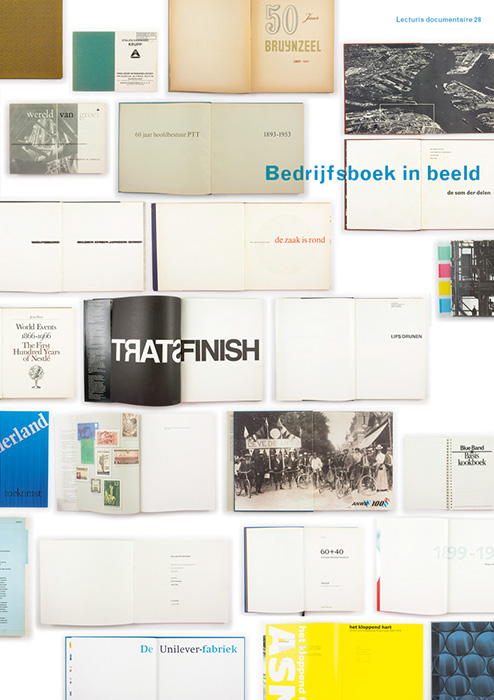


Documentaire 28: Bedrijfsboek in beeldRens Holslag en Jaap van Triest 
‘Show, don’t tell’  is learned by any commercial writer. The Lecturis Documentary aims to show with examples that this decree is also a recommendation for prefering photographs above texts.
This publication contains a personal collection which visually supports ​​a categorical treatment of business books and which shows the special role of photography in this book genre.
  • Author(s):Rens Holslag en Jaap van Triest
  • Pages:48
  • Size:210 x 297 mm
  • Edition:gehecht
  • ISBN:9789070108632
  • Year:2011
  • Design:Jaap van Triest


zaterdag 11 augustus 2012

Then and Now Hollywood Boulevard, from Sunset Plaza Drive in the East to Hillhurst Avenue in the West Ed Ruscha Photography


Foam Magazine Issue #31/ ref. / Ed Ruscha

Then and Now
Viewing Then and Now is like reading a historical timeline or a street map. In 1973, he photographed every building along a six-and-a-half-mile stretch of Hollywood Boulevard, from Sunset Plaza Drive in the East to Hillhurst Avenue in the West. He made contact sheets of the rolls of images and put them away in a box. Thirty-one years later, in 2004, he photographed the same route again, only this time with color film. The filmstrips put us in motion, as if we are in the passenger seat of the car looking out the side window. See for

all ed ruscha's artist books


 See also

Ed Ruscha Dutch Details Sonsbeek '71 Artist Book Graphic Arts Photography


dinsdag 7 augustus 2012

Transitions-Rochester 2010-2012 Theo Baart Cary Markerink Andrea Stultiens Photography


Transitions is an international collaboration looking at the changing city of Rochester, NY (USA), a former company town dealing with urban sprawl, new concepts of city planning, high unemployment rates and poverty. How does a city deal with transition? Urban development in America is often seen as exemplary for coming developments in Europe.
Transitions (so far) includes the work of Theo Baart (NL), Jason Bernagozzi (USA), FUA Krew (USA), Gregory Halpern (USA), Cary Markerink (NL), Juliana Muniz (USA) Oscar Palacio (CO), Andrea Stultiens (NL) and Dan Varenka (USA). The project is a collaboration between Visual Studies Workshop and FOTODOK. Partners in the project are the George Eastman House International Museum of Photography and Film and the Rochester Contemporary Art Center.

From “No Destiny” by Gregory Halpern

From “Inner Loop” by Cary Markerink
Transitions
2010-2012

Transitions is een internationale samenwerking waarin gekeken wordt naar stedelijke veranderingen in KODAK-stad Rochester, NY (USA). Rochester is een voormalige industriestad die te maken heeft met nieuwe concepten van stadsplanning, urban sprawl, hoge werkeloosheid en armoede. Hoe gaat een stad om met transitie? Stedelijke ontwikkeling in Amerika is vaak exemplarisch voor toekomstige ontwikkelingen in Europa. In het project Transitions houden we ons bezig met wat we kunnen leren van Rochester. 


De deelnemende fotografen en kunstenaars zijn:
Theo Baart (NL), Jason Bernagozzi (USA), FUA Krew(USA), Gregory Halpern (USA), Cary Markerink (NL), Juliana Muniz (USA), Oscar Palacio (CO), Andrea Stultiens (NL) en Dan Varenka (USA).


© Andrea Stultiens


KODAK was sinds het begin van de 19e eeuw de grootse werkgever van Rochester en omgeving. Hoewel KODAK aan de basis stond van de digitale fotorevolutie, heeft de directie gedacht dat de ontwikkeling van tijdelijke aard zou zijn en daardoor verkeerd gegokt. Als gevolg hiervan kromp het bedrijf van 65.000 werknemers naar 2.500 werknemers. Een forse klap voor de werkgelegenheid en het culturele leven in de stad, met alle problemen van dien. Rochester is een middelgrote stad in Amerika die door de teloorgang van KODAK en de huidige economische, genoodzaakt is zichzelf opnieuw uit te vinden om verval en leegloop te voorkomen.


© Cary Markerink


Niet alleen Amerika, ook Nederland heeft te maken met soortgelijke problematiek, denk aan krimpgebieden in de regio Limburg en Groningen of aan de herijking (post-Philips) van de stad Eindhoven. In Nederland is de overheidsbemoeienis groter dan in Amerika, en lijken de problemen zich niet in één gebied te concentreren. Met Transitions kijken we hoe in beide landen betrokkenen – voormalig werknemers, lokale en nationale overheden etc. – omgaan met dezelfde thema’s. De drijfveer voor Transition is dat we van elkaars situatie kunnen leren en daardoor misschien erger kunnen voorkomen. Het project is gericht op uitwisseling tussen Nederland en Amerika, maar er zijn gesprekken om het project uit te breiden met andere landen in Europa.


© Theo Baart


Presentatie
Het project heeft zijn aftrap in Amerika. Verschillende instituten in Rochester presenteren van 5 augustus t/m 13 november de projecten van de deelnemende kunstenaars en verschillende evenementen, zoals lezingen en debat. In 2012 komt Transitions naar Nederland en wordt uitgebreid met projecten over Nederland. Ook wordt er nagedacht over een vervolg in andere Europese landen.

- 5 augustus t/m 25 september presenteert Rochester Contemporary Art Center (ROCA) de tentoonstellingState of the City, in the Loop, met o.a het project Inner Loop van Cary Markerink (NL) 

- 2 september t/m 13 november presenteert Visual Studies Workshop Transitions-Rochester met werk van alle deelnemende kunstenaars.

- 6 oktober t/m 6 november presenteert het George Eastman House , international institute for photography and film Transitions-Rochester met werk van Theo Baart (NL), Gregory Halpern (USA), Cary Markerink (NL), Oscar Palacio (USA) en Andrea Stultiens (NL) 


Publicatie
Bij Transitions verschijnt een bundeling van alle projecten in de vorm van zes cahiers, die zijn vormgegeven door het Nederlandse ontwerpburo Kummer en Herrman. K&H hebben zich laten inspireren door de welbekende en doeltreffende vormgeving die KODAK jarenlang voerde voor al zijn producten. En ook het opvallende KODAK geel komt terug. De zes bijzondere boekjes zijn binnenkort te bestellen in FOTODOKs webshop.  


Volg de ontwikkelingen via de website en Nieuwsbrief.
Voor meer informatie email FOTODOK

maandag 6 augustus 2012

Child with Toy Hand Grenade the Photo Book Ian Jeffrey Photography


Child with Toy Hand Grenade by  

I'm currently working my way through Phaidon's The Photo Book and was struck by this picture by Diane Arbus. The commentary to the photo helped me understand why:

The grenade, grimace and claw-like hand seem to point to a desperate future, hysterical and militarized. The picture works because the strangeness of the boy is staged within a kindly natural scene: there is even a rhyme between those paired tree trunks and the child's spindly legs. Arbus's subject, here and elsewhere, is the discrepancy between imagined and idealized worlds, represented here by the trees and the sunlight in the park, and the violence apparently promised by the child. She imagined dystopia, but always regarded it from the point of view of the Garden of Eden (23)
It's interesting to compare this interpretation from the unknom Phaidon commentator with that of Wikipedia's. The former tries to grasp the photo within some kind of wider symbolic context and perhaps manages to grasp to the heart of its message. The latter interpretation, in true "historical-critical" fashion, is content to describe the surface image and tell us how the photo was taken. The result is that the power of the photo is lost in irrelevant detail.

Or is it irrelevant?


The Photo Book

Ian Jeffrey
The Photo Book , Jeffrey Ian, Since it was first developed by Daguerre in the 1840s, photography has followed an interesting and varied course in its progress from a practical means of documentation to an art form with its own icons, heroes, galleries and collectors. This eye-catching and engrossing book contains every sort of photography, all of it arranged in an easily accessible and fun format. Pictures of famous events such as the Royal Wedding and the first landing on the moon are here, next to familiar shots by the masters of photography such as Bill Brandt, Henri Cartier-Bresson, Cecil Beaton and Robert Doisneau. There is fashion, sport, natural history, reportage and society portraiture, as well as social documentary and art. The 500 photographers features range from William Henry Fox Talbot and Julia Margaret Cameron to Larry Clarke and Herb Rittz, from Robert Capa and Josef Kondelka to Nan Goldin and Pierre et Gilles. Arranged alphabetically, each full-page photograph is accompanied by an illuminating text which gives useful insight into the work and its creator, as well as extensive cross-references to others working in the same field or the same style. Glossaries of technical terms and movements and a directory of museums and galleries are included in the back of the book to provide a fully comprehensive and self-contained volume.

The Photo(graphy) Book--Phaidon's beautiful visual reference

 Written: Jun 01 '08 (Updated Jun 01 '08)
    Pros:great illustrations, good survey Cons:some artists probably deserve more treatmentThe Bottom Line:Great look at the first century and a half of photography
    The Photography Book is an attractively illustrated introduction to 500 of the most significant photographers in the first 150 years of the medium's history. The book takes an encyclopedic approach, arranging entries by the artists' names from the A of contemporary Dutch photographer Jaques-Laurent Aardsma to the Z of Harlem Renaissance man James VanDerZee. I've used this book as a ready reference item at the library and was impressed enough to add a paperback version to my own personal collection.

    Each entry is a page long and features a representative illustration from the artist along with a brief, one to two paragraph essay that combines biography with a review of the image and makes an attempt to contextualize both within relevant photographic movements. The book includes names that are highly recognizable and some that are less so, all given the same treatment. If the editors think the nature photography of Ansel Adams is superior to the celebrity portraiture of Herb Ritts or the Surrealist art of Man Ray somehow more worthy than the photojournalism of Robert Capa, there is no way to divine this from the text. Professional photography is celebrated in all of its aspects, from commercial to documentary to purely artistic.

    The Photography Book is available in different editions. In the library, we have the deluxe, oversize hardcover that retails between 40 and 60 dollars. I have a smaller paperback edition that is a very good value at $10. The detail on the photos is certainly enhanced by the larger scale of the hardcover edition, and that version is certainly easier to read. But the resolution is good either way, both being printed on glossy paper that captures the different hues and shades of gray nicely in each color and black and white illustration. A worthwhile addition to anyone's library of art


    Famous Scenes, Human Pathos, and Restrained BeautyNovember 14, 2000
    By 
    Donald Mitchell "Jesus Loves You!" (Thanks for Providing My Reviews over 113,000 Helpful Votes Globally) - See all my reviews
    (TOP 100 REVIEWER)    (VINE VOICE)    (HALL OF FAME REVIEWER)   
    This review is from: The Photography Book (Hardcover)
    Before considering this book, let me note that like many photography books this one contains a fair number of nude images of men and women that will offend some. If bare flesh is not something you want to see in your books, avoid this one.
    Grading this book was difficult. The photographs were well chosen to be interesting and rewarding, were reproduced faithfully, and worked well as images on facing pages. The page sizes are generous to allow more room for reproduction. Many of them are photographs that almost anyone would want to have. Almost anyone would agree that the photographs and design of the book deserve five stars.

    The accompanying texts, however, were not up to the standard of the photographs in most cases. I graded these texts on average at three stars. Averaging the two scores was how I arrived at four stars.

    The book's concept is to take 500 of the best photographers ever, and show one image of each in alphabetical order. Although this sounds strange, it actually works quite well. Most of the images are in black and white, but some are in color. As a result, you get a full dimensionalizing of what photography can do and mean to the photographer and viewer.

    Among the famous scenes in the book are Eddie Adams' Street Execution of a Vietcong Prisoner (1968), Neil Armstrong's Buzz Aldrin on the Moon (1969), Matthew Brady's General William Tecumseh Sherman (1865), Robert Capa's Death of a Loyalist Soldier (1936), Harold Edgerton's Milk Drop Coronet (1957), Alfred Eisenstaedt's V-J Day in Times Square (1945), Robert Jackson's The Murder of Lee Harvey Oswald (1963), Yousuf Karsh's Winston Churchill (1941), Joe Rosenthal's Iwo Jima (1945), Sam Shere's The Hindenburg Disaster (1937), and Nick Ut's Children Fleeing an American Napalm Strike (1972). If you are like me, these images brought me back to what I felt when I first saw these events or these photographs. It was a moving experience in each case. It is almost like looking at an album of your own life, once removed.

    I was also moved by the many images of human pathos that I had seen less often or not at all before. Especially noteworthy to me are Abbas' South African Miners (1978), Lucien Aigner's Benito Mussolini (1935), G.C. Beresford's Leslie Stephen and his Daughter Virginia (Woolf) (1902), Margot Burke-White's Mahatma Gandhi (1946), Charles Hoff's Ezzard Charles and Rocky Marciano (1954), Frank Hurley's The Endurance by Night (1915), Dorothea Lange's Migrant Mother (1936), and Arnold Newman's Georgia O'Keeffe (1968).

    Beauty was very much present, but almost always restrained in a variety of ways. That restraint created a tension that heightened the awareness of beauty. I particularly was affected by James Abbe's Bessie Love (1928), Eve Arnold's Marilyn Monroe (1960), Richard Avedon's Dovinna and Elephants (1955), Ian Bradshaw's Streaker (1975), Robert Mapplethorpe's Derrick Cross (1983), Man Ray's Tears (1930), Lennart Nilsson's A Human Foetus at Three Months (1973), Vittorio Sella's On the Glacier Blanc (c. 1880s), Frederick Sommer's Livia (1948), Jerry Uelsmann's Floating Tree (1969), and Edward Weston's Nude on Sand (1936).

    How can you further benefit from enjoying these images? I suggest that you dig out your old camera (or consider getting a new digital one), and find scenes that evoke the emotions and memories you most want. Take a few lessons from the ways the masters captured their scenes, and see what you can do. Like the student patiently painting a copy of a famous painting in a museum, you can create your own images to illuminate your life for now, for the future, and for future generations.

    Turn it all into a snap!


     Hans Aarsman Renesse 1988 ...

     Emmy Andriesse Modeontwerper en model ...

     Eva Besnyo Starnberggerstrasse ...

     Rommert Boonstra Zonder titel ...

     Rineke Dijkstra Hilton Head Island ...

     Ed van der Elsken Een liefdesgeschiedenis in Saint Germain des Pres ...

     Teun Hocks Heen en weer ...

     Johan van der Keuken Lelietjes-van-dalen verkopen ...

     Frans Lanting Ara's, Manu, Peru ...

     Bertien van Manen Tblisi, Georgie ...

     Jacob Molenhuis Dorpelingen ...

    Cas Oorthuys Haven van Rotterdam ...

    donderdag 2 augustus 2012

    Forthcoming The Photobook: A History - Volume 3 , Edited by Martin Parr and Gerry Badger, Phaidon, 2013 Photography


    Selected Group Publications

    Gregory Halpern


    The Photobook: A History - Volume 3 (Forthcoming), Edited by Martin Parr and Gerry Badger, Phaidon, 2013

    While the history of photography is a well-established canon, much less critical attention has been directed at the phenomenon of the photobook, which for many photographers is perhaps the most significant vehicle for the display of their work and the communication of their vision to a mass audience. In the third of three volumes, all co-edited by Martin Parr and Gerry Badger, the history of the photobook is brought fully up to date. This study provides an important corrective to the traditional history of photography. The selection of photographers made by Badger and Parr challenges the popular canon, and their survey of the history of the photobook reveals a secret web of influence and interrelationships between photographers and photographic movements around the world. The book is divided into a series of thematic chapters, each featuring a general introductory text providing background information and highlighting the dominant political and artistic influences on the photobook in the period, followed by more detailed discussion of the individual photobooks. The chapter texts are followed by spreads and images from over 200 books, which provide the central means of telling the history of the photobook. Chosen by Parr and Badger, these illustrations show the most artistically and culturally important photobooks in three dimensions, with the cover or jacket and a selection of spreads from the book shown.

    "Photographs Not Taken: A Collection of Photographers' Essays," Daylight Books, 2012
    The Photographs Not Taken is a collection of essays by photographers about the times they didn’t use their camera. Editor Will Steacy asked each photographer to abandon the conventional tools needed to make a photograph--camera, lens, film--and instead make a photograph using words, to capture the image (and its attendant memories) that never made it through the lens. In each essay, the photograph has been stripped down to its barest and most primitive form: the idea behind it. This collection provides a unique and original interpretation of the experience of photographing, and allows the reader into a world rarely seen: the image making process itself. Photographs Not Taken features contributions by: Peter Van Agtmael, Dave Anderson, Timothy Archibald, Roger Ballen, Thomas Bangsted, Juliana Beasley, Nina Berman, Elinor Carucci, Kelli Connell, Paul D'Amato, Tim Davis, KayLynn Deveney, Doug Dubois, Rian Dundon, Amy Elkins, Jim Goldberg, Emmet Gowin, Gregory Halpern, Tim Hetherington, Todd Hido, Rob Hornstra, Eirik Johnson, Chris Jordan, Nadav Kander, Ed Kashi, Misty Keasler, Lisa Kereszi, Erika Larsen, Shane Lavalette, Deana Lawson, Joshua Lutz, David Maisel, Mary Ellen Mark, Laura McPhee, Michael Meads, Andrew Moore, Richard Mosse, Zwelethu Mthethwa, Laurel Nakadate, Ed Panar, Christian Patterson, Andrew Phelps, Sylvia Plachy, Mark Power, Peter Riesett, Simon Roberts, Joseph Rodriguez, Stefan Ruiz, Matt Salacuse, Alessandra Sanguinetti, Aaron Schuman, Jamel Shabazz, Alec Soth, Amy Stein, and others.

    Smoke Bath, Seems Books, 2010.  
    Smoke Bath is a collection of photographs and art work loosely based on the theme of camping, nature, and exploring. The goal of Smoke Bath is to showcase the work of artists who are inspired by nature and raise money for Freshair.org in the process. The Fresh Air Fund is an independent, not-for-profit agency that provides free summer vacations to New York City children from low-income communities.


    "SF Jazz," TBW Books, 2010
    The SFJAZZ GROUNDBREAKING book was a commission by Robert Mailer Anderson and SFJAZZ. The objective was to create a visual accompaniment to the gala event honoring the new home of SFJAZZ in San Francisco. The book is 84 pages, featuring both heavyweight color and black and white pages, 7 of which are gate folding. The dust jacket is gold metallic printed and embossed, and all books are hand numbered 1-500.

    "No Destiny," Visual Studies Workshop and George Eastman House, 2011
    "No Destiny" was one in a set of six cahiers published as part of Transitions-Rochester, an international collaboration looking at the changing city of Rochester, NY, a former company town dealing with urban sprawl, new concepts of city planning, high unemployment rates and poverty.
    Transitions includes the work of three Dutch artists (Theo Baart, Cary Markerink and Andrea Stultiens) and six American artists (Jason Bernagozzi, FUA Krew, Gregory Halpern, Juliana Muniz, Oscar Palacio and Dan Varenka). The project is a collaboration between Visual Studies Workshop and FOTODOK. Partners in the project are the George Eastman House International Museum of Photography and Film and the Rochester Contemporary Art Center.

    "Tell Mum Everything is OK," The Éditions Frédéric Pierre & Camille Françoise
    Éditions FP&CF is an associativ and independent publishing house based in Paris, France. They publish the participative fanzine TELL MUM EVERYTHING IS OK in addition to other art books and zines.

    "The Collector's Guide to Emerging Art Photography," Humble Arts Foundation, 2009
    The Collector’s Guide is an invite only, 180–page source book distributed to collectors, art dealers, gallery directors, museum professionals, independent curators and photo editors.

    "Hope Dies Last: Keeping The Faith In Troubled," 2004, Studs Terkel, New Press
    Hope Dies Last is Studs Terkel's inspiring new oral history of social action in America. An alternative, more personal history of the''American century,'' Hope Dies Last forms a legacy of the indefatigable spirit that Studs has always embodied, and an inheritance for those who, by taking a stand, are making concrete the dreams of today. For Terkel, these interviews represent a change that has taken place in the last few years of uncertainty in America. From a doctor who teaches his young students compassion, to the now-retired brigadier general who flew the Enola Gay over Hiroshima, these interviews tell us much about the power of the American dream and the force of individuals who hope for a better world. Terkel's subjects express with grace and warmth their secret hopes and dreams, combining to tell an inspiring story of optimism and persistence that resonates with the eloquence of conviction.


    See also 

    To See and To Have The Photobook—A History and the Consequences Christoph Schaden Photobooks Photography ...