donderdag 12 februari 2009

Paul den Hollander Les Pyramides du Nord Photography


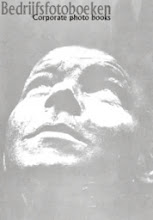
HOLLANDER, PAUL DEN / ACHTERBERG, GERRIT - Les Pyramides Du Nord
Breda, Paul den Hollander, 1992. first edition.

When we look at the photographs of Paul den Hollander, we don't see the reality of the photographs that surround us on any given day.
With Paul den Hollander's photographs, we find ourselves in the large room of the third eye.In this room stands a pyramid, and plants grow in it.Every once in a while, someone makes a fleeting appearance. In here, things are very realistic.

There are walls bearing announcements and windows, and through these windows one does not look outside but inside - back into the same room.
The windows aren't mirrors, for the difference between a mirror and the abstract reality of Paul den Hollander's room is the difference between what is seen by ordinary eyes and the third eye.
In here, the light looks at itself. Eddy Posthuma de Boer


Paul den Hollander Les Pyramides du Nord Photography


HOLLANDER, PAUL DEN / ACHTERBERG, GERRIT - Les Pyramides Du Nord
Breda, Paul den Hollander, 1992. first edition.

When we look at the photographs of Paul den Hollander, we don't see the reality of the photographs that surround us on any given day.
With Paul den Hollander's photographs, we find ourselves in the large room of the third eye.In this room stands a pyramid, and plants grow in it.Every once in a while, someone makes a fleeting appearance. In here, things are very realistic.

There are walls bearing announcements and windows, and through these windows one does not look outside but inside - back into the same room.
The windows aren't mirrors, for the difference between a mirror and the abstract reality of Paul den Hollander's room is the difference between what is seen by ordinary eyes and the third eye.
In here, the light looks at itself. Eddy Posthuma de Boer


zondag 8 februari 2009

Decline of fashion photography : an argument in pictures


Decline of fashion photography : an argument in pictures

This is an online essay taken from 'Slate' magazine, and written by Karen Lehrman. The essay uses a series of photographs taken through the ages to illustrate the changes and developments that have taken place since the 1950s in the realm of fashion photography. Lehrman questions the place of art within fashion photography, and uses several photographic examples to illustrate the different approaches used by different fashion photographers. The photographs in the essay are taken from a range of sources, including magazine editorial spreads, and adverts and catalogues. The work of several photographers are featured including Sarah Moon, Peter Lindbergh and Mario Testino. See for the slideshow ...

See for the fashion photography of William Klein, Steven Meisel, Frans Molenaar, Emmy Andriesse & Ata Kando ...

The New York Times has produced a perfect, short audio slideshow about Edward Steichen's fashion and celebrity photography. The slideshow is narrated by the exhibition curators, William A. Ewing and Todd Brandow ...

Hidden Depths : Jacques Henri Lartigue en stéréoscopie Photography

Hidden Depths :
Jacques Henri Lartigue en stéréoscopie

Une interview de Bill Hibbert


Hidden Depths

Galerie Photo: Bill, you're offering a sort of Jacques Henri Lartigue stereoscopic box – an unusual and delightful object... Who are you ? An editor ? A designer ? Where did you get the idea for such
a thing ?

Bill Hibbert : My career was in information technology so really I had no photographic background other than a general amateur interest. However after taking early retirement I began collecting photographs, acquiring a fairly haphazard collection of photographs I liked. As time passed I found the price of collectable photographs escalating beyond all reason (at least that was what I thought at the time – by comparison with current prices they seem positively cheap!), and so I switched to collecting books, almost exclusively photographic monographs.

One of my favourite photographers was Lartigue, and I accumulated perhaps 30 of his monographs. In one of them, Les autochromes de Jacques-Henri Lartigue, in an introductory interview Jacques commented that many of his early photographs had been taken in stereo and how sad he was that because of the reproduction difficulty it was impossible to show them in 3D. This chimed with me because a few months earlier I had bought a few WW I glass stereo slides and a viewer from a flea market in Brussels and been really astounded by the impact of these desolate visions of the fields of Flanders. I think it's very hard for people to understand quite how powerful a stereo transparency can be, particularly when the physical medium – in this case a tired, scratched black and white shard of glass – coincides so exactly with the bleak muddy trenches and burnt trees of the WW I killing fields.

So I resolved that the next time I was in Paris I'd go to the Association des amis de Jacques- Henri Lartigue (as it then was) and see his stereos in their original form. Of course, it was hopeless. The Association was producing its annual accounts ; everybody was feverishly busy ; and nobody had time to show an ignorant Englishman around their archives, a purpose for which they were not set up anyway. However Martine d'Astier, the directrice, kindly took the time to tell me a little about the archives, show me some prints, and arrange a time at which I could come back to talk in more detail. I returned, as I remember, a few weeks later, and was shown some of the slides, still in their original boxes, and given more information about the archives – 100,000 images, several thousand glass stereos (nobody was sure of the exact number!) in a variety of formats, 300,000 items in total.

Everybody loved the stereos, was anxious to see them published, but the technical difficulties and small probable market meant that no editor had expressed any interest in the project. A box of 12 stereos had been printed and issued in tiny quantities by the Association (Le troisième oeil), but was so expensive to produce they'd lost money on every one. As I left I remember saying that I might just possibly be interested in producing a book of the stereos... Note that at this point I knew nothing about stereo, nothing about book design, or production, or publishing or marketing, in fact of anything that might conceivably be useful in such a project. The only viewers I'd ever seen were Viewmasters as a child and the little box viewer I'd bought in Brussels, and the only 3D photographs those that went with them. Anyway, I started thinking about the design of the various components, presented some maquettes to Martine d'Astier to prove that I was at least a little bit serious, and eventually obtained permission to scan all the stereos. This I did over a period of several weeks, scanning some 5,000 glass negatives in a quasiindustrial process.


One of the 100 stereo photographs shown in Hidden Depths: on the front side, just above the image, there's a quotation by Lartigue taken from his journals ; on the back side some information about the photographer's life at the time he took the photo... an excellent work of iconography and very practical in use !


Let's talk about the contents of the box: it contains 100 stereo cards,
a book of 32 pages, and a stereoscope...

In producing Hidden Depths I was anxious that it should be a complete package – beautiful and interesting images, a great viewer, some information about Lartigue and his life, and just a little information about stereo and how it works. The biography and stereo information are in the book, and the images each have some text taken from Lartigue's memoirs, which are now out of print and not easy to find. I have tried to add some background to the story of each image on the reverse of the card, so they can be read like a book or browsed at random, as preferred. The biggest problem by far was the viewer. Originally I tried to design a collapsible viewer similar to a Holmes stereoscope, building a variety of prototypes, but the many constraints – cheap to build in large quantities, small enough to post cheaply, easy to assemble, and producing high quality images – were overwhelming, and I was on the verge of giving up when I had the brainwave of using folded polypropylene for the carcase and then the immense good fortune to find a job lot of excellent lenses on ebay at a reasonable price. Hence the current novel design, which not only meets all the requirements above but is also robust and offers a luminous shadow free image.

Did Jacques Lartigue work a great deal in 3D ?

As I mentioned above there are about 5,000 glass stereo negatives in the Lartigue archives, the vast majority in 6 x 13 format, taken between about 1905 and 1928.

Many of his most famous images were originally taken in stereo, including for example the shots of Bichonnade jumping down the stairs, Gabriel Voisin taking the first flight over French soil, and Jacques' brother Zissou posing as a ghost on the verandah of their house. This is about 5% of all the photographs Lartigue took in his lifetime, but probably nearer 25% of his published photographs, since the early ones are recycled time and time again to the almost complete exclusion of his later work.

It is clear that Lartigue held the stereos in particular affection, and I think the key to this was their ability to transport him back to the original event in a way that a flat print never could.

What criteria did you apply when you were choosing the images ? How did you make the selection ?

From the 5,000 negatives (plus a few positives whose negatives had disappeared) I scanned, I produced a long list of around 800 of the very best images and printed them off. This is a wonderful book to browse and gives a real indication of the high quality of Lartigue's photographs, but even so it could easily have been twice as long.

I have made the comment to several people that Lartigue was arguably the greatest stereo photographer ever. This claim is invariably met with a moue of scepticism, but no-one has so far managed to name another who produced so many stereos of anything like the same quality. I'm still waiting... In fact, Lartigue's work of this period is intrinsically effective in stereo. One views a stereo photograph differently from a plane image – the latter is further removed from the actual experience, so it is inevitably viewed more intellectually, while a good stereo tends to draw you into the frame – it is more immersive, more involving, more emotional, so Lartigue's relaxed, intimate style works very well in the 3D viewer.

In making the final selection, I tried to cover all of his interests – family, friends and lovers, the fashionable ladies, his sports, trips to the seaside and ski resorts, the cars and aeroplanes – and as far as possible the whole period during which he worked in stereo. I also wanted to have some famous images, for comparison with the published versions (which are often very different), and a range of new images that had never been published before. Finally I thought it was important to select images which had good depth and showed well in stereo – it would have been a wasted opportunity to show 'flat' photographs, no matter how beautiful they were.


The booklet of 30 pages : it has an introduction to the oeuvre of
Jacques Henri Lartigue and its place in the history of stereo photography,
as well as a technical introduction to the latter.

It's very nicely finished, and all the boxes are numbered – they could easily be of interest to collectors. Did you have them in mind ?

Thank you ! I anticipated from the beginning that the edition was more for collectors than for the general public, and this has proven to be the case.
Of course it's difficult to sell in a bookshop because it needs good light and quite a lot of shelf space, and also requires me to donate a viewer and some spare cards, which is not always easy to justify financially, so sadly the man in the street whom it might interest is unlikely ever to see it.

I think it's a good buy for collectors. There is a limited quantity and copies are numbered to prove that ; there will not be a reprint so it's now or never ; both the photographer and the technique of stereo are of great historical interest, although in the latter case sadly neglected by modern photographic historians ; and I think it fills quite a substantial gap in the literature.

It's also (I think!) great fun to read, and a real eye-opener for anybody interested in photography who has no experience of stereo.

You are English and your site is in English. But if a galerie-photo reader wants to buy Hidden Depths and goes to the shop on your website, in the 'Commercial' page he's going to find a French telephone number and an address in Narbonne. Are you living in France ?

Yes – we're almost neighbours! I've been installed here for over a year now, although I retain a base in the UK, and am greatly enjoying it. I've spent a great deal of my life living abroad, much of it in francophone countries, so you can imagine that I'm a francophile who adores the climate, culture, language (although I still fail to do it justice) and people of France, but I also find that simply living outside one's natural environment enriches everyday experiences wherever you are.

Of course I really wanted Hidden Depths to be at least bilingual English and French, but sadly I couldn't do the English to French translation myself and couldn't afford to pay a professional (the whole project was self-financed). However, all the original French text is available in a pdf file on my website which is at least a tiny concession to francophone sensibilities.


The stereoscope: a real little marvel of invention! The transparent walls of the self-assembled viewer allow the maximum light to fall on the view card.

You've chosen the publisher's name 'Design for Life' for your site and for the book. The viewer is superb, the presentation of the images is of great intelligence and sobriety. The whole thing is really easy to use and all for an incredibly reasonable price. This is an extremely successful and refined design. The name of the site implies there will be more items of this kind – is this correct ?

Thanks for the kind comments - developing Hidden Depths took a large part of my time over several years, and most of that was spent not on the original design, but on continual refinement. I had endless cardboard (easier to work with than polypropylene !) versions of the viewer, each a tiny bit better than the previous one, and I discovered to my cost that minuscule changes to the typography have a huge subliminal effect on the appearance and readability of text. It is a great pleasure to know that the effort was not wasted.

Curiously I originally chose the name 'Design for Life' for one of my other ventures - a furniture design company ! I ran this part-time for a year or two with a friend of mine, but although everybody loved the furniture, very few people bought it, so to my great regret the business had to be closed ; at least I was left with a very well-furnished house. However I still owned the company, Design for Life Ltd, and as it was such a generally applicable name it seemed sensible to continue to use it for the next project.

I am currently working on several further projects, two of which are associated with stereo photography. I'd rather not say too much about them at the moment, but I do think that when published they will be welcomed by the photographic community at large, and stereographers in particular. Anybody who's bought a copy of Hidden Depths from my site will get an email when anything new is released, and of course I'll keep the site updated with developments so keep watching.

Hidden Depths : Jacques Henri Lartigue en stéréoscopie Photography

Hidden Depths :
Jacques Henri Lartigue en stéréoscopie

Une interview de Bill Hibbert


Hidden Depths

Galerie Photo: Bill, you're offering a sort of Jacques Henri Lartigue stereoscopic box – an unusual and delightful object... Who are you ? An editor ? A designer ? Where did you get the idea for such
a thing ?

Bill Hibbert : My career was in information technology so really I had no photographic background other than a general amateur interest. However after taking early retirement I began collecting photographs, acquiring a fairly haphazard collection of photographs I liked. As time passed I found the price of collectable photographs escalating beyond all reason (at least that was what I thought at the time – by comparison with current prices they seem positively cheap!), and so I switched to collecting books, almost exclusively photographic monographs.

One of my favourite photographers was Lartigue, and I accumulated perhaps 30 of his monographs. In one of them, Les autochromes de Jacques-Henri Lartigue, in an introductory interview Jacques commented that many of his early photographs had been taken in stereo and how sad he was that because of the reproduction difficulty it was impossible to show them in 3D. This chimed with me because a few months earlier I had bought a few WW I glass stereo slides and a viewer from a flea market in Brussels and been really astounded by the impact of these desolate visions of the fields of Flanders. I think it's very hard for people to understand quite how powerful a stereo transparency can be, particularly when the physical medium – in this case a tired, scratched black and white shard of glass – coincides so exactly with the bleak muddy trenches and burnt trees of the WW I killing fields.

So I resolved that the next time I was in Paris I'd go to the Association des amis de Jacques- Henri Lartigue (as it then was) and see his stereos in their original form. Of course, it was hopeless. The Association was producing its annual accounts ; everybody was feverishly busy ; and nobody had time to show an ignorant Englishman around their archives, a purpose for which they were not set up anyway. However Martine d'Astier, the directrice, kindly took the time to tell me a little about the archives, show me some prints, and arrange a time at which I could come back to talk in more detail. I returned, as I remember, a few weeks later, and was shown some of the slides, still in their original boxes, and given more information about the archives – 100,000 images, several thousand glass stereos (nobody was sure of the exact number!) in a variety of formats, 300,000 items in total.

Everybody loved the stereos, was anxious to see them published, but the technical difficulties and small probable market meant that no editor had expressed any interest in the project. A box of 12 stereos had been printed and issued in tiny quantities by the Association (Le troisième oeil), but was so expensive to produce they'd lost money on every one. As I left I remember saying that I might just possibly be interested in producing a book of the stereos... Note that at this point I knew nothing about stereo, nothing about book design, or production, or publishing or marketing, in fact of anything that might conceivably be useful in such a project. The only viewers I'd ever seen were Viewmasters as a child and the little box viewer I'd bought in Brussels, and the only 3D photographs those that went with them. Anyway, I started thinking about the design of the various components, presented some maquettes to Martine d'Astier to prove that I was at least a little bit serious, and eventually obtained permission to scan all the stereos. This I did over a period of several weeks, scanning some 5,000 glass negatives in a quasiindustrial process.


One of the 100 stereo photographs shown in Hidden Depths: on the front side, just above the image, there's a quotation by Lartigue taken from his journals ; on the back side some information about the photographer's life at the time he took the photo... an excellent work of iconography and very practical in use !


Let's talk about the contents of the box: it contains 100 stereo cards,
a book of 32 pages, and a stereoscope...

In producing Hidden Depths I was anxious that it should be a complete package – beautiful and interesting images, a great viewer, some information about Lartigue and his life, and just a little information about stereo and how it works. The biography and stereo information are in the book, and the images each have some text taken from Lartigue's memoirs, which are now out of print and not easy to find. I have tried to add some background to the story of each image on the reverse of the card, so they can be read like a book or browsed at random, as preferred. The biggest problem by far was the viewer. Originally I tried to design a collapsible viewer similar to a Holmes stereoscope, building a variety of prototypes, but the many constraints – cheap to build in large quantities, small enough to post cheaply, easy to assemble, and producing high quality images – were overwhelming, and I was on the verge of giving up when I had the brainwave of using folded polypropylene for the carcase and then the immense good fortune to find a job lot of excellent lenses on ebay at a reasonable price. Hence the current novel design, which not only meets all the requirements above but is also robust and offers a luminous shadow free image.

Did Jacques Lartigue work a great deal in 3D ?

As I mentioned above there are about 5,000 glass stereo negatives in the Lartigue archives, the vast majority in 6 x 13 format, taken between about 1905 and 1928.

Many of his most famous images were originally taken in stereo, including for example the shots of Bichonnade jumping down the stairs, Gabriel Voisin taking the first flight over French soil, and Jacques' brother Zissou posing as a ghost on the verandah of their house. This is about 5% of all the photographs Lartigue took in his lifetime, but probably nearer 25% of his published photographs, since the early ones are recycled time and time again to the almost complete exclusion of his later work.

It is clear that Lartigue held the stereos in particular affection, and I think the key to this was their ability to transport him back to the original event in a way that a flat print never could.

What criteria did you apply when you were choosing the images ? How did you make the selection ?

From the 5,000 negatives (plus a few positives whose negatives had disappeared) I scanned, I produced a long list of around 800 of the very best images and printed them off. This is a wonderful book to browse and gives a real indication of the high quality of Lartigue's photographs, but even so it could easily have been twice as long.

I have made the comment to several people that Lartigue was arguably the greatest stereo photographer ever. This claim is invariably met with a moue of scepticism, but no-one has so far managed to name another who produced so many stereos of anything like the same quality. I'm still waiting... In fact, Lartigue's work of this period is intrinsically effective in stereo. One views a stereo photograph differently from a plane image – the latter is further removed from the actual experience, so it is inevitably viewed more intellectually, while a good stereo tends to draw you into the frame – it is more immersive, more involving, more emotional, so Lartigue's relaxed, intimate style works very well in the 3D viewer.

In making the final selection, I tried to cover all of his interests – family, friends and lovers, the fashionable ladies, his sports, trips to the seaside and ski resorts, the cars and aeroplanes – and as far as possible the whole period during which he worked in stereo. I also wanted to have some famous images, for comparison with the published versions (which are often very different), and a range of new images that had never been published before. Finally I thought it was important to select images which had good depth and showed well in stereo – it would have been a wasted opportunity to show 'flat' photographs, no matter how beautiful they were.


The booklet of 30 pages : it has an introduction to the oeuvre of
Jacques Henri Lartigue and its place in the history of stereo photography,
as well as a technical introduction to the latter.

It's very nicely finished, and all the boxes are numbered – they could easily be of interest to collectors. Did you have them in mind ?

Thank you ! I anticipated from the beginning that the edition was more for collectors than for the general public, and this has proven to be the case.
Of course it's difficult to sell in a bookshop because it needs good light and quite a lot of shelf space, and also requires me to donate a viewer and some spare cards, which is not always easy to justify financially, so sadly the man in the street whom it might interest is unlikely ever to see it.

I think it's a good buy for collectors. There is a limited quantity and copies are numbered to prove that ; there will not be a reprint so it's now or never ; both the photographer and the technique of stereo are of great historical interest, although in the latter case sadly neglected by modern photographic historians ; and I think it fills quite a substantial gap in the literature.

It's also (I think!) great fun to read, and a real eye-opener for anybody interested in photography who has no experience of stereo.

You are English and your site is in English. But if a galerie-photo reader wants to buy Hidden Depths and goes to the shop on your website, in the 'Commercial' page he's going to find a French telephone number and an address in Narbonne. Are you living in France ?

Yes – we're almost neighbours! I've been installed here for over a year now, although I retain a base in the UK, and am greatly enjoying it. I've spent a great deal of my life living abroad, much of it in francophone countries, so you can imagine that I'm a francophile who adores the climate, culture, language (although I still fail to do it justice) and people of France, but I also find that simply living outside one's natural environment enriches everyday experiences wherever you are.

Of course I really wanted Hidden Depths to be at least bilingual English and French, but sadly I couldn't do the English to French translation myself and couldn't afford to pay a professional (the whole project was self-financed). However, all the original French text is available in a pdf file on my website which is at least a tiny concession to francophone sensibilities.


The stereoscope: a real little marvel of invention! The transparent walls of the self-assembled viewer allow the maximum light to fall on the view card.

You've chosen the publisher's name 'Design for Life' for your site and for the book. The viewer is superb, the presentation of the images is of great intelligence and sobriety. The whole thing is really easy to use and all for an incredibly reasonable price. This is an extremely successful and refined design. The name of the site implies there will be more items of this kind – is this correct ?

Thanks for the kind comments - developing Hidden Depths took a large part of my time over several years, and most of that was spent not on the original design, but on continual refinement. I had endless cardboard (easier to work with than polypropylene !) versions of the viewer, each a tiny bit better than the previous one, and I discovered to my cost that minuscule changes to the typography have a huge subliminal effect on the appearance and readability of text. It is a great pleasure to know that the effort was not wasted.

Curiously I originally chose the name 'Design for Life' for one of my other ventures - a furniture design company ! I ran this part-time for a year or two with a friend of mine, but although everybody loved the furniture, very few people bought it, so to my great regret the business had to be closed ; at least I was left with a very well-furnished house. However I still owned the company, Design for Life Ltd, and as it was such a generally applicable name it seemed sensible to continue to use it for the next project.

I am currently working on several further projects, two of which are associated with stereo photography. I'd rather not say too much about them at the moment, but I do think that when published they will be welcomed by the photographic community at large, and stereographers in particular. Anybody who's bought a copy of Hidden Depths from my site will get an email when anything new is released, and of course I'll keep the site updated with developments so keep watching.

donderdag 5 februari 2009

50 Favourite Photo Sites, Articles and News of 2008 Photography

Our 50 Favourite Photo Sites, Articles and News of 2008

Posted Thursday, 5 February 2009 by Lars Hasvoll Bakke, Gudmund Aarseth and Josh Hodge in Photography, Inspiration

No, we didn't check out every photo posted, every blog post written, every announcement made, this is just our favourite blog posts, galleries and news pieces picked among the stuff we've come across during the last year.

Tutorials and learning
Photopreneur A blog focused on where a potential photo professional can find a market, and how to break into it.
Cambridge in colour tutorialsA bunch of excellent tutorials on understanding essential camera technology and photographic physics, as well as tutorials on the most important topics and techniques with regards to post-processing.
HDR tutorials roundupA great guide to the best places to go for learning about HDR (High Dynamic Range) photography.
Digital Photography SchoolHighly active website which combines a blog and a photo community. Blog posts are sorted into three broad categories, photography tips, equipment and post-production. Somewhat unusually for a photography website, it's well designed and good looking.
DIYPhotography.netAs the name suggests, here's a do-it-yourself approach to photography gear in particular, and other related topics. Many excellent, practical tips on building your own equipment.

General photography
StrobistA very popular blog on working with one of the most important aspects of photography, light, or to be more precise, lighting. Sprinkled with more general advice, such as not taking time of work in the week between Christmas and New Year, because nothing gets done anyway, so you can just sit back and relax, and get paid doing it.
RED Epic and Scarlet camerasNewbie (but hardly amateur) movie camera producer RED is apparently branching into professional still photography with the announcement of their Scarlet and Epic camera systems. The site linked to above is confusing to say the least, so check out the
Luminous Landscape's article for a more down-to-the ground explanation on what this is all about. The essence: RED is working on two highly modular camera systems, which promises changes to the concept of high-end photography equipment hardly seen in the past. If these camera systems do in fact materialize (which may happen during 2009), they may force the established camera producers to think long and hard about how they design their camera systems.
Of audiences and best sellersLuminous Landscape article discussing the need of an audience for ones photography, how to find it, how to please it, and how to not bore yourself to death doing it.
Do sensors "out-resolve" lenses?Written by a curious combination of an economist and a fashion photographer, this lengthy and somewhat technical article, revolving around the question of whether the resolution in today's SLR sensors is getting so high that the lenses, not the sensors are now the bottle-necks with regards to technical qualities. Some of us here at Crestock had assumed that this point was long past, but apparently not. Before embarking on this article, be warned, the end conclusion is not a simple, satisfying yes/no answer.
PhotocriticThere's a lot of learning to be done here, much of which is focussed on the technical/practical part of photography, though not in a schematic, scientific way like the Luminous Landscape article above. There are articles on the (equipment) history of photography, dynamic range, buying equipment abroad, but also coverage of more artistic subjects.
Best Photo Books of 2008Magnum photographers Alec Soth and Martin Parr has compiled lists of their favourite photo books of 2008, to be found in Magnum's blog.
MotherlandPromotion website for the photo book "Motherland" by Simon Roberts, shot all over Russia during 2004 and 2005. The nice thing with this site is that there's a fair few sample photos from the book to checkout. From the vast Siberian taiga and the Altai mountains to hydroelectric plants, decaying tenement blocks and teenagers in Tomsk, the book seems to have a bit of everything. On our wish list!
Love me TurkmenistanLens culture's short review of a photo book published in 2008 about one of the world's most bizarre dictators through the ages, Saparmurat Nyazov of Turkmenistan. Lars eagerly followed Nyazov's career up until his death in late 2006, and once won a rather nice Manchester City team jersey for being able to spell his name. The book covers the personality Nyazov, and the results of the cult-of-personality which he set up around himself. If the few sample photos here don't convince you, do some quick reading about him, and you might be convinced that a photo book about the guy has a lot of merit. Another definite placement on the wish list!

Photo blogs, galleries and exhibits
Jamie Livingston's "A photo a day" projectJamie Livingston took a polaroid photo (almost) every day from 1979 until his death in 1997. The entire collection was later scanned and put online by two of his friends, as a public exhibit and memorial to his life. The collection consists of 6697 polaroids, and is one of the most singularly amazing photographic websites we've ever seen. For a short primer on this project, check out the mental_floss blog's coverage of it.
The Magnum blogNot new for 2008, but it deserves mention and a recommendation. Magnum is pretty much the most glamourous it gets in the realm of photo agencies, and so, they've got their fair share of skilled photographers. Even if you skip all their writings, just browsing the blog every now and then for their photos is interesting enough.
Keith Yahrling - American consumerismUsing a large format camera, Keith has photographed something as simple as store isles, shelves, clothing racks and other manifestations of consumer culture. With lots of colours mashed together in a sort of organized chaos, it's more interesting than it might sound.
A photography blog.Frequently updated blog by New York photographer Rachel Hulin. The main focus seems to be on professional photographers, and most importantly in my mind, the presentation of a lot of great photos by said photographers in the blog, in a proper size!
Asian Photography BlogWhile the claim to being an "exploration of Asian photography and what it means to the world" may be a bit ambitious, this blog does indeed seem to cover a whole lot of Asia, not just the south-eastern portion where Yaohong (the blogger) lives. Further, it does so well, with big,interesting photos and good commentary presented in a clean and very suitable blog format.
Zarias.comPersonal photo blog of professional photographer Zack Arias. Aside from the sometimes amazing photos he turns out, there's also concrete information on how the various shoots where set up, equipment-wise.
BAGnewsNotesAccording to its own statement, BAGnews is "dedicated to visual politics, the analysis of news images and the support of 'concerned' photojournalism". The visual approach is important to us here at Crestock, to put it mildly, so naturally, this is a way of covering the news which we can appreciate. Mainly focused on the United States.
FlakPhotoSeemingly focused on promoting the work of little known, yet highly skilled professional (and possibly some amateur) photographers, our favourite feature on the site is their huge thumbnail gallery, filled with goodness of all sorts from the different photographers that submit their work to the site.
NickOnken shop talkCalls itself "a blog for fellow photographers", and that's about as specific as you can get about this blog. Good looking blog covering a lot of subjects within photography, mostly focused towards people doing it for a living, which should mean it's also of interest to the hordes of people dreaming of doing it for a living.
detroitblogFascinating, well researched and utterly rock solid photo documentary blog about Detroit. Focused on urban decay in Detroit, but also looks at the lives of ordinary people living in between it all.
50 strange buildings of the worldThe title pretty much sums it up, 50 weird and wonderful buildings from Pyongyang to Pennsylvania.
Verve PhotoBlog focused on promoting great photo documentary work from around the world.
[daily dose of imagery]Toronto resident Sam Javanrouh posts one big, solid photo per day in his photo blog. Pure, simple and sweet.Luan.comAnother great photo blog along the same lines as the above..
ChromasiaFrequently updated photo blog. No captions, just good photography.
Gaza strip fighting photosOutstanding photo collection from the recent Gaza strip fighting. Most, if not all are taken from outside of Gaza, but they're nevertheless highly dramatic and evocative.
Cool Photo blogsA simple website listing and ranking a whole host of interesting photo blogs. For a quick fix, check out their "Top Contributors" list.

Miscellaneous
Lomo shopBehold the power of gadgetry! While there's really nothing new about the whole Lomo industry, it had been a few years since any of us looked in on the official shop of the so-called Lomographic Society International, only to be amazed by the sheer amount of ludicrous gadgets they're pushing. An excellent, and rather funny case study in how one can create a demand that didn't exist beforehand.
The Intrepid Art Collector blogAs the title suggests, this blog revolves around buying art, photographic art to be specific. Written by professional art(collecting) adviser Lisa Hunter, it features tips on great bargains,interviews with photographers,
We Heart ItThere's been a fair bit of fuss about the image bookmarking thingy FFFFOUND! recently. It's invitation only, and since none of us have bothered with putting an effort into getting an invite, we never really got into it. Someone mentioned We heart it as a non-invite alternative, so we checked it out. It sounded a bit like a cheapo rip-off, but as it turned out, it seems to be genuine enough. Registration takes roughly ten seconds, after which you can either download their bookmarklet and start bookmarking images you've found on the web to your "heart" (your favourites), or you could browse images recently submitted by others and "heart" them if you'd like. To begin with, we chose the latter option, and found that the average We Heart It user probably owns a Lomo or a Holgo, at least three sets of silly, "ironic" eyewear and a lot of striped clothing. Not that there's anything wrong with that.
Flash vs. no flashAn amazing illustration of the difference between photos with flash and without. Har har. Picked up on Digg.

Best of 2008 photo galleries
The Big Picture - The year 2008 in photographsWonderful photo blog presenting big, outstanding photos of current events, primarily licensed from the big news agencies. The link goes to their 2008 summary, but you'll also find the link to the continuously updated main site of The Big Picture. Highly recommended!
Nikon Small World 2008The winners and runners of 2008's Nikon Small World contest. Bright, otherworldly photos of various tiny, exotic creatures and substances, such as diatom algae, nanotubes and cancer medicine.
DPChallenge - Best of 2008 Popular photo contest website DPChallenge set up a challenge specifically to find the best photos of 2008 shot by site members. The resulting top 500 has the makings of a few hours of intense, high quality photo browsing.After a non-exhaustive browse of the photo challenges run at DPChallenge during 2008, here are our favourites:
- Movie titlesUNICEF
Photos of the year 2008The UN Children's fund (UNICEF) is all about children, so too their annual photo contest. This year's winning photo was taken in a slum in Port-au-Prince, Haiti, by a 21 year old belgian woman. To see larger versions of the same photos, but with less informative captions, check out the same photos at Der Spiegel (gallery link at the bottom).
New York Times 2008 in picturesWith the New York Times being a big newspaper, they can afford to, and do buy loads of excellent, powerful editorial photos from the various agencies around the world. So when they compile their favourites from any given year, you can expect good stuff.
Der Spiegel 2008 in photosThis gallery by premier German news magazine Der Spiegel is the same basic concept as with the New York Times above, but with a distinctly global outlook.
Telegraph.co.uk pictures of the yearFrom the silly, via the spectacular, to the heart-rending, these excellent photo galleries has a bit of everything in the way of editorial photography, all in the quality you'd expect from the Telegraph:
Most spectacular- Our favourite:
Fireworks at the opening of The Palm, Dubai (check the scale!)

Wildlife - Our favourite:
Saxophone-playing walrus (I HAS SAX0PHONE!)

Funnies - Our favourites:
Sunbathers watch Russian marines training for Navy DayA baby cries as an amateur sumo wrestler tries to scare her

Weather - Our favourites:
Men play with snow in after a rare heavy snowstorm in Amman, JordanMammatus clouds hang over St AlbansDramatic cloud formation over Inglefield Bay, Northwest Greenland

Natural disasters - Our favourites:
Aid is dropped over the earthquake-hit QingchuanFish remain stuck in a fence on September 15 as flood waters recede

War and violent conflict - Our favourites:
Weapons seized by Iraqi security forcesA US Marine has a close call after Taliban fighters open fireMasai warriors with bows and arrows clash with members of the Kalenjin tribe