donderdag 19 april 2012

Real Fear Interrogation Donald Weber World Press Photo Photography


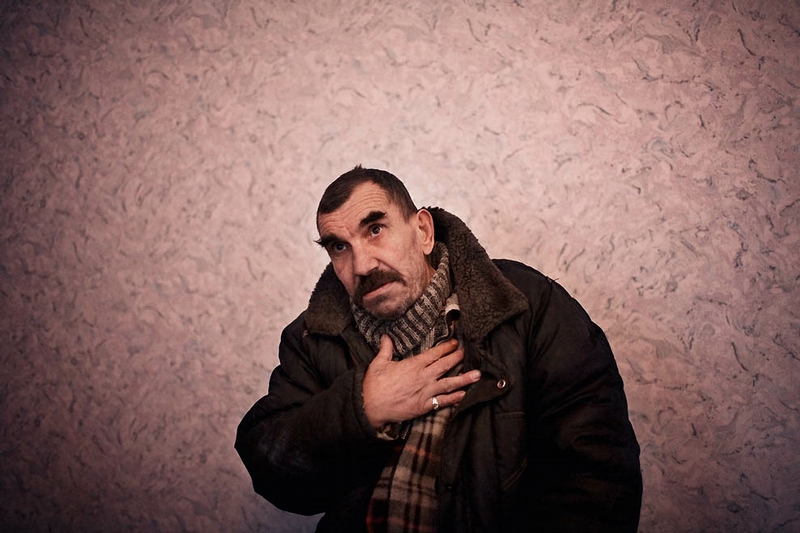
“Moron”.
In English, the word ‘interrogation’ has no negative coloring. It has one in Russian though. Donald Weber who had traveled in the post-Soviet countries a lot caught the concept of this word by collecting photo reports about interrogations, and published a book called Interrogation. The author claims that the book is not about Russia or Ukraine. He says it is about primitivism and cruelty inherent in all modern countries in general, including those claiming themselves to be 100% democratic. Their citizens, according to Weber, are aware of their own powerlessness when faced the law. Their fear fades away only when the trial proceedings are over and they are found not guilty.

One of the photographs by Doland Weber became a prize-winner in the photographic competition World Press Photo 2012. (Donald Weber—VII). See for a review ...

DONALD WEBER

photographer, Canada

Prior to taking up photography, Donald Weber trained as an architect, and worked at urban theorist Rem Koolhaas’s Office for Metropolitan Architecture in Rotterdam, the Netherlands. He freelanced for the international press in places as diverse as Africa, Eastern Europe, Russia, and South America, before involving himself in a personal project that focuses on how power deploys an all-encompassing theater for its subjects, in which he aims to record the collaboration of power with both masters and victims.
Weber’s recent major projects include The Underclass and Its Bosses: Crime & Punishment in Ukraine; The Drunken Bride, Russia Unveiled; Bastard Eden, Our Chernobyl, which won the Photolucida Book Award, and City of Cities, examining the future city of 2050. His first book, Bastard Eden, Our Chernobyl was published in 2008.Interrogations, about post-Soviet authority in Ukraine and Russia, will be published in 2012.
Weber’s work has appeared in numerous international publications including Amica, Der Speigel, The Guardian, Newsweek, The New York Times, The New York Times Magazine,Rolling Stone, Stern, Time, and The Walrus. He has worked with the NGOs Médecins sans Frontières, the United States Holocaust Memorial Museum, and War Child. His photography projects have been exhibited at festivals and galleries worldwide, including at the United Nations, the Musée de l’Armée, Les Invalides, Paris, the Portland Museum of Art, and the Alice Austen House Museum in New York. His photographs are in the permanent collection of the Portland Museum of Art, and the Museum of Memory and Tolerance in Mexico City.
Weber is the recipient of the Lange Taylor Documentary Prize, a Guggenheim Fellowship, the Chalmers Fellowship, and a previous World Press Photo award, amongst others. Further accolades include a Duke and Duchess of York Photography Prize, being listed inPDN’s 30, and named an Emerging Photo Pioneer by American Photo.


woensdag 11 april 2012

Using herself as a model Francesca Woodman Photography

Francesca Woodman, Polka Dots, November 1976

American photographer Francesca Woodman created a beguiling and important body of work during her short nine-year career. Working primarily with black-and-white photography, she mined some of the same themes as photographers as stylistically diverse as Ralph Eugene Meatyard (loss and the passage of time) and Cindy Sherman (self-presentation and role-playing). Woodman usually used herself as a model, contorting her body and exploring her relationship to her surroundings, often seeming to merge with them.  A recent acquisition, this rare vintage print is part of a series she made wearing a polka dot dress while a student at the Rhode Island School of Design; Woodman printed it at the time and gave it to a friend. Read for more ...


Documentaire Nadat de talentvolle Amerikaanse fotografe Sarah Woodman op 22-jarige leeftijd zelfmoord pleegde, kostte het haar ouders en broer - eveneens kunstenaars - jaren om in het reine te komen met haar dood.

Stille foto's van dode dochter

Zien

Marianne Vermeijden
artikel artikel | Dinsdag 10-04-2012 | Sectie: Media | Pagina: NH_NL02_034 | Marianne Vermeijden
De Amerikaanse fotografe Francesca Woodman (1958-1981) liet honderden zwart wit-opnamen na, veelal gemaakt in lege, aangetaste binnenruimten. De fotografe voert zichzelf onherkenbaar of nauwelijks zichtbaar op. Haar foto's roepen associaties op met verdwijning, afscheid en dood. Het meisje dat achter een schoorsteenmantel wegkruipt of dat zichzelf in de duisternis een engel waant was steeds Francesca Woodman. Met een sprong uit een New Yorks raam zou ze, 22 jaar oud, een eind aan haar leven maken. Haar werk leeft voort, Guggenheim New York toont een groot retrospectief.
Hoe kwam Francesca als dertienjarig meisje tot haar zelfportretten? Waarom pleegde ze zelfmoord? En lag de dood in haar werk besloten?
De documentaire The Woodmans uit 2010, vanavond te zien in Close up, probeert antwoorden te geven. Aan het woord komen onder meer Francesca's ouders, beiden kunstenaars. Eerder zeiden Betty en George Woodman in deze krant niet te geloven in een aangekondigde dood. George: Mensen denken dat Francesca in die foto's een geïsoleerde werkelijkheid verbeeldde. Maar wat we zien is een zeer bewust gemanipuleerde werkelijkheid, een vorm van theater, zoals je het leven ook als absurd theater kan zien. Betty: Ik kan niet bepalen wat anderen in het haar werk moeten lezen. Maar neemt u van mij aan, het gaat niet over de dood. Er zijn zoveel andere interpretaties mogelijk. Vaak reageren toeschouwers te emotioneel.
Marianne Vermeijden
Info: Close up: Francesca WoodmanNed. 2, 23.00 - 00.00 uur
Foto-onderschrift: De ouders van Francesca Woodman spreken over haar foto's en leven.
Op dit artikel rust auteursrecht van NRC Handelsblad BV, respectievelijk van de oorspronkelijke auteur.

Al bijna uit beeld

Te erg voor woorden: Francesca Woodman: Photographs

marianne vermeijden
Recensie Recensie | Vrijdag 23-12-2005 | Sectie: Boeken | Pagina: 30 | Marianne Vermeijden

Er bestaan genoeg foto`s die ik liever nooit gezien had. Foto`s die als `haunting images` mijn geest hebben vervuild. Ze onthullen bijvoorbeeld hoe mensen iets uitspoken met elkaar waar je in je meest kwaadaardige fantasieën niet op zou zijn gekomen. Zo publiceerde Reuters in het fotoboek The Art of Seeing (2000) de opname van een Haitiaanse man die uitzinnig van genot flarden van een ander (geroosterd) mens op straat staat op te eten. Goed, men at elkaar tijdens de stalinistische hongersnoden ook op, maar dan niet met het perverse plezier waarmee deze man dat publiekelijk deed.

Zoals ik met die Haitiaan zit opgescheept, zo zal ik me ook levenslang de foto`s van Francesca Woodman herinneren. Fragmenten van een fatale nachtmerrie die juist helemaal géén horror laten zien, maar wel laten voelen hoe iemand innerlijk de weg is kwijt geraakt en dan beelden componeert die misleidend mooi illustreren hoe je naar de afgrond wankelt.
Woodman - donkerblond, knap en net twintig - portretteerde zichzelf voortdurend in zwartwitfoto`s - als engel, als fossiel, als schaduw, als lichtflits. Dat deed ze scherp, doordacht en neutraal, alsof ze zich als een object had overgegeven aan de veeleisende choreograaf die ze zelf was. Aha, ze zocht dus naar haar identiteit, zoals dat tegenwoordig tot vervelens toe wordt genoemd. Welnee, vergeet dat gesjoemel met het begrip identiteit, dat zo`n aardige vluchtheuvel biedt om zaken te simplificeren en het in wezen nergens over te hebben. Woodman nam met die foto`s afscheid van dit leven, ze gebruikte haar camera om te verkennen hoe het zou zijn om er niet meer te zijn. Ze is op haar beelden fysiek bijna al om de hoek verdwenen, ze sluipt in hetzelfde antracietgrijs van omringende muren het beeld uit, ze verstopt zich als een klein meisje achter het afgescheurde behang en ze beitelt delen van haar lichaam uit de stenen vloer van haar atelier, zodat er tenminste iets blijvends zou achterblijven, én een schrijnende foto.
Op een dag in 1981 was Woodman er inderdaad niet meer. Uit een raam gesprongen, in New York, 22 jaar oud. Waarom? Om een liefde, zo lieten haar ouders doorschemeren, want zo radicaal en kortzichtig kunnen dochters en zonen op die leeftijd zijn. Haar ouders waren bij een tentoonstelling van het nagelaten werk van hun dochter in de Kunsthal in Rotterdam. Beiden waren kunstenaar, en beiden hadden nooit ook maar een zweem van de dood in het werk van hun Francesca waargenomen, vertelden ze. Ze begrepen ook niet hoe anderen dat morbide reisplan wél doorzagen. Francesca was toch altijd vrolijk, had toch veel vrienden gehad. Ons gesprek viel stil. En toen die stilte te zwaar werd, zijn we maar over de schoonheid van haar foto`s begonnen.
Misleidend mooi wankelt de fotografe langs de afgrond
Info: Francesca Woodman: Photographs. Catalogus Fondation Cartier pour l`art contemporain
Trefwoord: Fotografie
Persoon: Francesca Woodman
Op dit artikel rust auteursrecht van NRC Handelsblad BV, respectievelijk van de oorspronkelijke auteur.


Francesca Woodman "Untitled, Providence, Rhode Island, 1976,"

zondag 8 april 2012

Interiors of working-class homes and workplaces across America in the late 1960s and early 1970s Chauncey Hare Protest Photographs Photography

Kitchen, Kensington, California

Chauncey Hare made highly detailed photographs of the interiors of working-class homes and workplaces across America in the late 1960s and early 1970s. This new book contains twice as many moving, disturbing and often surprising photographs as have appeared in his two earlier books, Interior America (1977) and This Was Corporate America (1984).

Hare's fast-paced introduction to the book highlights his life of protest, a life filled with unbelievable coincidences, learning, and pain. He describes his strong identification with the people whose homes he photographs and his adamant unwillingness to betray them by selling their photographs at any price. He tells of his struggles to have his photographs, accompanied by explanatory text, accepted by the art world. He relates the abusive situations he has endured in his childhood, and in his work life as an engineer at a major oil company and at the U.S. Environmental Protection Agency.


Chauncey Hare - Protest Photographs - A review 
by stefan thorvaldsson

Yesterday I got Chauncey Hare´s "Protest photographs" from Amazon. It´s a staggering work of strange genius. The story behind it is very odd. He was a succesful engineer at Standard Oil and in his spare time he took pictures good enough to get three Guggenheim grants. He completed the projects made with these grants and the work was shown in MOMA and published by Aperture. One would have thought the world was his oyster. But instead everything turned sour, he quit his job, tried unsuccessfully to establish himself as a teacher of photography and finally quit photography totally. He was on the verge of destroying all his work but at the last minute he donated it all to the Bancroft Library, the only place that would accept his strict conditions regarding the use of the work. From that this book arose, a strange monument to the life work of this troubled man.

The book starts off with chapters written by his partner and then a longish chapter written by Mr. Hare himself, describing the story of his life and of the work that appears. He describes how he had his epiphany when invited into the house of an old worker with work-related lung disease. He got to photograph this man and his subsequent work revolved around photographing working people in their homes. He began to see the corporate world as profoundly unjust and autocratic. He obviously became a difficult man and successively burnt his bridges behind him. He ended up as a licensed psychotherapist dealing in work related issues, publishing a book on work abuse with his partner.


After having read these introductions the pictures come as a complete surprise. The reality that they describe is very mundane, mostly poor working people posing for the camera in their poorly furnished homes. Later in the book some photos appear from the offices of Standard Oil and some street scenes as well. But there is something strange about all these photos and if I hadn´t read the introductions I would have thought that this man was a big irony merchant and perhaps even cruel and heartless, because he exposes these people to a harsh unfavorable flash coming from the side, casting odd heavy shadows and laying bare their pathetic attempts to decorate their modest surroundings with cheap and tawdry pictures, knick knacks and random artifacts. He does this with a wide angle lens and he describes how he included much more in his pictures than his subjects would have been aware of. This also means that often big pieces of the floors and the ceilings are included to strange effect. In some pictures this creates the effect of cramping the space while in others the rooms appear oddly cavernous. One particularly strange picture (page 137) shows African Americans, a mother and daughter probably, weirdly isolated in a psychedelically patterned sofa in a huge living room while an arm juts into the frame from the right side, possibly the family father giving directions. One sometimes gets the same feeling as when looking at Lee Friedlanders photos, full of improbable detail and curious juxtapositions. The TV has a prominent role as have religious pictures and wall hangings, particularly the Last Supper. On page 169 we see an unusually ordinary living room, tidy and abandoned. But again we´re disturbed by the details. A rocking horse juts into the picture from the right. Not so strange. By the sofa on the left there are some rolled up socks and a pair of shoes, not so tidy. On the sofa table a model house which fits questionably with the rest of the decor. Again a little unusual but not so strange. Finally the eye wanders to the TV set in the corner which is turned on. We see two blurry figures and above them the text: "Live Color TV from the moon". Very strange.


But any feeling of Mr. Hare cruelly using these people to his own artistic ends are blown away by the strict conditions he put on the use of these pictures. He adamantly refused to sell them or having them displayed as art in galleries as that would have been a betrayal of the trust the subjects showed him when they let him into his home. This totally isolated him from the art world and his name soon fell into oblivion. One would have thought that the appearance of this book meant some kind of happy ending and belated recognition but it is apparent that Mr. Hare is not a man that feels good about himself but suffers from crippling anxiety. A sad ending to a strange story.

All in all a very moving book, both because of the content and because of the sad story of the photographer.


In 1977, after twenty-one years of employment, Chauncey Hare left his engineering job at Standard Oil Company of California in Richmond. He claimed that toward the end of his time there, his aversion and anger to the inhuman side of the competitive engineering world triggered attacks of nausea and vomiting. Having been a photographer for more than twenty years, he decided to pursue a master’s degree in fine art. From 1976–78, he photographed California workers at the Social Security Administration offices, in the electronics industry, and at Standard Oil; he published those images in the volume This Was Corporate America in 1984, dedicated to those “who are awakening to their own inner-authority.”

donderdag 5 april 2012

Interieurs pictures of social housing François Hers Sophie Ristelhueber Photography


Sophie Ristelhueber

Since the early 1980s, Sophie Ristelhueber has been building up a body of powerful yet restrained images that take an allusive approach to the complex realities of the contemporary world. She has extended this rigorous practice into other media, always working with great economy of means, making films and videos, sound pieces and installations. For exhibitions, she often enlarges her photographs to “tableau” or “painting” size, and sometimes sticks them directly on the wall like posters. She has published a dozen artist’s books, which she designs (layout, size, choice of texts) with the same care as her exhibitions.
In Fatigues, made for what is her first solo exhibition in France, she films her own images and confirms the experimental dimension of her work. This exploration of her photography in its dialogue with the exhibition context continues throughout the Jeu de Paume as she mixes formats, media and series, making the most of the natural lighting and the views of the Tuileries gardens.

Intérieurs

Bruxelles: Archives d'Architecture Moderne (1981). First Edition. Oblong quarto. The first book by photographer Sophie Ristelhueber, a collaboration with future husband François Hers, for which she was supposed to write only text, but unable to find words she picked up a camera instead. The first section, photographed by Hers, consists of color images of the interiors of homes with no people; the second section, Ristelhueber's, is comprised of black and white images of the inhabitants of these interiors. Preface by Jean-François Chevrier. Text by René Schoonbrodt. Near fine in photo-illustrated wrappers with integral French flaps. 


Born in Paris in 1949, Sophie Ristelhueber studied literature at the Sorbonne and École Pratique des Hautes Études in the early 1970s and went on to work in publishing and the press. Looking for a new direction, in 1979 she was commissioned by Belgian artist François Hers to write a text for his colour photographs of social housing, which he titled Intérieurs (1981). In the end, she did not write the text but instead made her own black-and-white photographs of the inhabitants. In 1980 she made a film, San Clemente, with Raymond Depardon, which was released in 1982. Also that year, she went out to Beirut and brought back a series of images that were radically different from the kind of photojournalism seen in the media.


Sophie Ristelhueber from Laure Vermeersch on Vimeo.

Photographic diary 


Beyrouth, Photographies, 1984
Empty structures, façades shattered by bullets and shells, and no human presence: far from the pathos and spectacle of war, this series in black-and-white simply records effects and, by linking war ruins to ancient vestiges, makes the ravaged city seem timeless. In 1984 a book of these photographs, with a text by Lucretius from De Rerum Natura, was published by Hazan in Paris and Thames & Hudson in London, provoking strong reactions. This would be the case with several of her emblematic series, in which the medium does not evacuate but mediates the lived reality.

Vulaines, 1989
Chosen from set of even, these three diptychs each combine a recent colour photograph of the artist’s family home, taken from a child’s vantage point, with an enlarged detail of a black-and-white photograph from a family photograph album. The temporal, spatial, technical and formal differences between these images manifest and evoke both the interplay between different periods of time and the construction of memory.


Fait, 1992
During the 1991 Gulf War, Sophie Ristelhueber was intrigued by an aerial photograph of the Kuwaiti desert published in Time Magazine and decided to do a piece of work that would dispense with all notion of scale or difference between the macroscopic and the microscopic. In October that year she travelled over the Kuwaiti desert on foot and by plane, then spent several months selecting 71 images from her many photographs to go into a paperback book and an exhibition of large-format prints. These ephemeral traces of the war on the desert surface bring to mind scars on the body but also the abstraction of Dust Breeding by Man Ray and Marcel Duchamp, which is a seminal image for Ristelhueber.


Every One, # 8 et # 141994 
In July 1991, Sophie Ristelhueber travelled to Yugoslavia with writer Jean Rolin. However, she did not come back with photographs of the fighting between Serbs and Croats; instead, two years later, and after much thought, she started work on Every One in a Parisian hospital. Also published in book form, these giant format photographs of bodies bearing their recent stitches, which seem to have no direct link with war, become an allegory.

L’air est à tout le monde I, 1997
“The air belongs to everyone” is a phrase from a game played by Ristelhueber as a child, which she has broken down into 19 small frames, each one containing a letter from the title. Also under this title, the artist has created three different installations [2000-2002], each one consisting of a large-format image installed in the corner of the exhibition space, accompanied by a sound recording made when the photograph was taken.

1999, 1999
To make this very humorous sound (sound, 1’12”) piece, the artist asked an auctioneer in New York State to put the year 1999 up for sale in his customary singsong voice.

La Liste, 2000 
In spring 2000, when asked by the Hôtel des Arts in Toulon to produce a work about the department of Var, Sophie Ristelhueber took 22 large-format colour photographs and stuck them directly on the walls of the space, playing on the relation between interior and exterior. She also asked actor Michel Piccoli to recite a list of over 2,000 department place names, as if this could somehow reassert the region’s identity. Here, as they listen to these names, visitors can see one of those large format photos from La Liste around the picture window affording a view through the Tuileries all the way to the Louvre’s Pavillon de Marsan.

Irak, 2001
In January 2000, during a trip to Iraq, cradle of Mesopotamian civilisation, Sophie Ristelhueber discovered a huge palm grove that had been smashed and charred. She decided that this was the vision she would bring back from her journey. It is presented here in triptych form.


WB, 2005
In winter 2003–04 Sophie Ristelhueber conceived another project dealing with the violent treatment of the earth, this time by observing all the different forms and material used to cut off roads in the West Bank (hence the initials of the title). The score of images here were chosen from the full series of 54.
Sophie Ristelhueber/_Portrait.


Eleven Blowups, 2006
As is often the case with Ristelhueber, the idea for this work was set in motion by a photograph, that of the car bomb killing of Rafic Hariri in Beirut on 14 February 2005. The presentation of this piece is adapted to its space. Here, 3 of the 11 images in the series are stuck directly onto the walls of the entrance hall in an “edge-to-edge” dialogue with the Tuileries gardens. Since it was impossible to travel to Iraq, Ristelhueber spent long hours at the Reuters agency in London studying rushes of videos by Iraqi cameramen showing car bombings in Iraq. The ground-level views of the huge craters caused by the blasts inspired these images which sometimes use bits of the landscapes she photographed when travelling in Iraq in 2000, or a mixture of elements from previous journeys.

Le Chardon, 2007
video [Beta digital], colour, 6’, sound_When invited to make a work in the Vercors natural park, Ristelhueber chose to make a film. In this work three travelling shots closely explore the texture of the black rock in a gorge and that of a mended road. Over these images we hear Michel Piccoli reading an excerpt from a Tolstoy story, a recollection evoking nature’s vitality and ability to survive the destruction wrought by man.

Fatigues, 2008
video [Beta digital], colour, 5’44’’, sound_Made specially for this exhibition, this film closes the sequence. The title refers both to moral and physical state of fatigue and to the clothes worn by soldiers to do various chores. Ristelhueber filmed three photographs from earlier series which she blew up to a giant scale and stuck to the wall or floor. The camera movements and sound track highlight the questions that inform her approach, and enact her probing of the physical scale of territories, while including her own body in the process.