dinsdag 10 januari 2012

Puzzling Netherlands the Netherlands – Off the shelf Hans van der Meer Photography


THE NETHERLANDS – OFF THE SHELF

Photographer Hans van der Meer depicts the Netherlands of today - opening January 21

Boskoop, foto: Hans van der Meer
Exhibition | NAI Rotterdam - | 21/01/12-01/04/12
What makes shopping streets and squares in our country so typically Dutch? How are they designed? To find out, photographer Hans van der Meer made a series of photos of town centres. He skipped large cities such as Amsterdam, The Hague and Eindhoven, preferring the shopping streets of Boskoop, Winschoten and Raalte. Why? Because the character of a country is most clearly visible in medium sized cities. What at first glance seems like an ordinary street, has often taken years of planning, multiple designs, debating and - also typically Dutch - seeking compromises. From January 21 until April 1, 2012, the photographs of Hans van der Meer are on show in the exhibition The Netherlands – Off the shelf in the NAi. A catalogue by the same name accompanies the exhibition.

A great deal has been built in the Netherlands in recent decades, particularly outside the major cities. In places like Heerhugowaard, Hellevoetsluis or Hoofddorp the population has in some cases increased tenfold. As a result, the country's appearance has changed dramatically; urban culture has slowly but surely been pushed into the country. Nowadays, a ciabatta with mozzarella and sundried tomatoes can be ordered just as easily in a small town like Nijverdal as in Utrecht.


Hans van der Meer’s photos show what is so unmistakably Dutch about the Netherlands. Over the years, the squares and streets have been repeatedly redesigned and rearranged, yet they remain familiar and at the same time interchangeable. Chain stores are popping up everywhere, just like street furniture and pavement signs. This is where regulations, coincidence and ambition coexist uneasily. The result is a fascinating compromise between different approaches and interests.

The furniture on the streets and squares can be ordered from a catalogue, on whose pages fashionable benches, tree grilles, street lamps, bicycle racks and rubbish bins are neatly displayed. Architects have never had such a wide range of paving stones and bricks to choose from. Behind this choice lies a desire for originality and identity: every city tries to distinguish itself with a different look. But the similarities between the designs, repeated in endless small variations, mean that everything starts to look the same again. This is the Netherlands off-the-shelf.

The Netherlands - Off the shelf has been co-produced by Paradox. The exhibition is designed by TomDavid Architecten, the graphic design by Kummer & Herrman. To accompany the exhibition, YdocPublishing is releasing a Dutch/English publication under the same title, with photography by Hans van der Meer and texts by Hans van der Meer and Ole Bouman.


‘Hoe zijn die straten ontstaan?’
Volkskrant Van onze verslaggever Wim Bossema − 11/08/09, 02:45
Hans van der Meer legt in foto’s het Nederland van nu bloot.
Fotograaf Hans van der Meer heeft ooit een paar stappen teruggedaan. Zo kreeg hij de achtergrond in beeld. De omgeving, de gebouwen, de landschappen eisten hun plaats op. De mensen en gebeurtenissen op de voorgrond geeft hij zo hun ruimte. Drie meisjes zitten te keuvelen op een bankje, maar Van der Meer laat meer zien: ze zitten in een decor van gebouwen rond een plein in Raalte. Die meisjes horen ergens.
Decor is een woord dat Van der Meer graag gebruikt. ‘Ik ga te werk als in theater.’ Hij struint voor zijn nieuwste project middelgrote plaatsen af op zoek naar die typisch Nederlandse straatbeelden met oude en nieuwe panden zij aan zij. Daarin figureren de spelers, toevallige passanten zoals de meisjes in Raalte. Of babbelende vrouwen op een straathoek, of een man die geld in een parkeerautomaat wil stoppen met een blik van ‘hoe gaat dat ook alweer’.
Zij bevolken Het raadsel Nederland, de werktitel van zijn sprokkeltocht. ‘Hoe konden die vreemde combinaties in die straten toch ontstaan? Dat is het raadsel.’ De contrasten zijn soms gruwelijk, de nieuwe gebouwen vaak foeilelijk. Omdat Van der Meer die graag in één beeld vangt met mooie oude huizen, is het effect een gevoel van weemoed: wat zou er zijn gesloopt? Hij wil niet te veel oordelen over mooi en lelijk. ‘Ik werk niet vanuit: getverdemme. Het staat daar zoals het is, dat wil ik laten zien.’
In het Nederlandse Fotomuseum in Rotterdam is tot 23 augustus een overzichtstentoonstelling te zien van zijn carrière. Van de eerste serie uit fotogeniek arm Boedapest in 1984, via de serie velden van amateurvoetballers waarmee hij internationaal furore maakte (1995-2005), tot de eerste goed bevonden foto’s uit Het raadsel Nederland.
Bij de voetbalvelden paste hij het terugstappen voor het eerst met succes toe. De sportfotografie voor de krant stelt scherp op de sterren, op spannende momenten in de wedstrijd. Van der Meer zocht velden in de provincie en liet die juist helemaal zien, plus een deel van de omgeving. Eerst in Nederland, later in allerlei uithoeken van Europa, van Hongarije tot Portugal. Voetbalvelden naast weilanden, omgeven door bergen, met uitzicht over zee. Zo groeien de velden uit tot iets groters, tot een tijdsbeeld.
‘Ik zocht in Hongarije soms wel twee dagenvoor ik een geschikte plek zag. Maar die vind je uiteindelijk altijd. Als ik het decor goed had, was het wachten op de dag dat de spelers het podium betraden.’ Het andere leven gaat door, dat moet je kunnen zien op zijn voetbalfoto’s.
Na tien jaar had hij alles over zijn velden gedaan – ook korte films gemaakt die in Rotterdam worden vertoond. ‘Een speler die ligt te creperen, kun je beter op film laten zien dan op een foto.’ Vermakelijk zijn de scènes waarin de camera een grensrechter, een Italiaanse supporter of een keeper volgt. Het was genoeg, nu wil hij geen voetbal meer fotograferen.
Maar de methode past hij nu toe in de beelden uit Nederlandse plaatsen. Geen afgebakende details, maar een wijde blik, met alles erop en eraan. Hij laat zien zoals het werkelijk is. De compositie op de foto moet wel goed zijn, natuurlijk, in balans. Dat betekent bij hem dat voor- en achtergrond evenveel aandacht vragen.
Dit project doet hij naast opdrachtfotografie, voor de lange adem. Hij wil het Nederland van nu vastleggen. ‘Televisie en kranten brengen nieuws in beeld, er blijft veel over dat niet onder de categorie nieuws valt, maar dat wel een verhaal vertelt over wie we zijn.’
Het zijn niet de foto’s die het fraaist zijn of het pregnantst waarnaar wij twintig jaar later zoeken in schoenendozen. Maar die van gewone taferelen, van straatbeelden die voorgoed zijn veranderd. ‘Als wij een foto terugzien van onszelf als kind, dan zijn we niet geroerd door het kind dat we waren, maar door dat fietsje dat erop staat en dat er niet meer is.’
Zal deze serie ‘de kern van Nederland’ raken? Dat is misschien wat te veel gezegd, vindt Van der Meer, maar toch raken de taferelen aan iets dat wij meteen als Nederlands herkennen. ‘Ja, alles in Nederland is gepland. Maar een aanklacht vind ik te gemakkelijk. Ik wil geen clichés, niet alleen een vinexwijk. Ik zoek een 19de-eeuws burgemeestershuis naast een bank uit de jaren zestig en daaromheen die cultuur van de middenstand.’
Wat is dan het verschil tussen Nijverdal of Dalfsen? Kan hij niet net zo goed naar één zo’n plaatsje reizen? ‘Nou, nee.’ Het is waar, alles wordt eenvormiger, daarom legt hij het juist vast, maar hoe meer hij in de provincie rondloopt, hoe meer details hem opvallen. Zelfs een Maggi-stelletje in een eetcafé vind hij op die manier leuk en treffend.
Hoeveel plaatsen hij nog zal bezoeken, hoeveel inwoners hij nog zal aanspreken, hoeveel jaar hij in dit project zal steken – Hans van der Meer heeft nog geen idee. Dit avontuur is nog maar net begonnen.


Raalte, photo: Hans van der Meer

zondag 8 januari 2012

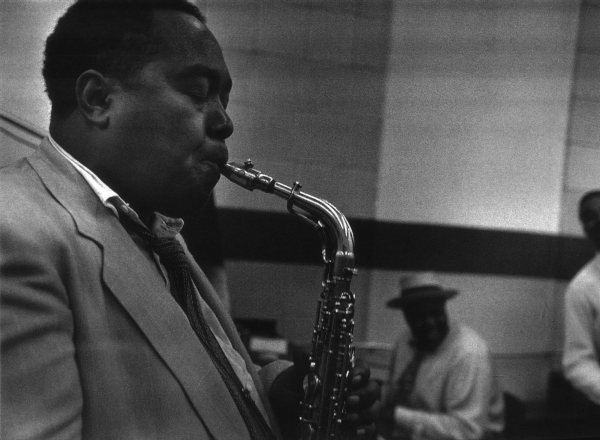
Photo essay Norman Granz Jam Session 1952 Charlie Parker Esther Bubley Photography


Norman Granz Jam Session on Mercury label. Released 1952.
Ballad Medley featuring Charlie Parker, Charlie Shavers, Oscar Peterson, Ben Webster, Johnny Hodges, Ray Brown, Flip Phillips, Barney Kessel.


In 1952 Esther Bubley was in LA, and her friend, illustrator David Stone Martin, was in LA to make sketches at a Charlie Parker Jam Session, and he invited Bubley to come along. So it happened that she was the photographer at the Norman Granz Jam Session recording in 1952. This book is the ultimate Charlie Parker photo essay, showing him in a variety of moods: attentive, jovial, exhausted, nervous, and most of all, respectful towards Johnny Hodges and Benny Carter, both of whom were Charlie's idols. It features timeless pictures of Bird, Benny Carter, Ben Webster, Flip Philips, Johnny Hodges, Charlie Shavers, Oscar Peterson, Ray Brown, Barney Kessel, and J.C. Heard.


For more Jazz & Photography ... William Claxton ... Ed van der Elsken ...


vrijdag 6 januari 2012

Go Back to your Future Irina Werning Photography

 Alexandra 1970 & 2011 Paris 


Irina Werning

I love old photos. I admit being a nosey photographer. As soon as I step into someone else’s house, I start sniffing for them. Most of us are fascinated by their retro look but to me, it’s imagining how people would feel and look like if they were to reenact them today... A few months ago, I decided to actually do this. So, with my camera, I started inviting people to go back to their future.


Andy 1964 & 2011 Los Angeles 


Lea B 1980 & 2011 Paris 


Johannes 1994 & 2011 Hambourg 


Maartje 1990 & 2011 Amsterdam 


Christoph 1990 & 2011 Berlin Wall 

donderdag 5 januari 2012

It is the photographer, not the camera, that is the instrument Eve Arnold Magnum Photojournalism Photography


If a photographer cares about the people before the lens and is compassionate, much is given. It is the photographer, not the camera, that is the instrument.”—Eve Arnold
Photographer Eve Arnold, who died Thursday morning at the age of 99, is probably best remembered for her celebrity photographs of Marilyn Monroe, made over the span of a decade from the early 1950s to those taken on the set of the movie star’s final film, The Misfits. But Arnold also traveled the world to make equally exceptional photographs of the poor and disposed.
Arnold, the daughter of Russian-Jewish immigrants, was born in Philadelphia, Pennsylvania in 1912. In the late 1940’s, she studied photography—alongside Richard Avedon—under inspirational art director Alexei Brodovitch at the New School for Social Research in New York. Her first photo story documented African-American fashion shows in Harlem and the project would lead directly to her being granted unprecedented access by Malcom X to document the Black Muslims and the way they worked over the next two years.
In the early 1950’s, she began working for the photo news publications of the day, first for Picture Post, then Time and Life magazines. And in 1957 she became the first woman photographer to join Magnum Photos.
She will perhaps be best remem bered for her exceptional photo graphs of people: the famous, politicians, musicians, artists —among them Malcolm X, Joan Crawford, Elizabeth Taylor, Paul Newman, Jacqueline Kennedy and Monroe. “I look for a sense of reality with everything I did,” she once said. “I didn’t work in a studio, I didn’t light anything. I found a way of working which pleased me because I didn’t have to frighten people with heavy equipment, it was that little black box and me”
But it is the long term reportage stories that drove Arnold’s curiosity and passion. She traveled extensively to make work on regions that had been off limits to the west—to China, Mongolia, the Soviet Union, and also to Cuba, South Africa and Afghanistan. In 1971 she made a film, Women Behind the Veil, going inside Arabian harems and hammams.
Arnold continued to work for respected publications, most notably the Sunday Times color supplement. In 2003 she was honored with an OBE in recognition for her services to photography. Her work is renowned for its intimacy. Whether photographing celebrity or the everyday, Arnold’s portraits are magical, memorable and enduring.
Read more: http://lightbox.time.com/2012/01/05/eve-arnold-21-april-1912-4-january-2012/#ixzz1ieqrViVq