zondag 26 oktober 2014

The Erotic and the Everyday Erotos Nobuyoshi Araki Photography

Erotos.

Tokyo: Libro Port Publishing, 1993. First Edition. Quarto. Black and white images with many closeups of food, body parts, plants, etc.

The erotic and the everyday

His images of bound women may be shocking, but Nobuyoshi Araki's work is full of life, says Adrian Searle

The GuardianAdrian Searle Tuesday 5 June 2001 03.19 BST 
A first encounter with the photographs of Nobuyoshi Araki is likely to be confusing - an occasion of pleasure, fascination and alarm. The sheer quantity and density of images, the sense of a whole world recorded, is daunting. In the dialogues between images, in his great walls of colliding imagery, there is a constant oscillation between carefully posed and constructed theatricality and snapshot immediacy and spontaneity. Here we find private fantasies acted out, voyeuristic and pornographic scenarios, photo-album mementos, games with plastic dinosaurs, flowers, portraits, street scenes, nudes, details.

The first comprehensive British exhibition of Araki's work, now running at the Ikon Gallery in Birmingham, has generated predictable tabloid shock. The local press have dubbed the 61-year-old Japanese artist "Wacky Araki", and fulminated against the display of his images in a gallery that advertises itself as "family friendly". Araki has also been through the mill of censorship in Japan, where shows have been closed by the authorities. Even though the Ikon's exhibition is an official event in the Japan 2001 festival, and has the support of the Japan Foundation, some doubt whether all his work will make it back to his homeland without being seized at the border.
The disquiet Araki provokes stems from his preoccupation with sexual imagery, in which the invariable focus is on the female body. In Araki's work women expose themselves in the street, lounge about on beds, pose like life models and porn stars, or go about their day naked. In his photographs they are often presented in extreme, elaborate and ritualistic forms of physical bondage: they are tied to bedposts, or bound up in cars; they dangle, fully made-up and dressed in kimonos, from complicated arrangements of ropes.
The whole of Araki's work can itself be seen as a knot of intentions and desires. His models' complicity, their willing subjugation, is never in any doubt; but that, somehow, isn't entirely the point. Maybe the tabloids are right. Araki's work is as shocking as it is full of life. In the end, you have to take Araki's work as a whole - and there is a very great deal more to it than the sex - or not at all. You can't sieve out the apparently unconscionable and hope to be left with anything other than a sanitised half-truth. You can't, in other words, keep the artist's portraits and flowers, but get rid of the old man with the rope tricks, the camera and the girls.
Araki sees his models as partners, believing that his photographs somehow collapse the distance between his subjects and himself. As for the bondage, it is pure theatre, and something of an art form in the way it manipulates and presents the body. Unlike, for example, the bondage in some of surrealist Hans Bellmer's work, or the gruelling sadomasochistic images in Robert Mapplethorpe's work, Araki's photos never show us female flesh as trussed meat. Araki has said that it was never a matter of tying girls up: "What I was aiming at was the female heart. That's what I wanted to put in shackles. As time went on, the models, so to say, tied themselves up, bound themselves to me."
"I am a genius," he has said, and "I am the photograph." Araki's hunger as a photographer, the fact that he is driven by a desire to consume the world with his camera - and to produce hundreds of publications, thousands of images - cannot be anything other than a kind of mania. In certain works - the long sequence Tokyo Nostalgy, for example - hundreds of images are abutted, unframed, spreading their way across adjacent walls. They are a world entire. They devour you. Almost more like a movie than a sequence of photos, they let you lose yourself in the flow of images. But the oddest sensation - as your eye is jolted by an image of a snail crawling over the tip of a penis, or a cloud in an empty sky - is that it is you who are flowing through this world of static moments.
Araki, it appears, lives through the medium of photography. When his wife, Yoko, died in 1990, he published Sentimental Journey, a series of intimate photographs memorialising their relationship: Yoko in bed, smoking; Yoko dancing; Yoko's hand, emerging from under her hospital sheet, holding Araki's; Yoko dead in her open coffin, up to her neck in flowers; Yoko's shrine, in Araki's home; Yoko's grave.
These photographs have migrated into later series of works. The images keep turning up, like memories - no, not "like" memories, but as memories. Yoko permeates Araki's life and his art.
"Maybe I only had a relationship with her as a photographer, not as a partner," Araki has said. "If I hadn't documented her death, both the description of my state of mind and my declaration of love would have been incomplete. I found consolation in unmasking lust and loss, by staging a bitter confrontation between symbols. After Yoko's death, I didn't want to photograph anything but life - honestly. Yet every time I pressed the button, I ended up close to death, because to photograph is to stop time." He went on: "I want to tell you something, listen closely: photography is murder." His models, he continued, come to him demanding to be murdered. "Women always go home 'happy' after I take their pictures. I truss them up or shave them. Ha ha ha. Then I get love letters, saying, 'It was a happy day for me'."
The children in Araki's photographs from the 1960s are oblivious, like children everywhere, to anything other than the present, as they play and lounge about on the Tokyo streets. And then there are the Tokyo streets, with their flowers and their toy-shop Godzillas and dinosaurs - and somewhere among all this an encounter with death. Even Araki's flowers might be seen as a tribute to the dead, in as much as they are saucy, gorgeous, sexual and full of life - but then the artist has remarked that he finds erotic overtones in the moment when the flowers are wilting. Araki's "Erotos" images of details on a larger scale - an eye, an oyster, a piece of thread on the tongue, cutlery smeared with oil - seem to me to be hymns to the eroticised everyday. The world glistens. You eat the images with your eyes.
Everything is full of life in Araki's world - even the inanimate. The bowls of food in a restaurant, street furniture and leaves, houses, bare branches, old bells, patios after rain, the empty sky. This is a life lived inside the camera, the camera of his imagination, Tokyo's camera.
Germano Celant has called Araki's photos "mosaics of erotic solitude". A beautiful phrase. For Araki, Eros is everything, an erotic tinged with words we find difficult, the taboo words "sentimental" and "nostalgia". A woman suspended from ropes, balanced in space, her body opened to the sights of the camera in a theatrical demonstration of inescapable availability, turned into a doll or a sculpture - she is stilled before the camera, even before she is stilled again by the photograph itself. If she is a metaphor - and she has been seen as a metaphor for the rigid codes of conduct that govern Japanese society - she might be emblematic of that peculiar hovering suspension that occurs in photography, a suspension that is also a distance between moments, between desire and the act, between life and death. But, of course, she is a woman, and Araki is a man.
· Nobuyoshi Araki: Tokyo Still Life is at the Ikon Gallery, Birmingham, until July 8. Details: 0121-248 0708. A version of this text appears in the catalogue to the exhibition.

Eros & Death: The World of Araki Nobuyoshi
Araki Nobuyoshi, Japan’s most infamous photographer, talks to David McNeill about age, sex and his unflagging work
If Araki Nobuyoshi likes you, he will take you to the cramped bar he owns in the Kabukicho red-light district of Tokyo.
This is the nighttime lair of perhaps the planet’s most prolific photographer of the female form, a man dubbed a misogynist, a porn-and-bondage-merchant and a genius, so you expect the outrĂ© and Araki doesn’t disappoint. The bar is wallpapered with Polaroid snaps of women: young, older, ripened by years in the water trade, some pigeon-toed and shy; others spread-eagled or violently hogtied, thrust up like Sunday roasts and skewered by his camera.
The middle-aged mama-san Araki employs to serve drinks flits about in a classy kimono, oblivious.
A visitors’ board records the celebrities who have come to pay homage. Bjork, who commissioned Araki to photograph her 1997 album cover Telegram, is there along with controversial Kids-director Larry Clark. “Thank you 4 a lovely day. U R a dirrrty devil,” says one of the more printable comments. The master himself dominates the room with the jittery, uncoordinated energy of a teenager, cackling at his own dirty jokes.
“Be careful of walking around and banging into things with that big cock of yours!” he shouts, as I stumble in the cramped space. Earlier he had told my bemused female companion some of his photographic techniques. “I sometimes blow into the breasts of women while I’m photographing them, to make them look bigger,” he says before exploding in laughter.
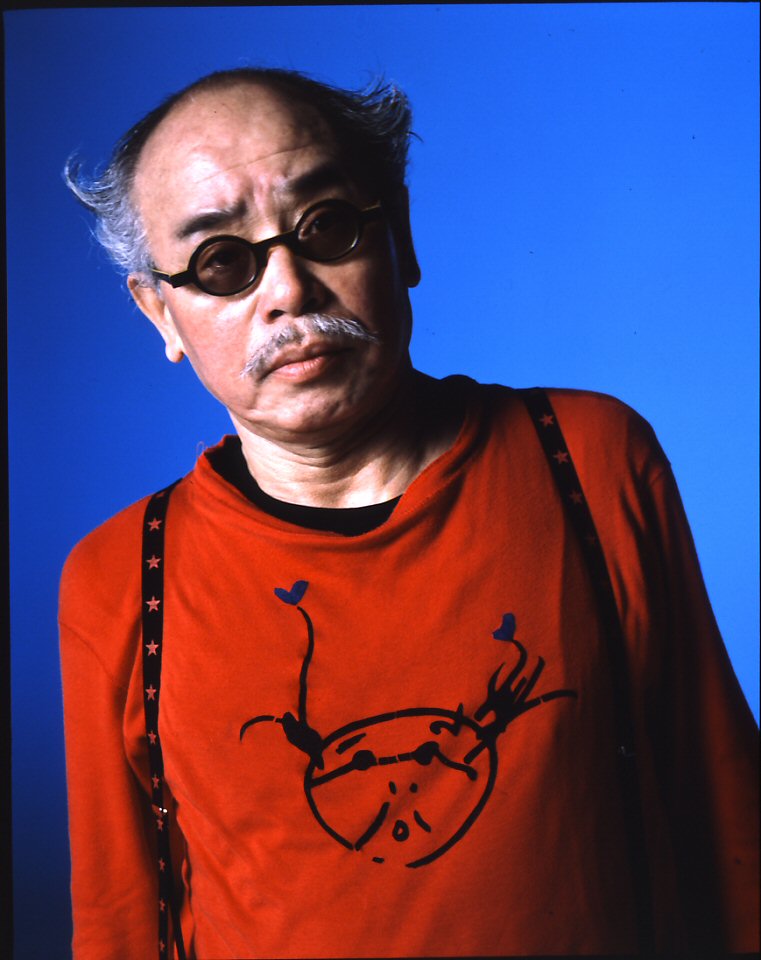
Araki Nobuyoshi
Araki Nobuyoshi
But visiting this bar is to merely sip stale water at the grand banquet of Araki’s work, which includes thousands of exhibitions and 350 books, an output he adds to at the staggering rate of 10 every year. His photos are always on display somewhere: a new collection runs at the Barbican in London as part of an exhibition called Seduce from Oct. 10th. Controversy inevitably follows. Last year, a protestor threw Molotov cocktails at an overview of his work inBelgium.
Perhaps his greatest work of art, however, is the iconic tuft-haired Araki himself, a man so famous in Tokyo he cannot walk down the street during the daylight hours. “Noooo, people come up and start snapping away with those damn mobile-phone cameras,” he complains. “They’re a nuisance. That’s not photography. There is no connection with the subject, no warmth.”
Not surprisingly, perhaps, Araki hates most modern photography. “When I look at photos I see no eros or passion. It doesn’t matter if it is a picture of a city landscape, or a woman or Mt. Fuji. They are all surface, no penetration,” he explains, face creased as he sips a martini. “The only photos I like to look at are my own, though it’s not modest to say so,” and he explodes in laughter again.
Araki can sometimes be spotted at night, walking around Shinjuku and talking to well-wishers. Tokyo’s DNA is imprinted so deeply on his soul that he claims to be incapable of photographing anywhere else. He was born in the downtown shitamachi district in 1940 and his life mirrors its rise from the smoldering ashes of World War II. He calls the city his “womb” and his “mother” and he seems to both feed off and reflect its vast energy as he pounds the streets, a stubby, comical force of nature armed with an arsenal of cameras.

From the collection at the Barbican in London
He has photographed other places, and even men, but it is Tokyo’s women he keeps coming back to, ever since picking up a camera in the sixties. “For me, taking photos is essentially an act of love,” he says. “I know when I look into the viewfinder and can’t sense the sexiness that it is going to be a bad photograph.” All creativity, he believes, comes from the sexual urge; he often compares the timing of depressing the shutter to sex. “I don’t take photographs with my head. I take them with my dick.”
Although often asked about his next projects, he never plans what he will shoot from one day to the next, and lives in the expectation of chance encounters. “I’m happy in the moment, when I meet someone new and I think we might hit it off. I know nothing about long-term happiness, only what I’m doing right now.” The sexual chemistry of those encounters is what makes a great photo, he believes. “You cannot put into words why you take photos, or what you’re doing when you’re taking them.”
Those libidinous instincts – calling it a philosophy might be pushing it – once made him one of the more shocking and transgressive photographers alive, though the days when a spread-eagled female body could bring the police calling are gone. Many of his photos are scattered around the Internet, along with much worse. Araki claims he never goes online. “I don’t even have a mobile phone.” His motivation, in any case, was never to challenge social or cultural rules, he explains. “I have no interest in changing society, though I might have changed two or three women in my time. I guess I’m stingy; I just don’t want to waste my time on other people. But if somebody says not to do something, it makes you want to do it all the more, right?”
Araki’s work, though, still unsettles, paradoxically – for a man who puts such store in the human warmth between photographer and model – because of the merciless, cold stare of his lens. Nothing is beyond the viewfinder’s unflinching gaze. He famously photographed his entire life with beloved wife Yoko, leaving little out: from their honeymoon and lovemaking to her struggle with cancer, and her cremated bones on a steel gurney.

From the collection at the Barbican in London
The best of his work goes well beyond female objectification and has a pathos that may help it outlive the pornographer tag, such as when Japanese poet Miyata Minori displays the surgery scars from the cancer that will eventually kill her.
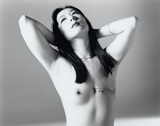
Miyata Minori
His latest collection (“6X7 Hangeki”) includes its fair share of pliant, demure young things, but many of the older women stare back at the camera with a mixture of defiance, anger, openness, perhaps affection for the cherubic little man at the other end of the lens. As Guardian critic Adrian Searle recently put it, for Araki, faces are the real private parts.
“I’m trying to catch the soul of the person I’m shooting. The soul is everything. That’s why all women are beautiful to me, no matter what they look like or how their bodies have aged.” Bjork was one of his most memorable shoots. “Half virgin, half old bag, like a shaman…what a face,” he remembers.

Araki’s Bjork
For a man whose libido is so firmly bound up with his art, Araki is surprisingly unfazed by the prospect of decrepitude. He has no fear of getting bored of the camera or being unable to work. “Taking pictures is as natural as eating and then taking a dump for me. It has nothing to do with age. I never think about it, and I’m very diarrheic,” he cackles, then hits again on my female companion. “Be my wife for a day,” he pleads. “Let’s ditch this joint.”
His work is included in “Seduced: Art and Sex from Antiquity to Now,” which runs at the Barbican Art Gallery Londonfrom 12 October 2007 - 27 January 2008.
David McNeill writes regularly for a number of publications including the Irish Times and the Chronicle of Higher Education. He is a Japan Focus coordinator. This article appeared in London Timeout on October 12, 2007. Posted at Japan Focus on October 18, 2007.


The Erotic and the Everyday Erotos Nobuyoshi Araki Photography

Erotos.

Tokyo: Libro Port Publishing, 1993. First Edition. Quarto. Black and white images with many closeups of food, body parts, plants, etc.

The erotic and the everyday

His images of bound women may be shocking, but Nobuyoshi Araki's work is full of life, says Adrian Searle

The GuardianAdrian Searle Tuesday 5 June 2001 03.19 BST 
A first encounter with the photographs of Nobuyoshi Araki is likely to be confusing - an occasion of pleasure, fascination and alarm. The sheer quantity and density of images, the sense of a whole world recorded, is daunting. In the dialogues between images, in his great walls of colliding imagery, there is a constant oscillation between carefully posed and constructed theatricality and snapshot immediacy and spontaneity. Here we find private fantasies acted out, voyeuristic and pornographic scenarios, photo-album mementos, games with plastic dinosaurs, flowers, portraits, street scenes, nudes, details.

The first comprehensive British exhibition of Araki's work, now running at the Ikon Gallery in Birmingham, has generated predictable tabloid shock. The local press have dubbed the 61-year-old Japanese artist "Wacky Araki", and fulminated against the display of his images in a gallery that advertises itself as "family friendly". Araki has also been through the mill of censorship in Japan, where shows have been closed by the authorities. Even though the Ikon's exhibition is an official event in the Japan 2001 festival, and has the support of the Japan Foundation, some doubt whether all his work will make it back to his homeland without being seized at the border.
The disquiet Araki provokes stems from his preoccupation with sexual imagery, in which the invariable focus is on the female body. In Araki's work women expose themselves in the street, lounge about on beds, pose like life models and porn stars, or go about their day naked. In his photographs they are often presented in extreme, elaborate and ritualistic forms of physical bondage: they are tied to bedposts, or bound up in cars; they dangle, fully made-up and dressed in kimonos, from complicated arrangements of ropes.
The whole of Araki's work can itself be seen as a knot of intentions and desires. His models' complicity, their willing subjugation, is never in any doubt; but that, somehow, isn't entirely the point. Maybe the tabloids are right. Araki's work is as shocking as it is full of life. In the end, you have to take Araki's work as a whole - and there is a very great deal more to it than the sex - or not at all. You can't sieve out the apparently unconscionable and hope to be left with anything other than a sanitised half-truth. You can't, in other words, keep the artist's portraits and flowers, but get rid of the old man with the rope tricks, the camera and the girls.
Araki sees his models as partners, believing that his photographs somehow collapse the distance between his subjects and himself. As for the bondage, it is pure theatre, and something of an art form in the way it manipulates and presents the body. Unlike, for example, the bondage in some of surrealist Hans Bellmer's work, or the gruelling sadomasochistic images in Robert Mapplethorpe's work, Araki's photos never show us female flesh as trussed meat. Araki has said that it was never a matter of tying girls up: "What I was aiming at was the female heart. That's what I wanted to put in shackles. As time went on, the models, so to say, tied themselves up, bound themselves to me."
"I am a genius," he has said, and "I am the photograph." Araki's hunger as a photographer, the fact that he is driven by a desire to consume the world with his camera - and to produce hundreds of publications, thousands of images - cannot be anything other than a kind of mania. In certain works - the long sequence Tokyo Nostalgy, for example - hundreds of images are abutted, unframed, spreading their way across adjacent walls. They are a world entire. They devour you. Almost more like a movie than a sequence of photos, they let you lose yourself in the flow of images. But the oddest sensation - as your eye is jolted by an image of a snail crawling over the tip of a penis, or a cloud in an empty sky - is that it is you who are flowing through this world of static moments.
Araki, it appears, lives through the medium of photography. When his wife, Yoko, died in 1990, he published Sentimental Journey, a series of intimate photographs memorialising their relationship: Yoko in bed, smoking; Yoko dancing; Yoko's hand, emerging from under her hospital sheet, holding Araki's; Yoko dead in her open coffin, up to her neck in flowers; Yoko's shrine, in Araki's home; Yoko's grave.
These photographs have migrated into later series of works. The images keep turning up, like memories - no, not "like" memories, but as memories. Yoko permeates Araki's life and his art.
"Maybe I only had a relationship with her as a photographer, not as a partner," Araki has said. "If I hadn't documented her death, both the description of my state of mind and my declaration of love would have been incomplete. I found consolation in unmasking lust and loss, by staging a bitter confrontation between symbols. After Yoko's death, I didn't want to photograph anything but life - honestly. Yet every time I pressed the button, I ended up close to death, because to photograph is to stop time." He went on: "I want to tell you something, listen closely: photography is murder." His models, he continued, come to him demanding to be murdered. "Women always go home 'happy' after I take their pictures. I truss them up or shave them. Ha ha ha. Then I get love letters, saying, 'It was a happy day for me'."
The children in Araki's photographs from the 1960s are oblivious, like children everywhere, to anything other than the present, as they play and lounge about on the Tokyo streets. And then there are the Tokyo streets, with their flowers and their toy-shop Godzillas and dinosaurs - and somewhere among all this an encounter with death. Even Araki's flowers might be seen as a tribute to the dead, in as much as they are saucy, gorgeous, sexual and full of life - but then the artist has remarked that he finds erotic overtones in the moment when the flowers are wilting. Araki's "Erotos" images of details on a larger scale - an eye, an oyster, a piece of thread on the tongue, cutlery smeared with oil - seem to me to be hymns to the eroticised everyday. The world glistens. You eat the images with your eyes.
Everything is full of life in Araki's world - even the inanimate. The bowls of food in a restaurant, street furniture and leaves, houses, bare branches, old bells, patios after rain, the empty sky. This is a life lived inside the camera, the camera of his imagination, Tokyo's camera.
Germano Celant has called Araki's photos "mosaics of erotic solitude". A beautiful phrase. For Araki, Eros is everything, an erotic tinged with words we find difficult, the taboo words "sentimental" and "nostalgia". A woman suspended from ropes, balanced in space, her body opened to the sights of the camera in a theatrical demonstration of inescapable availability, turned into a doll or a sculpture - she is stilled before the camera, even before she is stilled again by the photograph itself. If she is a metaphor - and she has been seen as a metaphor for the rigid codes of conduct that govern Japanese society - she might be emblematic of that peculiar hovering suspension that occurs in photography, a suspension that is also a distance between moments, between desire and the act, between life and death. But, of course, she is a woman, and Araki is a man.
· Nobuyoshi Araki: Tokyo Still Life is at the Ikon Gallery, Birmingham, until July 8. Details: 0121-248 0708. A version of this text appears in the catalogue to the exhibition.

Eros & Death: The World of Araki Nobuyoshi
Araki Nobuyoshi, Japan’s most infamous photographer, talks to David McNeill about age, sex and his unflagging work
If Araki Nobuyoshi likes you, he will take you to the cramped bar he owns in the Kabukicho red-light district of Tokyo.
This is the nighttime lair of perhaps the planet’s most prolific photographer of the female form, a man dubbed a misogynist, a porn-and-bondage-merchant and a genius, so you expect the outrĂ© and Araki doesn’t disappoint. The bar is wallpapered with Polaroid snaps of women: young, older, ripened by years in the water trade, some pigeon-toed and shy; others spread-eagled or violently hogtied, thrust up like Sunday roasts and skewered by his camera.
The middle-aged mama-san Araki employs to serve drinks flits about in a classy kimono, oblivious.
A visitors’ board records the celebrities who have come to pay homage. Bjork, who commissioned Araki to photograph her 1997 album cover Telegram, is there along with controversial Kids-director Larry Clark. “Thank you 4 a lovely day. U R a dirrrty devil,” says one of the more printable comments. The master himself dominates the room with the jittery, uncoordinated energy of a teenager, cackling at his own dirty jokes.
“Be careful of walking around and banging into things with that big cock of yours!” he shouts, as I stumble in the cramped space. Earlier he had told my bemused female companion some of his photographic techniques. “I sometimes blow into the breasts of women while I’m photographing them, to make them look bigger,” he says before exploding in laughter.
Araki Nobuyoshi
But visiting this bar is to merely sip stale water at the grand banquet of Araki’s work, which includes thousands of exhibitions and 350 books, an output he adds to at the staggering rate of 10 every year. His photos are always on display somewhere: a new collection runs at the Barbican in London as part of an exhibition called Seduce from Oct. 10th. Controversy inevitably follows. Last year, a protestor threw Molotov cocktails at an overview of his work inBelgium.
Perhaps his greatest work of art, however, is the iconic tuft-haired Araki himself, a man so famous in Tokyo he cannot walk down the street during the daylight hours. “Noooo, people come up and start snapping away with those damn mobile-phone cameras,” he complains. “They’re a nuisance. That’s not photography. There is no connection with the subject, no warmth.”
Not surprisingly, perhaps, Araki hates most modern photography. “When I look at photos I see no eros or passion. It doesn’t matter if it is a picture of a city landscape, or a woman or Mt. Fuji. They are all surface, no penetration,” he explains, face creased as he sips a martini. “The only photos I like to look at are my own, though it’s not modest to say so,” and he explodes in laughter again.
Araki can sometimes be spotted at night, walking around Shinjuku and talking to well-wishers. Tokyo’s DNA is imprinted so deeply on his soul that he claims to be incapable of photographing anywhere else. He was born in the downtown shitamachi district in 1940 and his life mirrors its rise from the smoldering ashes of World War II. He calls the city his “womb” and his “mother” and he seems to both feed off and reflect its vast energy as he pounds the streets, a stubby, comical force of nature armed with an arsenal of cameras.

From the collection at the Barbican in London
He has photographed other places, and even men, but it is Tokyo’s women he keeps coming back to, ever since picking up a camera in the sixties. “For me, taking photos is essentially an act of love,” he says. “I know when I look into the viewfinder and can’t sense the sexiness that it is going to be a bad photograph.” All creativity, he believes, comes from the sexual urge; he often compares the timing of depressing the shutter to sex. “I don’t take photographs with my head. I take them with my dick.”
Although often asked about his next projects, he never plans what he will shoot from one day to the next, and lives in the expectation of chance encounters. “I’m happy in the moment, when I meet someone new and I think we might hit it off. I know nothing about long-term happiness, only what I’m doing right now.” The sexual chemistry of those encounters is what makes a great photo, he believes. “You cannot put into words why you take photos, or what you’re doing when you’re taking them.”
Those libidinous instincts – calling it a philosophy might be pushing it – once made him one of the more shocking and transgressive photographers alive, though the days when a spread-eagled female body could bring the police calling are gone. Many of his photos are scattered around the Internet, along with much worse. Araki claims he never goes online. “I don’t even have a mobile phone.” His motivation, in any case, was never to challenge social or cultural rules, he explains. “I have no interest in changing society, though I might have changed two or three women in my time. I guess I’m stingy; I just don’t want to waste my time on other people. But if somebody says not to do something, it makes you want to do it all the more, right?”
Araki’s work, though, still unsettles, paradoxically – for a man who puts such store in the human warmth between photographer and model – because of the merciless, cold stare of his lens. Nothing is beyond the viewfinder’s unflinching gaze. He famously photographed his entire life with beloved wife Yoko, leaving little out: from their honeymoon and lovemaking to her struggle with cancer, and her cremated bones on a steel gurney.

From the collection at the Barbican in London
The best of his work goes well beyond female objectification and has a pathos that may help it outlive the pornographer tag, such as when Japanese poet Miyata Minori displays the surgery scars from the cancer that will eventually kill her.

Miyata Minori
His latest collection (“6X7 Hangeki”) includes its fair share of pliant, demure young things, but many of the older women stare back at the camera with a mixture of defiance, anger, openness, perhaps affection for the cherubic little man at the other end of the lens. As Guardian critic Adrian Searle recently put it, for Araki, faces are the real private parts.
“I’m trying to catch the soul of the person I’m shooting. The soul is everything. That’s why all women are beautiful to me, no matter what they look like or how their bodies have aged.” Bjork was one of his most memorable shoots. “Half virgin, half old bag, like a shaman…what a face,” he remembers.

Araki’s Bjork
For a man whose libido is so firmly bound up with his art, Araki is surprisingly unfazed by the prospect of decrepitude. He has no fear of getting bored of the camera or being unable to work. “Taking pictures is as natural as eating and then taking a dump for me. It has nothing to do with age. I never think about it, and I’m very diarrheic,” he cackles, then hits again on my female companion. “Be my wife for a day,” he pleads. “Let’s ditch this joint.”
His work is included in “Seduced: Art and Sex from Antiquity to Now,” which runs at the Barbican Art Gallery Londonfrom 12 October 2007 - 27 January 2008.
David McNeill writes regularly for a number of publications including the Irish Times and the Chronicle of Higher Education. He is a Japan Focus coordinator. This article appeared in London Timeout on October 12, 2007. Posted at Japan Focus on October 18, 2007.


vrijdag 24 oktober 2014

Hans Eijkelboom’s anti-fashion shots head to Paris Photography

Hans Eijkelboom’s anti-fashion shots head to Paris

Colette stages show based on Eijkelboom’s People of the Twenty-First Century as part of Paris Photo
From People of the Twenty-First Century by Hans Eijkelboom

Hans Eijkelboom’s pictures undermine the very ideas behind fashion. After all, who can believe the subtle promises of individuality and differentiation made by the clothes industry when you look at the grids of pictures in Eijkelboom’s new book, People of the Twenty-First Century, each shot in the same place during a two-hour window. Everyone looks so similar.
Nonetheless, the photographer will be the toast of the fashion industry's capital next month, with not one but two shows timed to coincide with Paris Photo, the international photography fair which takes place from November 13-16 in the city’s Grand Palais. 
From People of the Twenty-First Century by Hans Eijkelboom

From People of the Twenty-First Century by Hans Eijkelboom
Colette, one of Paris’ coolest fashion lifestyle stores, will be showing Eijkelboom’s pictures in its gallery, 2 – 29 November. Visit on the evening of 13 November to hear him talk with the great photo curator Erik Kessels, and sign some books.
The photographer will also be signing books at Dirk Bakker Books within the fair itself 6-8pm on 14 November. Additionally, a few minutes across town at the Centquatre cultural centre, Kessels and Eijkelboom come together again, to restage Small Universe, the Dutch photography exhibition Kessels presented at Recontres d'Arles earlier this year, for a longer run, 13 November 2014 - 4 January 2015. Read this interview with Erik, wherein he describes the show and Hans’s place within it.
From People of the Twenty-First Century by Hans Eijkelboom

From People of the Twenty-First Century by Hans Eijkelboom
Meanwhile, across the border in Belgium, at Antwerp’s M HKA art museum, Eijkelboom’s photographs join pieces by Francis AlĂ¿s, Antoni Muntadas, Hermann Pitz in an ‘intervention’ by the Russian-born artist Olga Chernysheva, combining her own work with others in a lively group show. The exhibition, which runs 24 October 2014 - 15 January 2015, will be “a commentary on different understandings of vision: as something both physical and mental, both individualised and socially engaged.”
From People of the Twenty-First Century by Hans Eijkelboom

From People of the Twenty-First Century by Hans Eijkelboom
Hans sounds like a good fit for this exhibition. Read this interview with him, to hear him explain why everything he does relates back to notions of identity; and to see more of this incredible photo series, buy a copy of People of the Twenty-First Century Here.


Ten questions for photographer Hans Eijkelboom

Our People of the Twenty-First Century photographer on The Sartorialist, Martin Parr and the consumer society

If you're anything like us you will, at some point, have gone into a clothes shop, picked out a garment which you thought expressed an element of your personality, and at the till been hit with the realisation that thousands of people across the planet will also buy and wear exactly the same piece of clothing.
It’s this fallacy of modern individualism that the 65-year-old Dutch photographer, Hans Eijkelboom examines in his new book, People of the Twenty-First Century. His photo series, shot during two-hour sessions on the street in Western cities over the past twenty two years, captures people as they truly dress: not with the individual panache so often dreamed of in clothes shop dressing rooms, nor with the rigid uniformity common in stricter society, but instead with a kind of uncanny groupthink. View these shots laid out in a grid formation by Eijkelboom and the viewer becomes aware not only of unconscious conformity at work in this supposed age of the individual, but also how herd-like our habits are. Read on to discover how Eijkelboom thinks this book serves as a kind of mirror; why no one has ever complained about his pictures, and who he thinks he owes his greatest photographic debt to.
 
You’ve been shooting photographs since the 1960s. How would you characterise your work prior to shooting the pictures in this book? Basically, throughout my whole career I have examined the same things. It’s always about identity. In the beginning it was about my identity, and now it’s more about identity generally in society. I studied architecture and I used my camera to photograph landscapes and maquettes and so on. Then I was interested in trying to capture how weather affected buildings, for example how houses change colour when it’s raining. This led me to photograph myself when I was wet, and that was the start of all my work. 
When did you start making the pictures in this series? In 1992. Before I had made similar shots, but not on a daily basis. Again, the inspiration was identity and society. When I started the project, I wondered whether I was a product of the consumer society, rather than my own man. I wanted to make the series almost as a mirror, in which to see myself. If I can see the surrounding society, then I can see what makes me who I am. I think ‘how can you be so naĂ¯ve to go to a shop, to buy clothes that sum up your personality, and not realise that, at the same time, 10,000 men and women around the world do and think the same things?’ But I do it too, of course. We’re told we’re individuals, and we buy these things, and we are a product of the culture that we live in.  
How and where do you shoot them? Whenever I go to a new city I look around for a good place. It’s something to do with a crowd and the light. Shopping centres, of course, are where lots of people come together. At the moment I am working by the Bullring in Birmingham, England. It’s great there; I can really move around. In Broadway and Prince in New York, and in de Dam in Amsterdam, too.
How long does it take to get a series together? I look around for ten or fifteen minutes. Then I pick my spot and start photographing for between twenty minutes and two hours - never longer than two hours. If I go on for any longer it is not interesting for me. You can find everything if you look for it for a year, but it is very important that it is a part of what my eyes are seeing for one or two hours. The series, which I always lay out in these grids, must really be what everybody else can see in the city. And they often do end up seeing it too. I often hear from people who’ve seen an exhibition of mine and say ‘oh, I hate it, because whenever I go to the city now, that’s all I see.’ 
In terms of set-up, we understand you wear a camera around your neck and carry a remote trigger concealed in your jacket pocket? That’s correct. That way, people almost always don’t know I’m taking their shot. OK, sometimes I look towards them too intently and they might be aware, or they can hear the shutter sound. When I work with a Canon D5, it’s better to find a place that is noisy, to mask that sound. That’s a problem.
Since you started other photographers, such as Scott ‘The Sartorialist’ Schuman, Bill Cunningham, or Brandon Stanton (Humans of New York) have sprung to fame. Do you feel any affinity with their work? I’ve certainly seen their websites. I think they’re good, but the big difference between my pictures and theirs is that they are interested in the things that are exceptional, whereas I’m looking for things that you see all the time on the street.  
It's often said, quite wrongly, that Martin Parr's photos are misanthropic. How do you feel about yours? Both Martin and I love people. It’s impossible to be on the street for days and days and not to love people. But it’s critical, too, because of the struggle of life. You have to show people how complicated life is. Take Martin’s shots at the beach, which people always say are unkind. Well, when I go with my wife to the beach here in the Netherlands, it’s also complicated to find a really nice place. Or when you go on holiday, you hope to sit on the most beautiful beaches in the world, but the practice of life is different. You cannot speak about that in terms of uncritical or critical, you can only say I love life, but it is difficult. I feel a great affinity with Martin Parr. I’m very interested in August Sander, the Bechers, and the father for me for everything is Walker Evans. Gary Winogrand was a big influence too. He showed me how to become more or less an investigator with a camera.
Have people ever complained about you photographing them? No. Some people are happy with the photograph, but most people never see them. My work is on show in a big theatre in Amsterdam. About four or five times in a year, I get a message from someone asking for a copy of their picture. They only ever ask for their own picture, but I also send them the other pictures in the grid too. Still, the question is always ‘can I have my photo?’ 
Do you think people will ever  realise that buying fashionable clothes doesn't actually make them look different or special? I’m not sure. I think there’s an interesting development happening. I think people are regarding it increasingly important how they look on the street, and more important how they look online. Young people will communicate with young people in China, say. It doesn’t matter what they’re wearing at the moment.  
That’s interesting. So is there more scope for this kind of anthropological street photography? Yes, I think there’s more scope. I’m happy I started with this project before the internet became big, because I’ve captured the analogue generation and the digital generation. I think we’re at the cusp of a new era. A lot is changing very quickly, in social terms, in relation to identity, fashion, internet and so on. Only, I’m not sure how it is changing. It’s too complicated for a 65-year-old man, but I look at it and it’s very interesting for me. Take a look at People of the Twenty-Firist Century in the bookstore.