dinsdag 26 april 2011

The Photo-book as Artist’s Book Ringier Annual Report 2002 Aleksandra Mir Design Photography

HELLO Ringier 
Ringier Annual Report 2002, Zurich 2003. 


My name is Aleksandra Mir, I am an artist, and I have been asked to make your annual report this year. Here it is. The artwork on these pages is based on an ongoing research project of mine entitled ‘HELLO’ that I have already produced and exhibited on seven occasions and in as many cities around the world. In principle, ‘HELLO’ is a visual daisy chain, connecting people throughout the world and the history of photography. Each person appears twice, in two different photos, with two different people, so that each added image is an answer to the preceding one, and poses a question to the next. It is a simple idea, but given all the variables the project grows immensely complex and easily becomes a lifetime commitment, theoretically encompassing the whole photographed population of the earth.

‘HELLO’ is always produced with the help of local resources and assistance, the composition of which varies greatly, but which always imprints itself and becomes an inevitable part of the resulting work. During my two-month residency here at the Ringier offices in Zurich, I was offered a chance to explore the structure of the corporation, to meet and interact with the people who work here and to dive into the gold mine of the photographic archives. I also made day trips around Switzerland to investigate further leads on the natural course of people’s lives, or to link with external resources. It has been very interesting.

The in-house photographic archive of some 10 million images (nobody really knows how many there are in the basement) is a strange, beautiful and deeply unpredictable land, in constant negotiation with itself and the external world. On a pragmatic level, it is simply the collection of past news stories, quietly filed away, in most cases never to be discovered again. But when things are pulled from the past to briefly comment on the present, something truly magical occurs. Traces of past technology, such as pre-Photoshop editorial markings in red crayon on b/w photos, meet the glaring color saturation of a fully digitally produced image. Between the two, a baby has grown into an adult woman with a child of her own.

One of the greatest pleasures in the course of creating this work was, for example, to first find a fantastic early ’70s photograph of the pop star Toni Vescoli holding his newborn baby daughter Natalie on his guitar. Then two days later, to be sitting on a train on my way to a small town I had never heard of before, and to be picked up at the station by Natalie herself; to meet her family in turn and to browse through her own, more recent albums at the kitchen table. After a mutual brainstorming session to decide where the lead could go next, a call is placed to her neighbor, writer Nicolas Lindt, connected via their children, who play together, which leads directly to a photo of him with The Edge from U2. This picture was taken during an interview for Schweizer Illustrierte at U2’s world tour concert in Gothenburg, Sweden, in 1986. And Gothenburg happens to be the town where I grew up. Later, back in the archive, I found myself in a crowd photo from that very concert. It was crazy.


Another route could be followed by starting off at the local library in St. Moritz, with photos of Charlie Chaplin and Douglas Fairbanks posing together with their local ski instructor. Then, following these celebrities, who visit Switzerland again and again over time, eventually relating them to a news story produced in-house by the Ringier journalist and photographer Joseph Ritler, whom I later connect with on the phone and who sends me more of his personal pictures. With all of this, I have relied heavily on the guidance, translation, anecdotes and personal interest of many of Ringier’s employees, who have considerably shaped the outcome of the work, as have all other public, private and external contributors whom I thank deeply at the back of this publication.

Spending time on location in Switzerland seems to call for the development of a national theme. But if anything, this project proves the impossibility of stating the coherence of any community at all; instead it follows the irregular and sprawling flow of people’s dispersed relations through time and place. Hollywood, of course, will always be a shared nucleus for everyone on this earth. But, perhaps as a joke on the improbability of coherence, a strange local theme has occurred quite spontaneously in the course of making this version of ‘HELLO’: winter sports, in fact and fiction, with celebrities and regular people enjoying the best of what Switzerland has to offer. So have I. Thank you.

Aleksandra Mir, Zurich, March 2003.

Ringier is a multinational integrated media company. Founded in 1833, Ringier is carrying print, broadcast, radio, online and mobile media brands, and is a successful player in the printing, entertainment and internet business. Ringier is a Swiss family-company with headquarters in Zurich.



The Photo-book as Artist’s Book Ringier Annual Report 2002 Aleksandra Mir Design Photography

HELLO Ringier 
Ringier Annual Report 2002, Zurich 2003. 


My name is Aleksandra Mir, I am an artist, and I have been asked to make your annual report this year. Here it is. The artwork on these pages is based on an ongoing research project of mine entitled ‘HELLO’ that I have already produced and exhibited on seven occasions and in as many cities around the world. In principle, ‘HELLO’ is a visual daisy chain, connecting people throughout the world and the history of photography. Each person appears twice, in two different photos, with two different people, so that each added image is an answer to the preceding one, and poses a question to the next. It is a simple idea, but given all the variables the project grows immensely complex and easily becomes a lifetime commitment, theoretically encompassing the whole photographed population of the earth.

‘HELLO’ is always produced with the help of local resources and assistance, the composition of which varies greatly, but which always imprints itself and becomes an inevitable part of the resulting work. During my two-month residency here at the Ringier offices in Zurich, I was offered a chance to explore the structure of the corporation, to meet and interact with the people who work here and to dive into the gold mine of the photographic archives. I also made day trips around Switzerland to investigate further leads on the natural course of people’s lives, or to link with external resources. It has been very interesting.

The in-house photographic archive of some 10 million images (nobody really knows how many there are in the basement) is a strange, beautiful and deeply unpredictable land, in constant negotiation with itself and the external world. On a pragmatic level, it is simply the collection of past news stories, quietly filed away, in most cases never to be discovered again. But when things are pulled from the past to briefly comment on the present, something truly magical occurs. Traces of past technology, such as pre-Photoshop editorial markings in red crayon on b/w photos, meet the glaring color saturation of a fully digitally produced image. Between the two, a baby has grown into an adult woman with a child of her own.

One of the greatest pleasures in the course of creating this work was, for example, to first find a fantastic early ’70s photograph of the pop star Toni Vescoli holding his newborn baby daughter Natalie on his guitar. Then two days later, to be sitting on a train on my way to a small town I had never heard of before, and to be picked up at the station by Natalie herself; to meet her family in turn and to browse through her own, more recent albums at the kitchen table. After a mutual brainstorming session to decide where the lead could go next, a call is placed to her neighbor, writer Nicolas Lindt, connected via their children, who play together, which leads directly to a photo of him with The Edge from U2. This picture was taken during an interview for Schweizer Illustrierte at U2’s world tour concert in Gothenburg, Sweden, in 1986. And Gothenburg happens to be the town where I grew up. Later, back in the archive, I found myself in a crowd photo from that very concert. It was crazy.


Another route could be followed by starting off at the local library in St. Moritz, with photos of Charlie Chaplin and Douglas Fairbanks posing together with their local ski instructor. Then, following these celebrities, who visit Switzerland again and again over time, eventually relating them to a news story produced in-house by the Ringier journalist and photographer Joseph Ritler, whom I later connect with on the phone and who sends me more of his personal pictures. With all of this, I have relied heavily on the guidance, translation, anecdotes and personal interest of many of Ringier’s employees, who have considerably shaped the outcome of the work, as have all other public, private and external contributors whom I thank deeply at the back of this publication.

Spending time on location in Switzerland seems to call for the development of a national theme. But if anything, this project proves the impossibility of stating the coherence of any community at all; instead it follows the irregular and sprawling flow of people’s dispersed relations through time and place. Hollywood, of course, will always be a shared nucleus for everyone on this earth. But, perhaps as a joke on the improbability of coherence, a strange local theme has occurred quite spontaneously in the course of making this version of ‘HELLO’: winter sports, in fact and fiction, with celebrities and regular people enjoying the best of what Switzerland has to offer. So have I. Thank you.

Aleksandra Mir, Zurich, March 2003.

Ringier is a multinational integrated media company. Founded in 1833, Ringier is carrying print, broadcast, radio, online and mobile media brands, and is a successful player in the printing, entertainment and internet business. Ringier is a Swiss family-company with headquarters in Zurich.


maandag 25 april 2011

RINGIER ANNUAL REPORT 2006 ART AND VISUAL CONCEPT BY RICHARD PHILLIPS


(PHILLIPS, RICHARD). RUF, BEATRIX, FRANK A. MEYER & RICHARD PHILLIPS -RINGIER ANNUAL REPORT 2006: ART AND VISUAL CONCEPT BY RICHARD PHILLIPS

 -
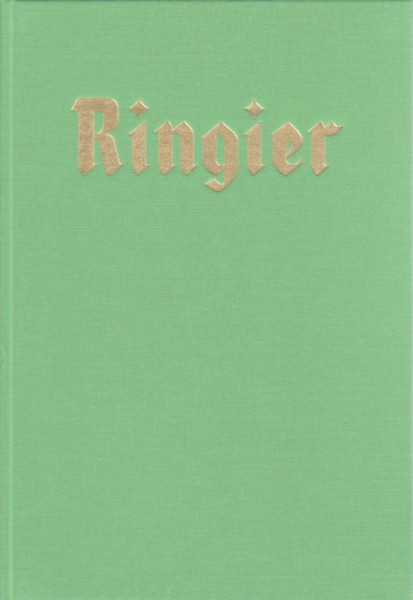
Zurich, SWITZERLAND, Ringier AG Corporate Communications., 2007, First Edition. Gilt Debossed Boards, Small 4to, xx + 40pp, profusely illustrated in color and duotone. Text in English. Published as Swiss media conglomerate Ringier's 2006 annual report, this beautiful hardbound tome is an artist's book designed by Richard Phillips after a 1930s German monograph on the Medieval sculptor Tilman Riemenschneider. It features reproductions of eleven works on paper by the artist executed during 2006 (including a delightful appropriated drawing of Tom Cruise!) along with a discussion of the project with noted curator Beatrix Ruf.

Ringier is a multinational integrated media company. Founded in 1833, Ringier is carrying print, broadcast, radio, online and mobile media brands, and is a successful player in the printing, entertainment and internet business. Ringier is a Swiss family-company with headquarters in Zurich.


Richard Phillips, designer of the 2006 Ringier annual report

The tenth artist to design a Ringier annual report.

Zurich, 22 March 2007

Richard Phillips, who lives and works in New York, was born in 1962 in Marblehead, Mass.

His choice of Fraktur as the report’s principal typeface can be traced back to an inspiration he drew from a book, published in the 1930s, about sculptor and woodcarver Tilman Riemenschneider. Says Phillips: “After studying the ways in which the previous artists worked with the report I felt that by accepting the commission I would have an opportunity to change the way art, within the context of media, represents and functions as no more than entertainment and décor (...) My aim is to use art to contest the validity, sanctity and acceptance of images as conveyors of meaning stripped of consequence – propaganda, in other words.”

Ringier collection curator and director of Kunsthalle Zurich, Beatrix Ruf writes: “In his works in general and for this report in particular, Richard Phillips makes use of the iconic quality of pictures which the media and art use daily – each according to its own agenda. In his paintings and his works executed on paper, the artist potentiates an ambivalence inherent in these pictures, in which he takes their tempting beauty and ambiguity to the breaking point. He translates pictures he found, which deal with the marketability of man, his wishes, ideas, actions, identity, sexuality, politics, power and death, into drawings and then, masterful paintings, executed in an elaborate process.”

The pictures Phillips selected for the Ringier annual report are the drafts of eleven large-size paintings which he will present to the public for the first time in April 2007, in Los Angeles.

See for a review of the Ringier Annual Reports ...


zaterdag 23 april 2011

Spying in Mecca Christiaan Snouck Hurgronje The First Western Photographer in Mecca, 1884-1885 Photography


Christiaan Snouck Hurgronje: The First Western Photographer in Mecca, 1884-1885

Auteur Durkje van der Wal; Manfred & Hanna Heiting Fund / Rijksmuseum; 40 kleurenafbeeldingen, 56 pagina's, gebonden


He was an adventurer, a scholar, and possibly a spy -- but as Dutchman Christiaan Snouck Hurgronje proved with his rare 1885 photographs and sound recordings of Mecca, he was also a pioneering multimedia journalist.

Snouck's extraordinary collection of sepia-tinted images of Mecca in a bygone age have gone on display in Dubai ahead of the annual Hajj pilgrimage that originally drew him to the heart of Islam.

Accompanied by crackling, eerie soundscapes captured by Snouck using Thomas Edison's newly-invented wax cylinders, the exhibition paints a very different picture from the ornate and built-up Mecca familiar to modern visitors.

Among the newly-restored platinum prints, one image taken from a nearby hillside shows the Kaaba, the instantly recog nizable cubic building considered by Muslims to be the holiest place on the planet.

But though the galleried compound which surrounds it is echoed by Mecca's contemporary architecture, the sparsely-built city of Snouck's era bears only a passing resemblance, as do the rudimentary travelers' tents on the dusty plains outside the city.

The images are all the more astounding, says Elie Domit -- creative director of Dubai's Empty Quarter gallery, which is hosting the exhibition -- when one considers the lengths he went to to get them.

"People tend to forget the situation because cameras today are so versatile and light," he told CNN. "In Snouck's day they probably weighed about 40 kilos, and he needed to take all the chemicals for developing, which he would have done on site."

"And he not only took photographs, but also recorded sounds. Can you just imagine going there and going through all the hardship to record that moment in history? It's fascinating."

Also fascinating, says Domit, is the story of Snouck himself. A pioneering traveler, he was a rare Western presence in Mecca, but embraced the culture and religion of his hosts with passion, converting to Islam.

He stayed for five months, documenting the run-up to Hajj, but although he had intended to stay for the pilgrimage, he was forced to leave after unfounded accusations of his involvement in an attempt to steal a historical artifact.

"Being one of the first Europeans, people were suspicious of his agenda, particularly as he had gained the confidence of the Ottoman leader," added Domit.

"So when they heard the rumor he was a thief, he had to escape -- leaving his camera equipment behind."

The equipment wasn't wasted. After Snouck's departure, Al-Sayyid Abd al-Ghaffar, a local physician that the Dutchman had worked alongside, began using the camera, possibly becoming Mecca's first home-grown photographer.

Al-Ghaffar continued sending his images to Snouck in The Netherlands. Many of the photographs were originally credited solely to Snouck but they are now jointly credited, with experts unable to tell who shot what.

The images, archived by Leiden University Library, were published four years after Snouck's trip. Original copies of the album now sell for about $45,000, according to the gallery.
There was, says Domit, more to Snouck than pictures and sound.

"He never said himself that he was a spy because there was no Hollywood to pay tons of money for his inside story, but there have been many documents and historians claiming this.

"Most likely he was working as an agent of espionage in order to furnish information to the Dutch who had an interest in finding out about Muslim insurgents trying to topple the colonialism of the Netherlands.

"But he was also very convinced about the state of Islam, very knowledgeable and very dedicated. He was a kind of dichotomy: Here was a guy sent on a mission, but after he arrived he was convinced by and converted to Islam.

"I'm sure in terms of his personality, it was quite difficult."

According to Domit, Snouck also left behind a pregnant Ethiopian wife when he fled Mecca, but later married again while working in the what is now Indonesia. "He married several times, I believe. Very convenient when the Dutch government is paying your bill." See also The Snouck files ...


Uitgeleide van hajs (hadjis) bij Koetapandjang, Gajolanden (?)

Indisch filmarchief: Het groote Mekka-feest Unieke beelden van pelgrimstocht in 1928
  • 21 mei 2008
In 1928 maakte het Krugers Filmbedrijf een 4-delige film over de pelgrimstocht van Indonesische islamieten naar Mekka. Destijds zeer bijzondere beelden, de film begint dan ook met een foto van de cineast Krugers: "De koene operateur, C. Krugers, die er voor 't eerst in slaagde een filmbeeld naar waarheid vast te leggen van dezen over de geheele wereld zoo bekenden doch noch nimmer door een Westerling gezienen pelgrimstocht." De film bevat unieke beelden van Arabische steden in de jaren 20.

Pilgrims from Aceh in the Dutch Consulate in Jeddah for the hajj to Mecca

Mekkagangers uit Ambon Key en Banda (Molukken) in het Nederlandse Consulaat in Jeddah Saoedi Arabië

Mekkagangers uit Mandeling Sumatra in het Nederlandse Consulaat in Jeddah Saoedi Arabië

Mekkagangers uit Palembang in het Nederlands Consulaat in Jeddah Saoedi Arabië

Terugkomst van de Mekkagangers op het eiland Bawean Surabaya Java

vrijdag 22 april 2011

Dutch Surrealism Retrospective Emiel van Moerkerken Photography

Emiel van Moerkerken (1916-1995)

23 April 2011 - 4 September 2011
The role of Emiel van Moerkerken in the history of Dutch photography is highly important but hard to sum up. In the 1960s, he made reportage-type photos for Dutch Salvation Army magazine Strijdkreet, while at the same time snapping provocative nudes for satirical magazine Gandalf. In the 1930s and ’40s, his work was mainly Surrealist in nature. He was fascinated by the relationship between perception and the subconscious, and between sexuality and imagination. He was one of the few photographers in the Netherlands to produce Surrealist work. In the 1930s, he was even in touch with the Surrealist artists surrounding André Breton in Paris. In addition to his Surrealist images, Emiel van Moerkerken also produced journalistic travel photos and worked as a filmmaker, film teacher, novelist and psychologist. This retrospective at the Hague Museum of Photography offers a fascinating impression of his rich and varied work in the fields of photography and film.

Moerkerken saw Paris as the seedbed of his oeuvre. Even as a child, he regularly went to the French capital to visit exhibitions with his parents. In the 1930s, he often spent time there photographing, filming and meeting other artists. He was inspired by the bohemian existence of the city’s artists, the general atmosphere of freedom and the colourful life of the terrains vagues on the outskirts of Paris. In 1934, Belgian film magazine Documents gave him his first taste of Surrealism: seeing its reproductions of work by artists like Man Ray and Giorgio de Chirico, he experienced a shock of recognition. But he also felt a sense of kinship with the communist ideals of the Surrealists, always feeling at home in left-wing circles and loathing everything that smacked of right-wing attitudes, Catholicism or fascism. In 1947, he published his first photo book, Reportages in Licht en Schaduw, including numerous examples of his Surrealist work and many portraits.


Van Moerkerken photographed countless female models with immaculate complexions and sometimes detached or slightly anxious expressions. Subconscious desires and fantasies were favourite themes of Surrealist artists. Like the French Surrealists, Van Moerkerken turned the female body into a voluptuous object, a fetish devoid of personality. His oeuvre and private life featured innumerable beautiful women and he openly admitted to being a ‘coureur de femmes’ (a womanizer).
His landscapes and urban views are marked both by an interplay of light and dark and by a feeling for detail. From the late ’40s, his photography became more documentary in nature, a change that is apparent in his later photo books Amsterdam (1957) and Meisjes van Nederland (1959). This mixture of reportage and documentary is also reflected in his many portraits of writers and artists, including prominent figures like Simon Vestdijk, E. du Perron, Bertolt Brecht, Gerard Reve, W.F. Hermans, Carel Willink, Brassaï and André Gide.
In addition to the extensive overview of Emiel van Moerkerken’s photographic oeuvre, visitors to the exhibition will also be able to view four of his short films. These will include Volgend jaar in Holysloot (Next Year in Holysloot) in which the artist himself plays the main character, a blind man traversing a variety of landscapes on foot on his way to the village of Holysloot. In 1983, the film won a Golden Calf award for the best Dutch short film of that year. It has recently been restored and digitalised by the Film Institute Netherlands (EYE). 


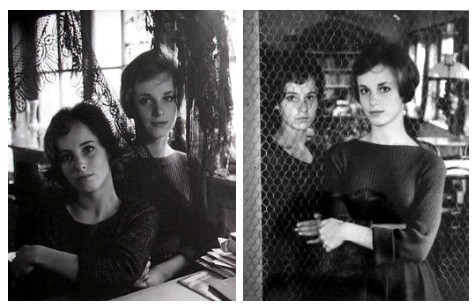
EMIEL VAN MOERKERKEN - original photograph [1958] - 33 x 26 cm
Original silverprint showing a 1958 image of twin sisters.
The photograph was personally printed in 1986 by Van Moerkerken, his signature and pencil annotations are on the back.
The girls pictured are Yvonne and Georgette Apol.
Earlier images of them were published in 1955: Joan van der Keuken included several photographs of the sisters in his famous work WIJ ZIJN 17 (WE ARE 17, see Parr/Badger Vol 1, page 244), although at the time the girls hadn't reached that age yet.
Yvonne and Georgette (one of them was married with Van der Keuken for a short period) were immortalized by means of the classic ACHTER GLAS, another fine work by Van der Keuken, published in 1956 (see Parr/Badger Vol 1, page 244).
Van Moerkerken captured the sisters at the more mature age of 18 and had them put - nameless - in his book Meisjes van Nederland / The Girls of Holland, published in 1959.